 Whatcom County
 Samish's Exterior Climate: What Homes Are Actually Up Against
Samish sits in that stretch of Whatcom County where the landscape does double duty — open water nearby, timber and farmland behind, and weather that moves through fast and often wet. Homes here deal with a combination most siding products were never designed around: salt-tinged air off the bay, long stretches of driving rain that comes in sideways more than straight down, and a moss season that can run from October through April in a wet year. That's not a one-off storm event to plan for. It's a baseline, year after year, and it's the reason exterior materials in this part of the county age differently than they would fifty miles inland.
Salt air matters more than people expect. It doesn't just affect metal fasteners and flashing — it accelerates the breakdown of paint films and finishes on wood-based siding, and it works into seams and cut edges faster than fresh rainwater alone. Combine that with wind-driven rain that gets pushed up under laps and around trim, and you've got a house that's rarely given a real chance to dry out between weather systems. Add moss and algae growth on north-facing and shaded walls, and you have three separate stressors — salt, moisture, and organic growth — all working on the same siding at the same time.
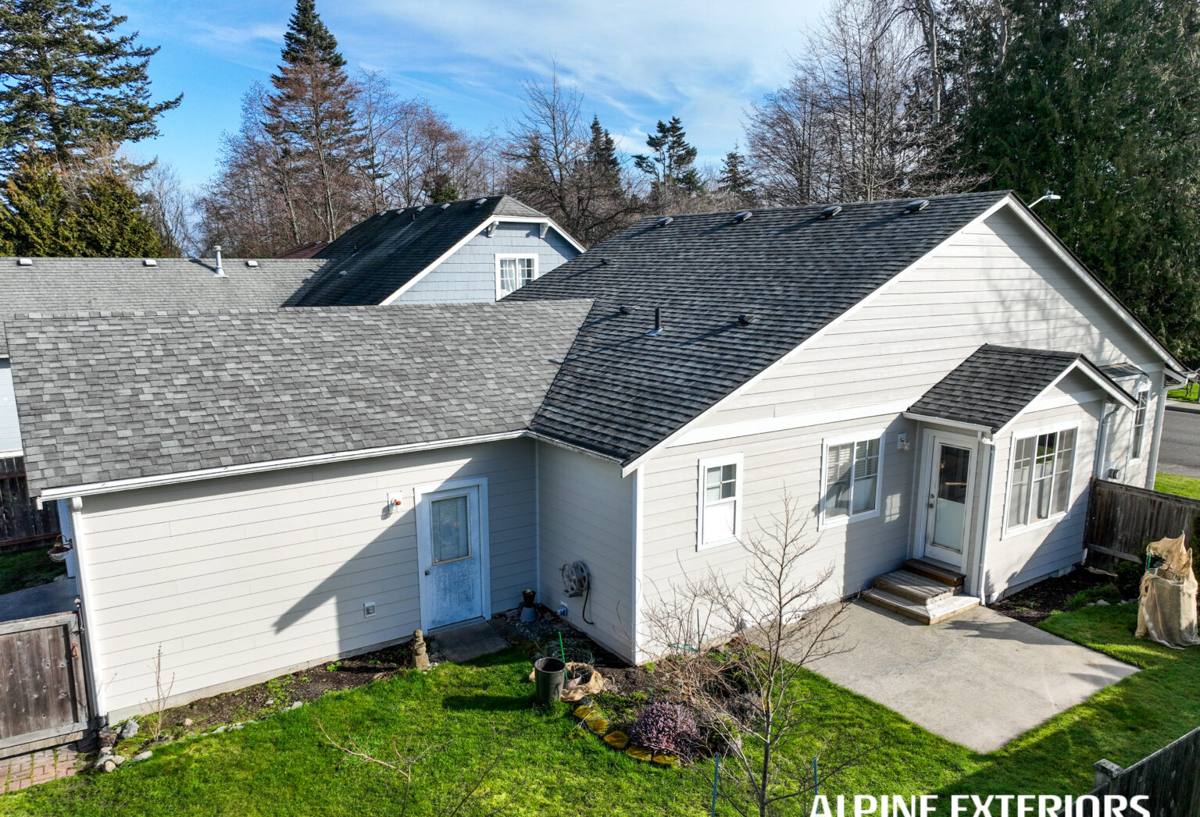
Why Local Conditions Should Drive the Material Choice
A lot of siding failures we see in Whatcom County aren't really about bad installation — they're about a product that was a reasonable choice somewhere drier being asked to perform in a maritime climate it wasn't built for. Wood-based composite sidings and untreated wood products depend on their factory coating and careful edge-sealing to keep moisture out. In a climate where walls stay damp for days at a time and salt air is chewing on that coating, any gap in the finish — a cut edge, a nail hole, a scuffed corner — becomes a place where moisture gets in and doesn't leave. Once that happens, swelling, soft spots, and eventual rot follow, often from the inside out where you can't see it until it's advanced.
This is the core reason our company made the call years ago to install only James Hardie fiber cement siding. It's not a marketing position — it's a response to what actually holds up on homes in this exact climate. Fiber cement doesn't have organic material for moisture to feed on, it doesn't swell and rot the way wood-based products can, and it's dimensionally stable enough to keep tight seams over decades of wet-dry cycling.
What "Climate-Engineered" Actually Means
James Hardie makes region-specific product lines (HZ5 for harsher, wetter climates like ours) engineered for the freeze-thaw and moisture exposure patterns of the Pacific Northwest, rather than a single national formula. That matters in Samish specifically because the product spec is matched to the actual weather the siding will face, not a national average.
Why We Don't Install Vinyl, LP SmartSide, or Other Alternatives
We get asked about alternatives regularly, and it's a fair question — they're often cheaper up front. Here's our honest read on why we don't put them on homes in this county:
| Product | What it gets right | Why we don't install it here |
|---|---|---|
| Vinyl siding | Low upfront cost, low maintenance in mild climates | Can warp or crack in temperature swings, seams allow water intrusion, doesn't hold up to wind-driven coastal rain as well as a sealed fiber cement system |
| LP SmartSide | Engineered wood, reasonable cost, decent workability | Wood-strand core is vulnerable if the factory coating is ever breached — a real risk with our sustained wet seasons and cut/fastener exposure points |
| Primed spruce / cedar | Natural look, traditional appeal | Requires ongoing repainting and sealing to survive our rain and salt air; maintenance burden is high and failure is often hidden until advanced |
| Cemplank / Allura (other fiber cement) | Same base material category as Hardie, generally solid performers | We standardized on one manufacturer for consistent installation specs, warranty terms, and finish quality across every job — not a knock on the material itself |
None of these are "bad" products in every application. They're just not what we're willing to put our name behind in a climate that gives siding this little downtime between wet weather events.
James Hardie: The Product System We Actually Install
James Hardie fiber cement is a mix of cement, sand, and cellulose fibers, pressed and cured into planks, panels, and trim boards that are non-combustible and stable in the kind of moisture cycling Whatcom County sees most of the year. A few specifics that matter for homes in Samish:
- ColorPlus Technology — a factory-applied, baked-on finish that resists fading and doesn't rely on a field-applied paint job to hold up to salt air and UV
- HZ5 engineered formulation — built for regions with significant moisture exposure and freeze-thaw cycling, which fits our winters better than a generic national product
- Non-combustible core — a real advantage during Washington's increasingly active wildfire seasons, even for homes not directly in a fire zone
- Transferable limited warranty — coverage that can pass to a new owner, which matters for resale value in this market
The product only performs to that standard when it's installed to spec — correct clearances, proper flashing and house-wrap integration, factory-recommended fastening, and caulking only where Hardie's install guide actually calls for it. A lot of the difference between a Hardie install that lasts thirty-plus years and one that fails early comes down to installation discipline, not the product itself.
Siding Installation: What the Process Looks Like
Assessment and Removal
We start by evaluating the existing wall assembly — checking for hidden moisture damage, rot at window and door openings, and the condition of the sheathing underneath. In a climate like ours, what's under the old siding often tells us more than the siding itself.
Weather Barrier and Flashing
This step gets more attention here than it would in a drier climate. Proper house-wrap, correctly lapped and taped, along with flashing at every window, door, and horizontal trim transition, is what actually keeps wind-driven rain from finding its way behind the cladding.
Installation to Manufacturer Spec
Hardie board goes up with the clearances, fastener patterns, and joint treatment the manufacturer specifies — not shortcuts that speed up the job but compromise the warranty or the wall's ability to shed water.
Finish and Detail Work
Trim, corners, and transitions get finished to shed water rather than trap it — especially at horizontal surfaces where standing moisture and moss are most likely to take hold.
Roofing, Windows, and Decks: The Rest of the Envelope
Siding doesn't work in isolation. A roof that's shedding granules or has failing flashing sends water down into the wall assembly behind good siding. Windows with worn seals let moisture and drafts in around the frame no matter how well the siding around them is installed. Decks exposed to the same driving rain and moss growth face their own structural wear, especially at ledger connections and stair stringers. We handle all four — siding, roofing, windows, and decks — because in this climate they're one connected system, not four separate projects, and problems in one area usually show up as damage in another if they're left unaddressed.
Moss, Algae, and Ongoing Care
Even with the right materials, homes in and around Samish benefit from periodic exterior checks — clearing debris from behind gutters where moss likes to establish, keeping vegetation trimmed back from north-facing walls that stay shaded and damp longest, and a rinse-down of siding surfaces where algae streaking tends to build up. Fiber cement resists organic growth far better than wood-based products, but no exterior material is entirely maintenance-free in a climate this wet.
Why a Local Crew Matters
A crew that works Whatcom County regularly knows which wall orientations take the worst of the wind-driven rain, how deep the moss problem runs on shaded elevations, and how salt air behaves differently on homes closer to the water versus further inland. That local pattern recognition shows up in small decisions — where to add extra flashing attention, which trim details are worth reinforcing — that a crew unfamiliar with this specific stretch of coastline wouldn't necessarily catch on the first pass.
What to Look For When Hiring an Exterior Contractor Here
- Manufacturer-specific training or certification for the siding product being installed, not just general carpentry experience
- A clear explanation of flashing and moisture-barrier details before the quote, not just a per-square-foot number
- Written, itemized estimates that separate material, labor, and any tear-off/disposal costs
- Local references or work history in Whatcom County specifically, given how different our climate demands are from drier regions
- Straight answers about warranty terms — both the manufacturer's product warranty and the contractor's workmanship warranty
If your Samish home's siding, roofing, windows, or deck are showing signs of wear from our salt air, rain, and moss cycles, we're glad to take a look and walk you through honest options — no pressure, no hard sell. Reach out below for a free estimate.