 Whatcom County
 Siding in Happy Valley: A Neighborhood Shaped by Bellingham's Weather
Happy Valley is one of Bellingham's older, established residential neighborhoods, with a mix of home ages and styles sitting close enough to the water and the surrounding hills to catch the full range of what Whatcom County weather has to offer. That mix — some homes from decades past, some newer builds filling in the gaps — means the siding on any given block can be anywhere from freshly installed to well past its service life. What all of it shares is exposure to the same regional conditions: salt-laden marine air, long stretches of driving rain, and a moss season that seems to start earlier and last longer every year.
We've worked on homes throughout this part of Whatcom County long enough to know that siding here doesn't fail the way it does in drier climates. It's rarely one dramatic event. It's slow, cumulative moisture exposure that finds the weak points — a butt joint that was never caulked right, a corner post with no flashing behind it, paint that was holding on by a thread — and turns them into real problems over a few wet winters.
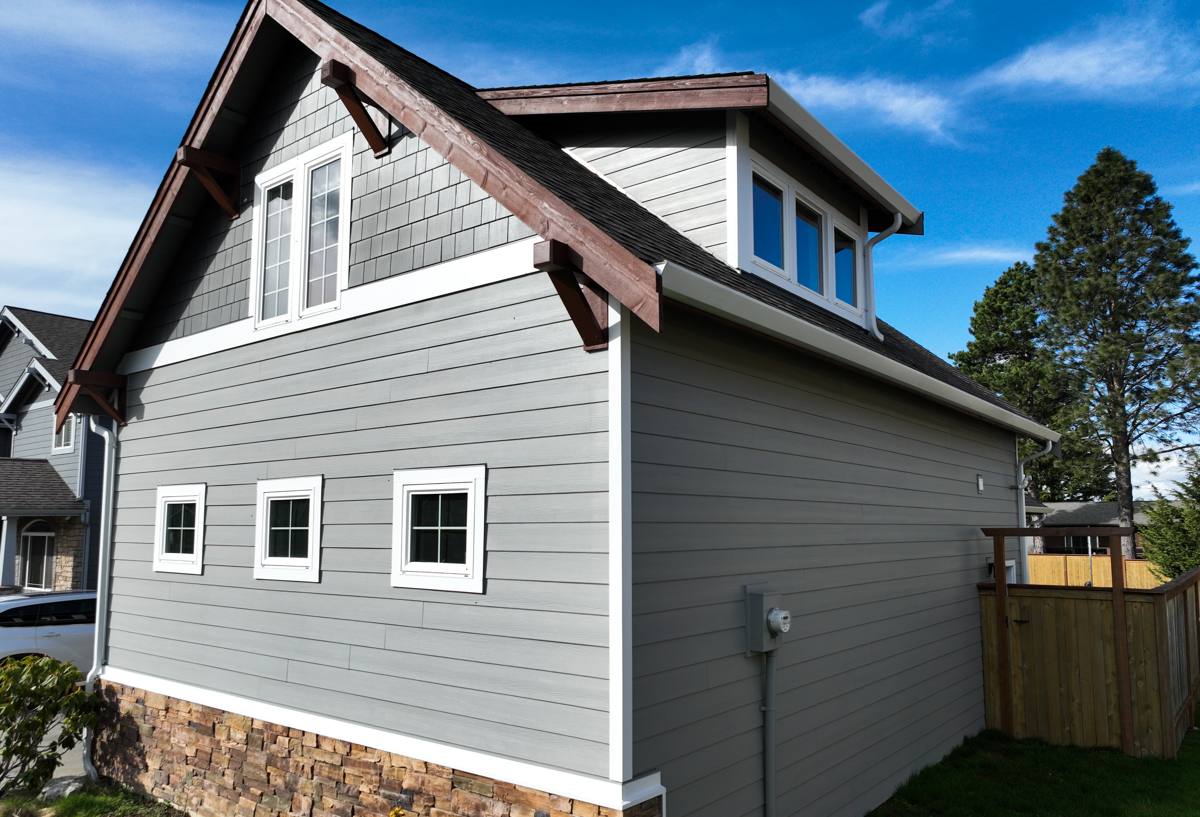
What Happy Valley Homes Are Up Against
Salt Air and Moisture
Being close to Bellingham Bay means homes throughout this area deal with airborne salt and near-constant humidity, even on days without rain. Salt air accelerates corrosion on fasteners and metal flashing, and it keeps wood-based siding damp longer than it would stay in a drier inland climate. Over time that moisture cycle — wet, dry, wet, dry — is what breaks down paint film and lets water behind the siding in the first place.
Driving Rain
Whatcom County doesn't just get a lot of rain — it gets a lot of wind-driven rain, pushed sideways into wall assemblies rather than falling straight down. That matters because siding systems are engineered to shed water moving downward, not water being forced horizontally into seams, laps, and trim joints. Homes with west- or south-facing exposure in Happy Valley tend to take the brunt of this, especially on gable ends and around window and door trim.
Moss, Shade, and Slow Drying
Mature trees and closely spaced lots keep a lot of Happy Valley homes in partial shade for much of the day, which is great for cooling in the summer and rough on siding the rest of the year. Shaded, north-facing walls dry slowly after rain, and that's exactly where moss, algae, and mildew take hold. On wood-based products, sustained moss growth holds moisture against the surface and accelerates rot at the seams. It's a cosmetic issue at first and a structural one if it's ignored long enough.
What We Look For on an Inspection
When we walk a Happy Valley property, we're checking more than whether the paint looks tired. We're looking at how the siding has actually performed against the specific conditions of that lot — sun exposure, tree cover, prevailing wind direction, and how close the home sits to grade.
- Soft or spongy spots at the bottom courses, where splashback and slow drying do the most damage
- Caulk that's cracked, shrunk, or missing at butt joints and trim intersections
- Paint that's peeling, alligatoring, or bubbling — often a sign of moisture trying to escape from behind the siding
- Moss or algae buildup concentrated on shaded or north-facing walls
- Gaps or missing flashing at window heads, corner boards, and roof-to-wall transitions
- Fastener corrosion or staining bleeding through the siding surface
Any one of these on its own might just need a repair. Several together, especially on a home that's 15-25 years old, usually means the siding is nearing the end of what it can reasonably protect.
Why We Install Only James Hardie Fiber Cement
We made a deliberate decision to install one siding system, and only one: James Hardie fiber cement. We don't install vinyl, LP SmartSide, Cemplank, Allura, or unfinished wood siding like primed spruce or cedar. That's not a marketing position — it's a standard we hold because of what we've seen these products do, and not do, in exactly the kind of climate Happy Valley sits in.
Vinyl siding is inexpensive and low-maintenance, but it's a thin plastic product that expands and contracts with temperature swings, can crack in cold snaps, and offers no real fire resistance. Wood-based engineered siding like LP SmartSide performs well when it stays dry, but any breach in the factory coating exposes wood fiber to exactly the sustained moisture this region delivers every winter. Unfinished wood siding — cedar or primed spruce — looks great on day one and then puts the maintenance burden entirely on the homeowner: re-staining, re-caulking, and watching for rot at every seam, indefinitely.
James Hardie fiber cement is a genuinely different material. It's cement, sand, and cellulose fiber, not wood and not plastic, which means it doesn't rot, it doesn't feed moss the way wood fiber can, and it's non-combustible. The ColorPlus factory finish is baked on under controlled conditions rather than applied on-site, which gives it a more durable, consistent finish than field-applied paint. Hardie also engineers specific product lines (their HZ5 formulation) for wetter, more variable coastal climates like ours, which is a level of climate-specific engineering the other products we mention simply don't offer.
Comparing the Options
| Siding Type | Moisture Resistance | Maintenance | Fire Resistance | Typical Lifespan |
|---|---|---|---|---|
| James Hardie Fiber Cement | Excellent, non-organic material | Low, factory finish holds color | Non-combustible | 30-50+ years with proper install |
| Vinyl | Sheds water but seams can leak | Low, but fades and can crack | Combustible, can melt/warp | 20-30 years |
| LP SmartSide | Good if coating stays intact | Moderate, watch cut edges and seams | Treated wood, more resistant than raw wood | 20-30 years |
| Cedar / Primed Spruce | Poor once coating fails | High, regular re-staining/painting | Combustible | 15-25 years, install-dependent |
This isn't about any of these products being poorly made. It's about which one holds up with the least ongoing risk in a climate that stays wet for months at a time. For us, that's a clear answer.
Why Correct Installation Matters as Much as the Product
Even the best siding material fails early if it's installed wrong, and fiber cement is unforgiving of shortcuts. Proper installation in a climate like Whatcom County's means a correctly lapped weather-resistive barrier behind the siding, flashing at every horizontal transition, the right fastener pattern and spacing, and clearance between the bottom of the siding and grade, decks, or roof lines so water has somewhere to go. Butt joints need to be back-primed or caulked to spec, not just butted together and painted over.
We see the cost of skipped steps regularly: siding that looks fine from the curb but is trapping moisture behind it because the house wrap wasn't lapped correctly, or because a crew nailed too tight and cracked the board's ability to move with seasonal humidity changes. Product quality and installation quality are two separate things, and in a wet climate, a mediocre install on a great product will still fail early.
More Than Siding: A Full Exterior Approach
Siding doesn't work in isolation — it's one piece of the building envelope, working together with the roof, windows, and any attached structures like decks. We handle roofing, window replacement, and decks alongside siding because these systems all interact at the same vulnerable points: roof-to-wall transitions, window flashing, and ledger board connections where decks tie into the house. A siding job done without paying attention to the roof edge above it, or the window trim it butts against, just moves the moisture problem somewhere else.
For Happy Valley homeowners planning a larger exterior project, it's worth evaluating siding, roofing, and windows together rather than one at a time. Coordinating the work means flashing details get handled once, correctly, instead of being patched around by whichever trade shows up next.
Why a Local Crew Matters Here
A crew that works Whatcom County year-round understands things that don't show up in a spec sheet — which walls in this part of Bellingham take the worst of the winter storms, how much clearance actually matters given how long moss-prone shade holds moisture on a north wall, and what the building department expects for flashing and drainage details on local permits. That local knowledge is part of what keeps a siding job performing the way it's supposed to for decades, not just the first few dry summers.
Signs It's Time to Have Your Siding Looked At
- Paint that's peeling, chalking, or hasn't held color in several years
- Soft spots when you press on siding near the bottom of the wall
- Persistent moss or dark streaking that comes back after cleaning
- Visible gaps, warping, or separation at seams and corners
- Rising energy bills that suggest the wall assembly isn't sealing like it used to
- Siding that's original to a home built more than 20-25 years ago
If any of these sound familiar, it doesn't necessarily mean full replacement — but it does mean it's worth a real inspection rather than a guess from the sidewalk.
Get a Straight Answer About Your Home
Every home in Happy Valley faces this climate a little differently depending on shade, exposure, and age of the existing siding. We're happy to come take a real look and give you a straightforward assessment — no pressure, no scare tactics, just what we see and what it means. Reach out below for a free estimate and we'll walk the property with you.