 Whatcom County
 Living on the Edge of the Salt Chuck
Blaine sits about as far northwest as you can go in Washington State, tucked against Drayton Harbor and Semiahmoo Bay, a few minutes from the Canadian border. It's a beautiful place to have a house, but it's also one of the more demanding spots in Whatcom County for exterior building materials. Salt-laden air off the water, wind-driven rain that comes in sideways off the Strait of Georgia, and long gray stretches where surfaces stay damp for days at a time all add up to real wear on siding, trim, and roofing over the years.
Homeowners in Blaine often notice the same pattern: paint that fails faster than it should, caulk joints that open up, trim that goes soft at the corners, and a persistent green tint on north-facing walls that never seems to fully go away. None of that is bad luck. It's what happens when ordinary building materials meet a marine environment without being matched to it. We handle siding, roofing, windows, and decks for homes in this area, and siding is usually where that climate mismatch shows up first and worst.
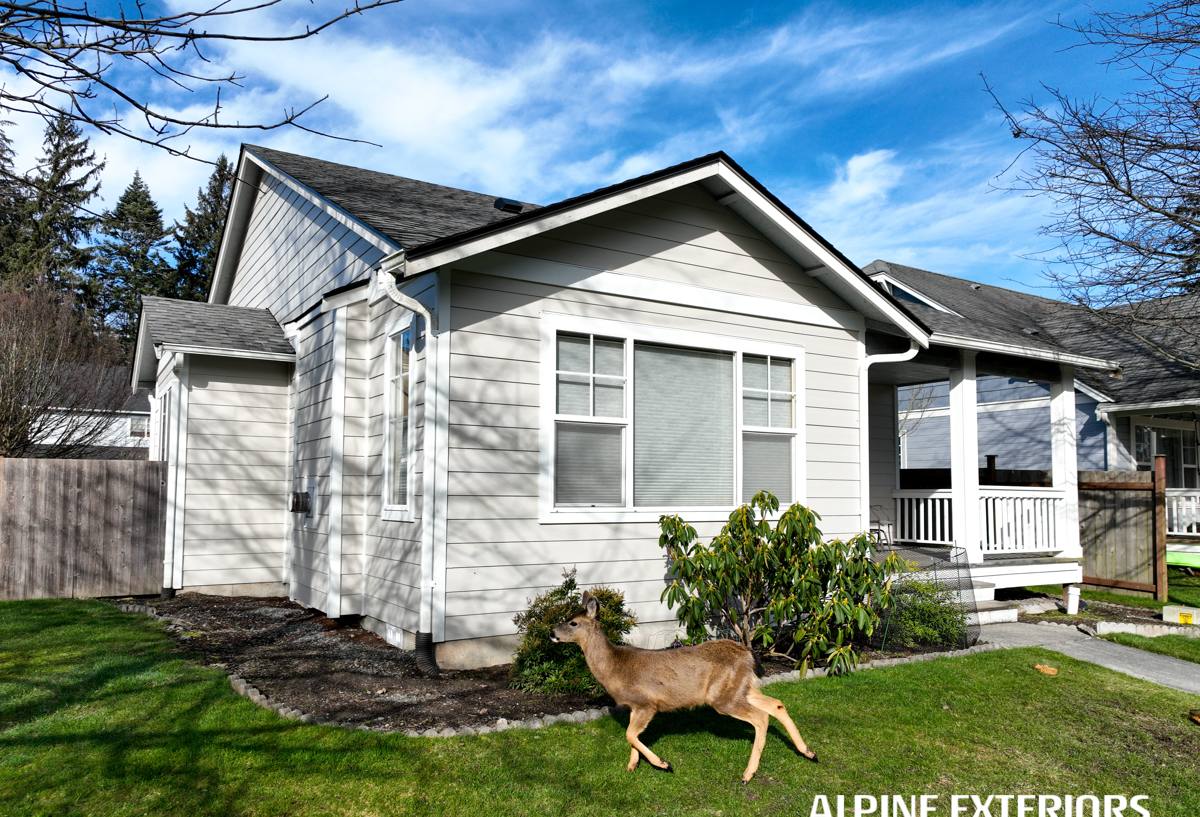
What Blaine's Coastal Climate Does to Exterior Siding
Salt Air and Corrosion
Being this close to Semiahmoo Bay and the open water beyond it means airborne salt is a constant, low-level presence, even a mile or two inland. Salt is hygroscopic — it pulls moisture out of the air and holds it against whatever surface it lands on. Over years, that accelerates corrosion of fasteners, staples, and any exposed metal trim, and it keeps wood-based siding products damper, more often, than the same product would stay in a drier inland town.
Driving Rain
Storms coming off the Strait don't just drop rain straight down — wind pushes it sideways into wall assemblies, especially on west- and south-facing elevations. That kind of wind-driven rain finds every gap in flashing, every under-caulked seam, and every place where siding wasn't lapped correctly. It's less about total rainfall and more about how much of that rain gets forced horizontally into the wall.
A Long Moss and Mildew Season
Cool temperatures, high humidity, and shade from mature trees give moss, algae, and mildew a long growing season on this part of the coast. Anything porous or slow to dry — untreated wood, some engineered wood products, weathered paint film — becomes a host surface. It's mostly cosmetic at first, but sustained moisture at the surface eventually works its way into seams and end cuts if the underlying material isn't built to shed it.
Why Product Choice Matters More Here Than Elsewhere
In a mild, dry inland climate, a lot of siding products perform adequately for a while. On the Whatcom County coast, the gap between products that are engineered for moisture and products that merely tolerate it shows up faster — often inside the first decade.
| Material | How it handles salt air & driving rain | Long-term concern in Blaine |
|---|---|---|
| Vinyl siding | Doesn't rot, but panels expand/contract with temperature swings and can warp or gap over time, opening water paths behind the cladding | Seams and J-channels are common entry points for wind-driven rain |
| Primed spruce / cedar | Natural material, absorbs and releases moisture with the weather; needs a sound paint film to stay protected | End grain and butt joints swell and split faster in sustained damp conditions |
| LP SmartSide (engineered wood) | Better than raw wood, but still a wood-strand product that relies on factory coatings and careful field sealing at cuts | Any breach in the coating (cut edges, fastener heads, impact damage) can let moisture into the strand core |
| James Hardie fiber cement | Cement-based composition doesn't absorb and swell the way wood does; factory ColorPlus finish is baked on, not brushed on | Still requires correct flashing, gapping, and caulking at every joint — the material is only as good as the install |
That last line matters. No siding material is maintenance-proof, and no product installed incorrectly will perform as advertised. But starting with a material engineered for moisture resistance gives a coastal home a real head start, which is why we standardized on one product line rather than offering several tiers.
Why We Install Only James Hardie Fiber Cement
We don't install vinyl, LP SmartSide, Cemplank, Allura, primed spruce, or cedar siding. That's a deliberate standard, not a lack of options. James Hardie fiber cement is a blend of cement, sand, and cellulose fibers, engineered specifically to resist the freeze-thaw, moisture, and UV exposure that Pacific Northwest coastal homes see year after year. It's also non-combustible, which matters increasingly across Washington as wildfire risk expands the areas where fire-resistant materials are recommended or required.
James Hardie's HZ5 product line is engineered specifically for the wetter, cooler climate zones that include western Washington, with a moisture and mold resistance profile suited to exactly the conditions Blaine sees most of the year. The factory-applied ColorPlus finish is baked on under controlled conditions rather than field-painted, which means better adhesion and a longer, more even service life than site-applied paint on wood or engineered wood products. Hardie also backs the product with a strong, transferable limited warranty, which carries real weight in a market like this one, where homes change hands and buyers want documented protection on major exterior work.
We're upfront that Hardie costs more up front than vinyl and is priced comparably to or above engineered wood options. We think that trade-off is worth explaining honestly rather than glossing over — which is the whole point of pages like this one. For a coastal Whatcom County home, the lower long-term maintenance burden and moisture resistance are what we'd want on our own house.
Beyond Siding: The Whole Exterior Envelope
Siding doesn't work in isolation. On a home this close to the water, roofing, windows, and decking all interact with the same moisture and salt exposure, and a weak link in any one of them undermines the rest.
Roofing
Roof condition directly affects how much water siding and trim have to deal with. A roof shedding water properly, with intact flashing at valleys, chimneys, and wall intersections, keeps that water away from siding penetrations instead of funneling it toward them.
Windows
Window flashing and integration with the siding plane is one of the most common failure points we find on coastal homes. Even excellent siding will let water in if the window openings around it weren't flashed and sequenced correctly.
Decks
Decks take the most direct beating from driving rain and standing moisture of any part of the exterior, and ledger board connections in particular need careful flashing where they meet the house to avoid feeding water into the wall assembly behind the siding.
Because we handle all four trades, we look at a home's exterior as one connected system rather than four separate quotes, which matters on coastal properties where problems tend to originate at the boundaries between materials.
What Correct Installation Looks Like in a Coastal Climate
The material is half the equation. Installation technique is the other half, and it's where a lot of the real protection against salt air and driving rain actually comes from. On every siding job in this area, a few things are non-negotiable:
- Proper rain-screen or drainage gap behind the siding so any moisture that gets past the cladding can drain and dry instead of sitting against the sheathing
- Correct flashing and head flashing at every window, door, and penetration, installed in the right sequence relative to the weather-resistive barrier
- Manufacturer-specified fastener spacing, gapping, and caulking at butt joints and trim, since Hardie's own warranty depends on installation to spec
- Stainless or hot-dip galvanized fasteners appropriate for a marine-influenced environment, to resist the corrosion that ordinary fasteners see faster here
- Careful attention to grade clearance and drainage at the base of walls, so splash-back and standing water near the foundation don't stay in contact with the siding
Skipping any one of these doesn't necessarily cause an immediate problem — it shows up two, five, or ten years later as a callback nobody wants, on either side.
Maintenance in a Salt-Air, High-Rain Environment
Even the right material benefits from basic upkeep in this climate. A periodic rinse to clear salt residue and organic buildup, keeping gutters clear so water isn't overshooting onto walls, trimming back vegetation that shades siding and keeps it damp longer, and a visual check of caulking at trim and penetrations every year or two go a long way. Fiber cement doesn't demand the repainting cycle that wood siding does, but it isn't a walk-away product either — a little attention keeps it performing the way it's designed to.
Why a Local Crew Matters in Blaine
A crew that works this specific corner of Whatcom County regularly knows how the wind comes off Semiahmoo Bay, which elevations take the worst of the driving rain on a given lot, and how long moss actually takes to become a real problem versus just a cosmetic one. That local knowledge shapes decisions — where extra flashing attention pays off, which details matter most on a west-facing wall versus a sheltered one — in ways a crew unfamiliar with this stretch of coastline wouldn't necessarily catch. It also means someone who installed the siding is reachable down the road if a question comes up, not a name attached to a one-time job from out of the area.
If you're weighing a siding project on a Blaine home — or want a second opinion on roofing, windows, or a deck while you're at it — we're happy to take a look and put together a straightforward, no-pressure estimate using the form below.