 Whatcom County
 Siding Built for Bellingham's Climate
Bellingham sits where the marine air off the Salish Sea meets the wet, mossy backdrop of the North Cascades foothills. That combination is beautiful to live in and hard on a house. Homes here deal with salt-laden air moving in off the water, long stretches of driving rain in the fall and winter, and a moss and mildew season that can run most of the year on shaded north- and west-facing walls. Siding that works fine in a drier climate often struggles in Whatcom County, and it shows up as premature paint failure, soft trim, swollen panel edges, and dark streaking that keeps coming back no matter how many times it's cleaned.
We install James Hardie fiber cement siding exclusively, and Bellingham is exactly the kind of market that product line was engineered for. It's not the cheapest material on the market, and we're upfront about that. But when a house is going to sit a few miles from saltwater for the next 30-plus years, the material matters more than it does somewhere drier and more sheltered.
What Local Homes Are Up Against
Salt Air and Coastal Moisture
Properties closer to Bellingham Bay and the surrounding shoreline take on airborne salt that settles on exterior surfaces and accelerates wear on paint films, fasteners, and softer wood-based products. Salt exposure doesn't just sit on the surface — it draws moisture, which keeps siding damper for longer after every rain event.
Driving Rain and Wind-Driven Wetting
Whatcom County's weather pattern brings extended periods of steady, wind-pushed rain rather than short, heavy downpours. That matters for siding because wind-driven rain gets forced sideways into laps, seams, and butt joints — spots that a product needs to shed water from, not absorb it.
Moss, Algae, and Shade
Between the tree cover common in Bellingham neighborhoods and the region's overcast stretches, north- and west-facing walls often stay damp far longer than south-facing ones. That's ideal growing conditions for moss and algae, and it's one of the main reasons paint and caulk fail early on homes here — organic growth holds moisture against the surface long after the rain has stopped.
Why We Only Install James Hardie
We get asked fairly often why we don't offer vinyl, LP SmartSide, cedar, or primed spruce siding alongside Hardie. The honest answer is that we standardized on one product because it's the one we're confident telling a Whatcom County homeowner will still be doing its job in three decades, and because narrowing our focus lets our crews get genuinely good at one installation system instead of average at five.
What We Turn Down, and Why
- Vinyl siding is affordable and low-maintenance in mild climates, but it's a petroleum-based product that expands and contracts with temperature swings, can warp or crack in impact events, and isn't fire-rated. In a region with wind-driven rain, seams and J-channels are where water intrusion tends to start.
- LP SmartSide is an engineered wood product with a resin-treated strand core. It performs reasonably well when installed and maintained perfectly, but any breach in the factory coating — a nick, an unsealed cut edge, a fastener installed wrong — gives moisture a path into a wood-based core, and that's a real risk in a climate that stays wet for months at a stretch.
- Cedar and primed spruce are genuinely attractive materials, but they're solid wood. They need regular refinishing, they're a food source for moss and mildew in shaded, damp conditions, and they're combustible. In a climate where north walls barely dry out between October and April, the maintenance burden is significant.
- Cemplank and Allura are fiber cement competitors to Hardie and share some of the same core advantages over wood and vinyl. We simply chose to standardize on one manufacturer's system — for warranty consistency, factory finish quality, and crew training — rather than stock and install multiple fiber cement lines.
None of this means those products are bad on every house in every climate. It means that after years of doing this work in a wet, mossy, coastal county, we decided fiber cement from one manufacturer, installed correctly, gives our customers the best odds of a siding job that looks right for the long haul.
What James Hardie Gets Right for This Climate
Fiber cement is made from cement, sand, and cellulose fibers. It doesn't rot, it isn't a food source for moss or mildew, it's non-combustible, and it holds its shape in freeze-thaw cycles and heavy wetting far better than wood-based products. James Hardie's ColorPlus finish is baked on at the factory under controlled conditions, which gives it better fade and moisture resistance than field-applied paint — and it comes with a longer color warranty than most homeowners get from repainting a wood or engineered wood exterior every several years.
Hardie also builds region-specific product lines, called HZ10 and HZ5, engineered for different climate zones' moisture and freeze patterns. Whatcom County falls into the range where that climate engineering actually matters, rather than being a marketing footnote.
Siding Options for Bellingham Homes
| Product | Look | Best For |
|---|---|---|
| HardiePlank lap siding | Traditional horizontal lap, smooth or cedar-textured | Most single-family homes; the most common choice in the area |
| HardiePanel vertical siding | Vertical panel with battens | Craftsman and modern facades, accent walls, gables |
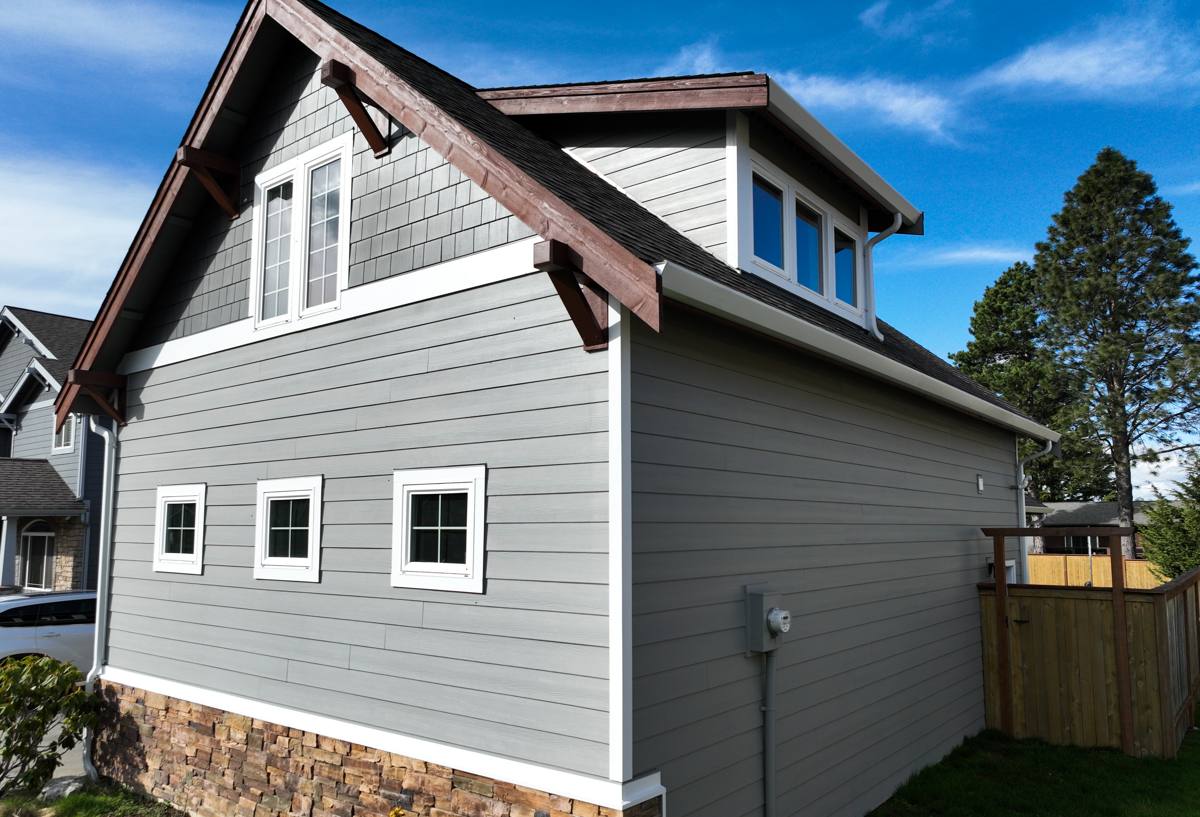
| HardieShingle | Staggered or straight-edge shingle profile | Homes wanting a cottage or Pacific Northwest cedar-shake look without the maintenance |
| HardieTrim | Fiber cement trim boards | Corners, window and door casings, fascia — matched durability with the siding field |
How We Approach a Siding Project Here
Inspection First
Before we quote anything, we look at the existing siding, the sheathing and moisture barrier underneath where accessible, window and door flashing, and any trouble spots — north walls, areas under overhangs that trap moisture, and ground-contact zones. In a climate like this, what's happening behind the siding matters as much as the surface.
Weather Barrier and Flashing
Correct installation means a proper drainage plane, correctly lapped and taped house wrap or building paper, and flashing at every window, door, and penetration that directs water out and down rather than letting it track behind the cladding. This is the step that gets rushed on a lot of jobs, and it's the step that matters most in a wind-driven-rain climate.
Fastening and Clearances
Hardie's warranty depends on installation to their specifications — correct fastener type and spacing, proper clearance from grade, decks, and roof lines, and caulking at the right joints (not all of them — over-caulking traps moisture too). We install to those specs because that's what keeps the manufacturer warranty intact and the wall assembly dry.
Beyond Siding
We also handle roofing, windows, and decks, which matters on a lot of Bellingham homes because siding problems are frequently connected to a roofing or flashing issue somewhere else on the exterior. A leaking gutter, a failed roof-to-wall flashing detail, or a rotting deck ledger board can all show up as siding damage below or beside them. Having one crew that understands how those systems interact, rather than three separate contractors pointing at each other, tends to get problems actually fixed.
What Drives Cost
- Home size and the amount of wall area, including gables, dormers, and cutouts
- Number of stories and how much scaffolding or lift access is needed
- Whether existing siding needs to be removed and disposed of, or if there's sheathing repair underneath
- Trim complexity — corner boards, window casings, fascia, and any custom detailing
- Product line and profile chosen (lap width, smooth vs. textured, shingle vs. panel)
- Color — standard ColorPlus colors vs. premium or custom color options
We give straightforward written estimates and won't push a homeowner toward more scope than their house actually needs.
Signs Bellingham Homeowners Should Watch For
- Dark streaking or green-black growth on north- or west-facing walls that comes back soon after cleaning
- Paint that's peeling, bubbling, or chalking, especially on wood or engineered wood siding
- Soft spots when you press on siding near the bottom courses or around window sills
- Visible gaps or separation at butt joints and corner boards
- Musty smell or visible moisture inside exterior walls near siding seams
Any of these on their own isn't necessarily an emergency, but they're worth having looked at before the next wet season, since moisture problems in this climate tend to get worse quietly, behind the wall, before they show up as something expensive.
Why a Local Crew Matters
A crew that works Whatcom County year-round knows which walls on a typical Bellingham lot stay wet the longest, how the local wind and rain patterns actually hit a house, and where flashing details tend to get missed on homes built to older or more generic standards. That local pattern recognition is hard to replace with a crew that's only occasionally in the area. It also means someone is reachable if a question comes up on a project two or five years down the road, not just during the install.
If you're weighing a siding project in Bellingham — whether it's a full replacement, storm damage, or you're just trying to figure out what's going on with a problem wall — we're happy to take a look and give you a straightforward, no-pressure estimate.