 Whatcom County
 Why Bellingham Roofs Work Harder Than the Weather Report Suggests
On paper, Bellingham's climate looks mild — no hurricanes, no hail the size of golf balls, nothing that makes national news. In practice, a roof here is under quiet, constant pressure from three things at once: salt-laden air coming off Bellingham Bay and the Salish Sea, wind-driven rain that gets pushed sideways instead of falling straight down, and a moss and algae season that runs most of the year because the wood, humidity, and shade never really let up. None of those three problems is dramatic by itself. Together, over a decade or two, they're what separates a roof that ages gracefully from one that starts failing at the seams and fasteners while the field of the material still looks fine.
Metal roofing handles this combination better than most materials when it's specified and installed correctly for this environment — and worse than most materials when it isn't. The metal itself is rarely the weak point. The failures we get called out to inspect are almost always at the details: fasteners, flashing, underlayment choices, and panel-to-panel connections that weren't built with salt air and standing moisture in mind.
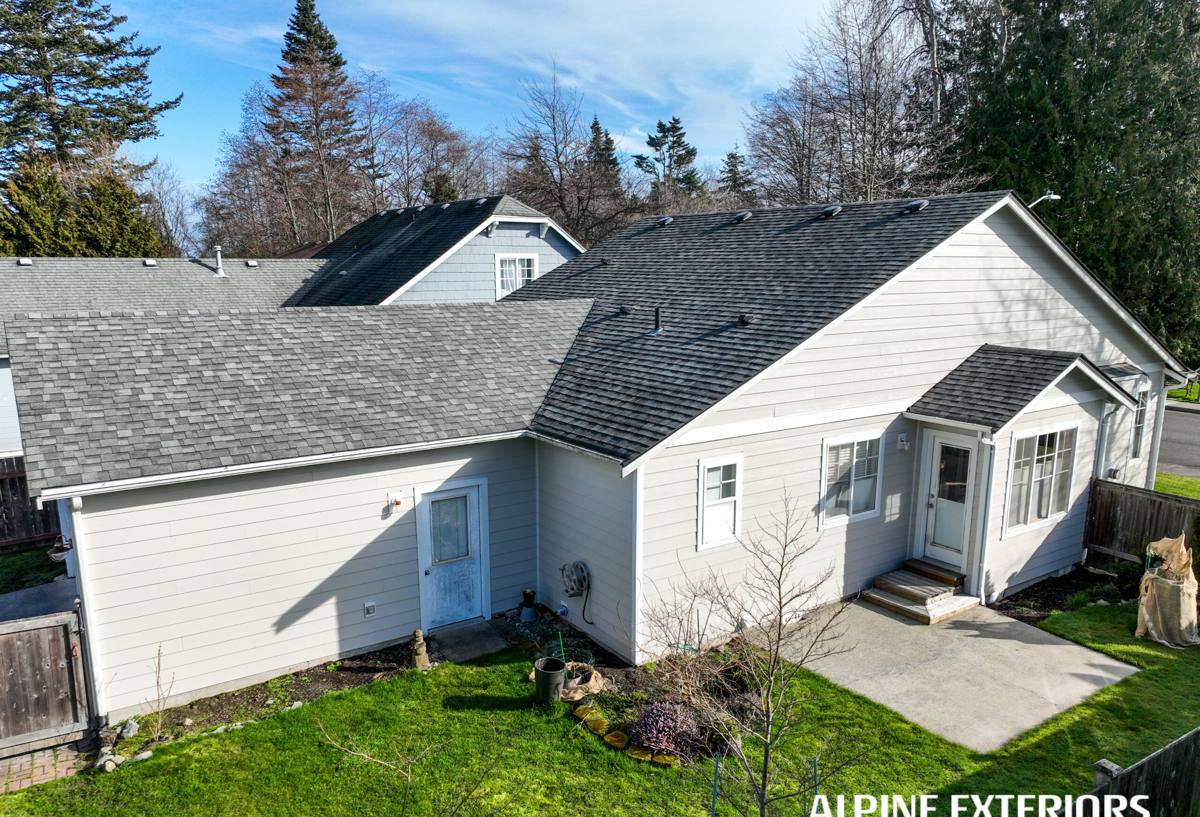
What a Correctly Specified Metal Roof Looks Like in This Climate
Panel Type: Standing Seam vs. Exposed-Fastener
The single biggest decision on a metal roof isn't the color — it's whether the panels are fastened through the face (exposed-fastener, sometimes called corrugated or R-panel) or joined at raised seams with concealed clips (standing seam). Both are legitimate products. They age very differently in a wet, salty environment.
| Factor | Exposed-Fastener Panel | Standing Seam |
|---|---|---|
| How it's attached | Screws driven through the panel face into the deck or purlins | Concealed clips under raised seams; no fasteners penetrate the panel face |
| Long-term weak point | Screw gaskets compress and harden over time; each one is a potential leak path | No exposed penetrations in the field of the roof to fail |
| Typical lifespan here | 20–30 years before fastener/gasket maintenance is needed | 40–60+ years with a quality finish |
| Upfront cost | Lower | Higher |
| Best fit | Outbuildings, shops, budget-driven projects | Primary residence roofs, especially anything with low slope or complex valleys |
We'll install either one depending on the building and the budget, but we tell homeowners plainly: on a house roof in a place that gets this much rain, the fastener penetrations on an exposed-fastener panel are the first thing that ages, and re-torquing or replacing hundreds of screw gaskets fifteen years in is real, recurring maintenance. Standing seam avoids that problem structurally, not just with a better warranty.
Underlayment and Moisture Control
Metal roofs don't leak from rain landing on them — they leak from moisture that gets underneath the panel, either through wind-driven rain finding its way past a lap or fastener, or from condensation forming on the underside of cold metal in a humid attic. Both are common issues in this climate and both are solved before the first panel goes down, not after.
- A self-adhered ice-and-water membrane at eaves, valleys, and penetrations — not just a code minimum, but a deliberate choice given how much of the year this roof sees standing or wind-driven moisture
- A full synthetic underlayment across the deck, lapped correctly with the slope
- An air gap or slip-sheet under the panel where condensation risk is higher, so moisture can't sit directly against the metal
- Attic or roof-assembly ventilation sized to the square footage, so warm interior air isn't condensing against the cold underside of the panels
Skip any one of these and the panel warranty still covers the metal — it just won't cover the plywood underneath it, which is the part that actually fails first.
Salt Air and Corrosion: The Coastal Factor Most Estimates Skip
Bellingham sits close enough to saltwater that airborne salt is a real factor in material selection, even if the property isn't waterfront. Salt accelerates corrosion at any point where two dissimilar metals touch, or where a coating has been scratched or drilled through. This shows up in a few specific ways on a metal roof:
- Fastener material matters more here than inland. Fasteners should match or be compatible with the panel material — stainless steel or properly coated fasteners, not bargain-bin screws that will streak and corrode faster than the roof around them.
- Galvanic corrosion between dissimilar metals — aluminum flashing against a steel panel, or the wrong gutter material against the roof edge — creates a reaction that eats away at the less noble metal over time. Flashing and trim need to be matched to the panel material, not just whatever's on the truck.
- Cut edges and drilled holes expose bare metal. Factory-painted panels are protected on the face and back, but any field cut or drilled hole needs to be sealed or capped, or that exposed edge becomes the starting point for rust.
None of this means metal roofing is a bad choice near the water — it's one of the better choices, if the fastener and flashing materials are specified with salt exposure in mind rather than treated as an afterthought.
Moss, Algae, and the Long Wet Season
Metal roofing has a genuine advantage over composition shingle or wood shake when it comes to moss: moss needs a porous surface with grit to root into, and it can't establish itself on a smooth, factory-finished metal panel the way it can on shingle granules or cedar. That's a real benefit in a county where moss season runs most of the year on shaded, north-facing roof slopes.
That doesn't mean a metal roof is maintenance-free in this climate. Moss and algae still accumulate as loose debris — needles, seed pods, moss fragments washed down from nearby trees — and that debris collects in valleys, at panel laps, and behind snow guards or ridge details. Left alone, it holds moisture directly against the panel and the fasteners in exactly the spots where dampness does the most damage. The fix is simple and low-cost compared to shingle moss treatment: keep valleys and gutters clear, and keep overhanging branches trimmed back so less debris lands on the roof in the first place.
Flashing, Penetrations, and the Detail Work That Actually Fails
If a metal roof leaks, it's almost never through the panel itself. It's at a transition: where the roof meets a wall, where a chimney or vent pipe punches through, at a valley where two roof planes meet, or at the ridge. These details take real fabrication skill — bending and fitting flashing to the specific geometry of that roof, not pulling a generic piece off the shelf and caulking the gaps.
| Detail | Why it's high-risk | What a correct install does |
|---|---|---|
| Valleys | Concentrate the most water volume on the whole roof | Open or closed valley metal sized for real rainfall volume, not a narrow "just enough" strip |
| Wall-to-roof transitions | Wind-driven rain gets pushed up and under a poorly lapped step flashing | Step flashing woven correctly with siding, not just sealant bridging the gap |
| Pipe and vent penetrations | Boots and collars degrade with UV and age faster than the panel around them | Boots matched to pipe size and material, checked as part of routine maintenance |
| Ridge and hip caps | Highest wind exposure on the roof; also a common moss-debris trap | Vented ridge detail sized correctly, sealed and fastened to the panel manufacturer's spec |
How Our Process Works
- On-site inspection of the existing roof, deck condition, ventilation, and any trouble spots — including a look at surrounding trees and exposure to wind and salt air.
- Panel and finish selection based on the roof's slope, exposure, and your budget — including an honest recommendation on standing seam versus exposed-fastener for that specific roof.
- Deck prep — repairing or replacing any damaged sheathing found once the old roofing is off, since this is the one point in the roof's life where the deck is fully visible.
- Underlayment installation — ice-and-water membrane at vulnerable areas, full synthetic underlayment across the field.
- Panel installation with fasteners and clips matched to the panel material, working to the manufacturer's spacing and fastening spec rather than a generic pattern.
- Flashing and detail work at every valley, penetration, and transition — fabricated to fit, not forced to fit.
- Final walk-through covering maintenance expectations and what to watch for as the roof settles in through its first wet season.
Cost Factors on a Bellingham Metal Roof
Every metal roof quote should break down along the same lines. Broad ranges only — your exact number depends on the roof's size, pitch, and complexity, which is why an on-site estimate matters more than a phone quote.
| Factor | What drives the cost |
|---|---|
| Panel type | Exposed-fastener panels cost less installed than standing seam; standing seam costs more but removes a long-term maintenance category |
| Panel gauge and finish | Heavier gauge steel and higher-grade paint finishes (PVDF/Kynar-type coatings) cost more but hold color and resist chalking longer in UV and salt exposure |
| Roof complexity | Valleys, dormers, skylights, and multiple roof planes all add flashing labor beyond the base square footage |
| Tear-off vs. overlay | Removing old roofing adds cost but lets us fully inspect and repair the deck — something we generally recommend rather than roofing over unknown conditions |
| Ventilation upgrades | Adding or correcting attic ventilation as part of the job is inexpensive during a re-roof and expensive to retrofit later |
Maintenance Checklist for a Bellingham Metal Roof
- Clear valleys, gutters, and behind any snow guards of needles and debris at least once or twice a year
- Trim back branches that overhang the roof to reduce debris load and shade-driven dampness
- Walk the roofline (or have it inspected) after major windstorms for lifted flashing or loosened fasteners
- Check exposed fasteners on any screw-down panel roof for gasket wear every few years
- Watch for streaking or discoloration at cut edges or fastener heads — an early sign of coating failure or corrosion, not just cosmetic staining
- Confirm attic or roof-assembly ventilation isn't blocked by insulation, storage, or debris
Why It Matters That the Crew Already Works Bellingham
A metal roof is only as good as the details it's installed with, and those details change based on where the building sits. A roof a few blocks from Bellingham Bay needs different fastener and flashing choices than one further inland in Whatcom County, even if the panel itself is identical. A crew that works this area regularly already knows which roofs face the worst wind-driven rain, which neighborhoods deal with heavier tree cover and moss debris, and which fastener and coating combinations actually hold up here rather than in a manufacturer's brochure written for a drier climate. That local pattern recognition is the difference between a spec sheet followed correctly and a roof actually built for the place it sits.
If you're weighing a metal roof for a home in Bellingham or elsewhere in Whatcom County, we're happy to take a look and walk through the options in plain terms — no pressure, no upsell script. Fill out the form below for a free estimate and we'll go from there.