 Whatcom County
 What Primed Spruce Siding Actually Is
Primed spruce siding is solid or finger-jointed wood board siding — often milled as lap siding, channel siding, or reverse board-and-batten — that arrives from the mill with a factory primer coat already applied. The idea is that the primer gives the installer a head start: prime once at the factory, hang the boards, caulk the joints, and finish with a top coat of paint on site. It's been a staple in the Pacific Northwest for decades because spruce is affordable, easy to mill into clean profiles, and takes paint well when it's fresh.
We get asked about it regularly, usually from homeowners comparing bids or restoring an older Whatcom County home that already has it. We don't install it. Not because it's a bad piece of lumber — it's because of what happens to that lumber once it's on a wall in this climate, year after year, and what that means for the homeowner's wallet down the road.
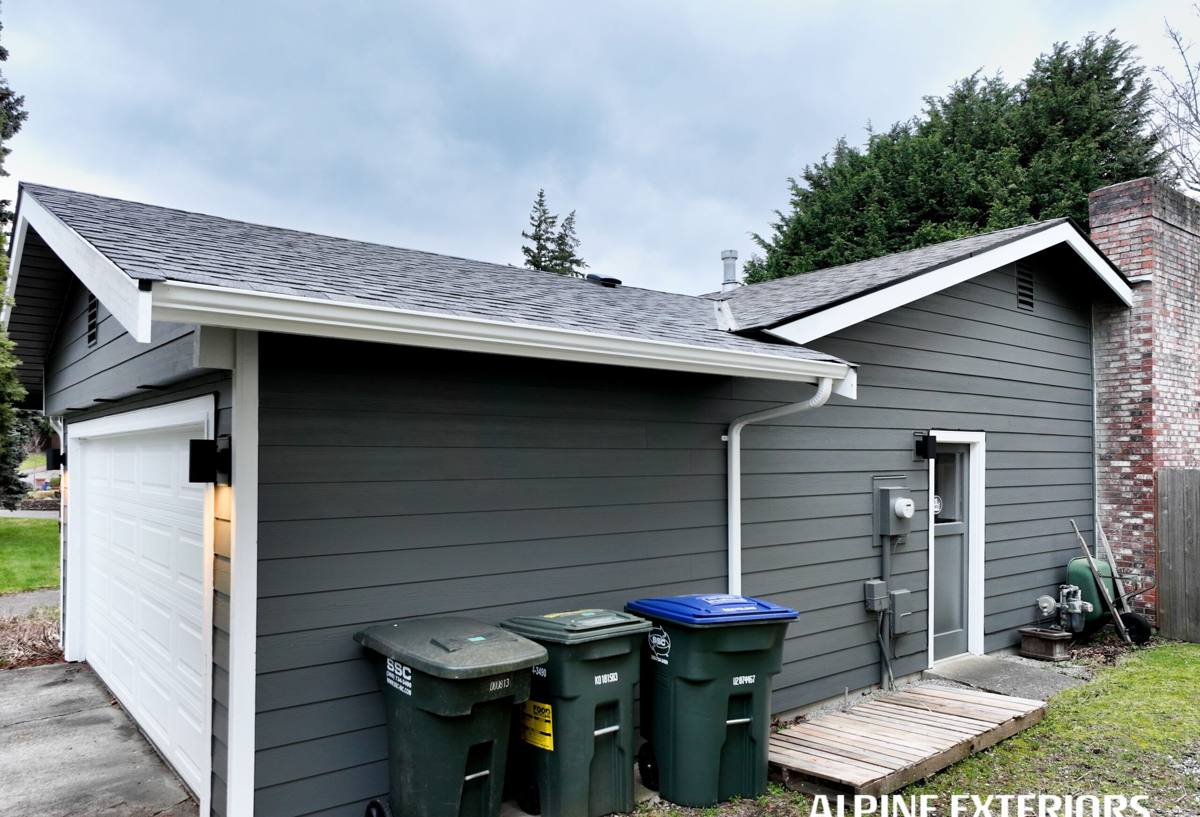
The Core Problem: Primer Is Not a Moisture Barrier
Factory primer does one job well: it seals the wood surface enough to accept paint evenly and slow initial moisture uptake during shipping and storage. It was never engineered to be the long-term defense against Whatcom County's rain. Once that primer and the top coat over it start to age, crack, or get breached at a nail hole, a butt joint, or a cut end, the wood underneath has no built-in resistance to rot. Spruce isn't naturally decay-resistant the way old-growth cedar or heartwood redwood is — it depends entirely on an intact paint film to stay dry.
That's a real problem in a place that gets soaking, wind-driven rain for months at a stretch. Water doesn't need to fall straight down to find its way behind lap siding — it gets pushed sideways and upward under eaves, into laps, and into any gap in the caulk. Once moisture gets past the paint film and into the wood fiber, it doesn't dry out quickly here. Long grey stretches with high humidity mean the wood stays damp far longer than it would in a drier climate, which is exactly the environment that favors rot fungi.
End Grain Is the Weak Point
Every factory-primed board still needs to be cut on site — at corners, around windows, at butt joints. Those cut ends expose raw, unprimed end grain, which soaks up water many times faster than the face of the board. The fix is simple in theory: field-prime every cut end before installation. In practice, it's the single most commonly skipped step in wood siding installation, because it slows the job down and it's invisible once the board is up. Skip it once, on one board, and you've created a moisture entry point that will show up as soft, dark, swelling wood years before the rest of the wall.
Why Whatcom County's Climate Makes This Worse
We're not describing a generic wood-siding problem — we're describing what actually happens on homes from Bellingham to Blaine to Lynden. A few things stack against primed wood siding specifically here:
- Driving rain volume: Whatcom County sees a long wet season with sustained, wind-pushed rain rather than short showers, which pushes water into joints and laps that a calmer climate wouldn't stress as hard.
- Salt air: Homes closer to Bellingham Bay, Birch Bay, Point Roberts, and the county's shoreline communities deal with airborne salt that accelerates paint film breakdown and corrodes fasteners, both of which shorten the life of any painted wood product.
- Moss season: The same cool, damp conditions that grow moss on roofs and north-facing walls also keep organic matter sitting against siding for months, holding moisture against the paint film and feeding mildew and mold growth on the surface.
- Short drying windows: Even after a wet spell breaks, overcast, humid stretches mean wet wood doesn't get much sun and airflow to dry out before the next system rolls in.
None of this means primed spruce siding falls apart on a schedule. It means the maintenance clock starts ticking the moment it's installed, and in this specific climate that clock runs faster than it would in a drier region.
The Maintenance Burden Nobody Budgets For
The upfront cost of primed wood siding is genuinely attractive compared to fiber cement — that's a fair, honest point in its favor. But the lifecycle cost tells a different story once you account for repainting.
| Factor | Primed Spruce Siding | James Hardie Fiber Cement (ColorPlus) |
|---|---|---|
| Repaint interval | Typically every 5–8 years in this climate, sooner in salt-exposed or shaded/mossy areas | Factory finish warrantied 15 years; no repaint needed to maintain color |
| Moisture response | Relies entirely on intact paint film; end grain and joints are vulnerable | Cement-based board does not swell, rot, or absorb water like wood fiber |
| Combustibility | Combustible, as with any solid wood product | Non-combustible core material |
| Warping/cupping risk | Present, especially with wet/dry cycling common in marine climates | Dimensionally stable under moisture cycling |
| Warranty scope | Usually covers product/primer defects only; paint performance is separate and often the homeowner's responsibility | Manufacturer warranty covers the substrate and the factory finish together |
| Typical install cost | Lower material cost | Higher material cost, offset by lower long-term maintenance spend |
When we price a job, we're not just pricing the install — we're thinking about what that homeowner will be dealing with in year six, year ten, year fifteen. A product that needs scaffolding and a paint crew back on the house every several years, in a region where wet-weather work windows are already tight, isn't the standard we want to put our name on.
Installation Sensitivity Is a Real Factor
Primed wood siding isn't forgiving of shortcuts, and the margin for error is smaller than most homeowners realize:
- Every cut end needs field priming before it goes up — no exceptions, no "we'll get it later."
- Caulk joints need to be maintained and re-caulked as they age, or they become the entry point for water.
- Back-priming (coating the hidden backside of the board) matters as much as the visible face, but it's invisible once installed, so it's easy for a crew to skip without the homeowner ever knowing.
- Fastener choice matters — the wrong nail corrodes, stains the paint, and eventually loosens the board.
These aren't hypothetical failure points we're speculating about — they're well-understood installation requirements for painted wood siding in any wet climate. The issue is that they depend on every step being done right, every time, for the life of the product, and that's a heavier ongoing burden than fiber cement asks of either the installer or the homeowner.
What We Install Instead, and Why
We install James Hardie fiber cement siding exclusively. It's not a marketing preference — it's a standard we settled on after weighing exactly the trade-offs above against what this county's weather does to a house over twenty or thirty years.
ColorPlus Factory Finish
Instead of a job-site paint job that starts degrading the moment it's exposed to salt air and rain, Hardie's ColorPlus finish is baked on at the factory under controlled conditions, with a warranty that follows the finish itself — not just the substrate underneath it.
Engineered for This Climate
Hardie's HZ product lines are specifically engineered for regions with heavy moisture exposure like ours. The fiber cement composition doesn't rot, doesn't support the kind of organic growth that thrives in a long moss season, and doesn't rely on an unbroken paint film to keep water out of the material itself.
Non-Combustible
Fiber cement doesn't burn. That's a straightforward material advantage over any solid wood product, regardless of how it's finished.
A Warranty That Covers the Whole System
Hardie's transferable warranty covers both the board and the factory finish together, which matters if you ever sell the home — a future buyer isn't inheriting a repaint schedule as an unstated cost of ownership.
If You Already Have Primed Spruce Siding
We're not in the business of telling every homeowner with existing wood siding that they need to rip it off tomorrow. If your siding is well-maintained, still has an intact paint film, and isn't showing soft spots, that's a house that's been cared for properly. What we'd flag as warning signs to watch for:
- Paint that's alligatoring, peeling, or bubbling, especially on the north side or under eaves where drying is slowest
- Soft or spongy spots when you press on the board, particularly near the bottom edge or at butt joints
- Visible swelling, cupping, or separation at finger-joints
- Persistent moss or dark staining that keeps coming back even after cleaning
- Gaps in caulk lines that haven't been maintained in the last few years
Catching these early with routine repainting and caulk maintenance can keep primed wood siding performing for a long time. Once rot sets in at the framing behind it, though, it's no longer a paint problem — it's a full siding and sheathing conversation.
Our Honest Bottom Line
Primed spruce siding isn't a scam or a defective product — it's a wood product that performs the way wood performs, and that performance depends on an ongoing maintenance commitment that's harder to keep up with in a marine, high-rainfall climate like Whatcom County's. We'd rather be straightforward about that trade-off than sell a homeowner something we know will bring them back for a repaint crew every few years. That's why we install James Hardie fiber cement on every project we take on — it's built for the water, the salt air, and the moss season we actually live with here.
If you're weighing your siding options — whether you're replacing failing wood siding or building new — we're happy to walk your specific house and give you a straight, no-pressure estimate for what a Hardie fiber cement install would look like and cost.