 Whatcom County
 Siding in Cordata: Built for What North Bellingham Weather Actually Does
Cordata sits in the part of Whatcom County where marine weather off the Salish Sea meets the everyday grind of a Pacific Northwest winter. Homes here deal with a specific combination of stressors: salt-tinged air moving in off the water, driving rain that comes in sideways during a January storm, and a moss season that can run from October through May if conditions are right. None of that is exotic or unusual for this part of Washington, but it does mean exterior materials on a Cordata home work harder than they would in a drier inland climate. Siding is the first line of defense, and it needs to be chosen and installed with that reality in mind, not with a one-size-fits-all approach borrowed from a warmer, drier market.
Cordata has grown into a mix of newer residential development and established neighborhoods, with homes ranging from recent builds to houses that are now old enough to be on their second or third exterior. Whatever the age of the house, the climate math is the same: moisture exposure is constant, and the siding has to shed water, resist rot, and hold its finish without constant upkeep.
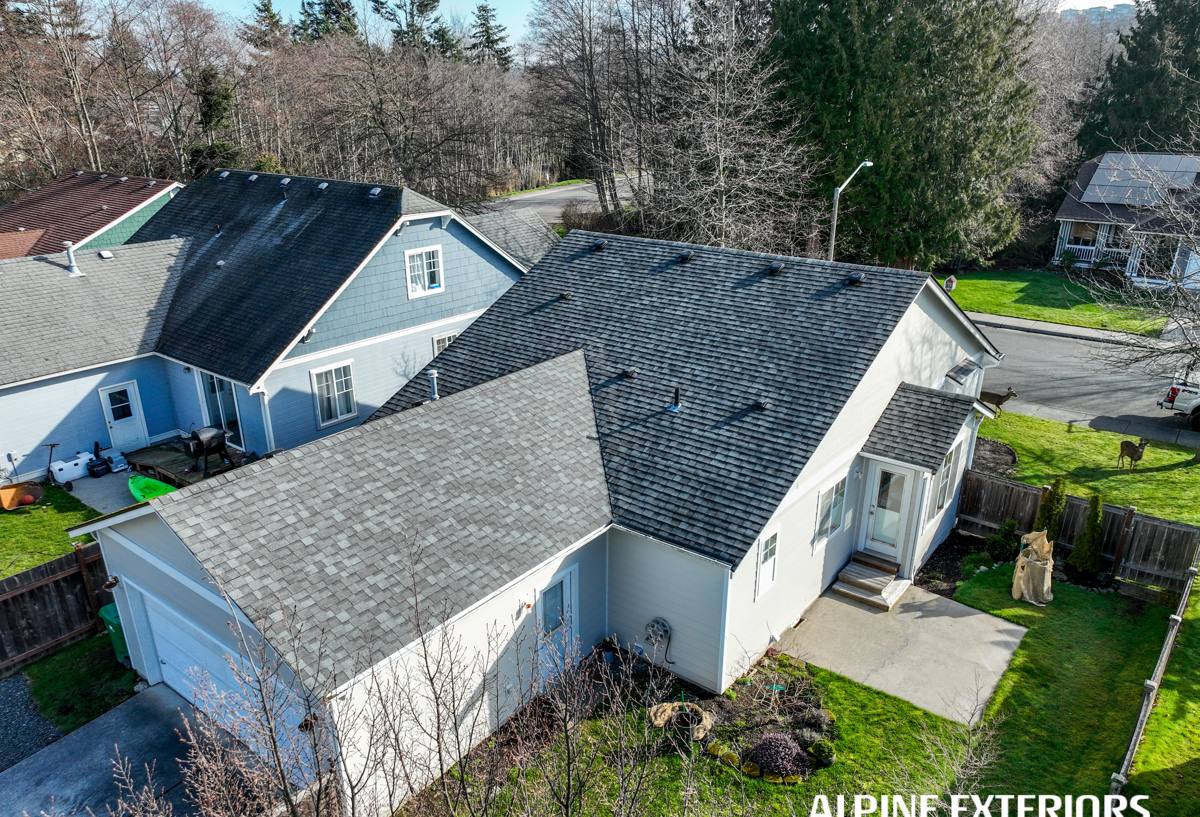
What Whatcom County Climate Does to Siding Over Time
Moisture Load
Whatcom County gets a lot of rain, but it's the type of rain that matters as much as the volume. Wind-driven storms push water horizontally into wall assemblies, not just straight down onto roofs. Siding that isn't dimensionally stable, or that relies on paint film alone to stay waterproof, starts to show it in the form of swelling, cupping, or soft spots at seams and butt joints.
Moss and Organic Growth
Consistent moisture, moderate temperatures, and shaded north- and west-facing walls create ideal conditions for moss, algae, and mildew to take hold on exterior surfaces. Porous or textured materials give organic growth more surface area to grip. Over years, untreated growth holds moisture against the substrate and accelerates whatever deterioration is already happening underneath.
Salt Air
Proximity to Bellingham Bay and the broader Salish Sea means airborne salt is a real factor for homes throughout this part of Whatcom County, Cordata included. Salt exposure is harder on fasteners, trim, and any material with a metal component or a finish that isn't engineered to resist it. It also tends to accelerate fading and chalking on lower-grade paint systems.
Temperature Swings and UV
Summers bring longer stretches of direct UV exposure, and the freeze-thaw cycles of winter put stress on any material that expands and contracts unevenly. Siding that isn't stable under these swings eventually cracks at fastener points or opens up at seams.
Why We Install Only James Hardie Fiber Cement
Whatcom County Siding installs James Hardie products exclusively. We don't install vinyl, LP SmartSide, Cemplank, Allura, primed spruce, or cedar. That's a deliberate standard, not a lack of options, and it's worth explaining why in the context of a climate like this one.
- Non-combustible: Fiber cement doesn't contribute fuel to a fire the way wood-based or wood-fiber products can, which matters given wildfire smoke and drought stress patterns that have become more common across the broader region in recent years.
- Moisture stability: James Hardie's fiber cement formulation is engineered to resist swelling, cupping, and warping from repeated wetting and drying, which is exactly the cycle Cordata homes go through most of the year.
- Factory-applied ColorPlus finish: Rather than relying on field-applied paint that has to cure correctly on-site and gets reapplied every several years, ColorPlus is baked on in a controlled factory environment, with far better UV and fade resistance and a longer service interval before repainting is needed.
- Climate-engineered product lines: James Hardie makes region-specific formulations (HZ5 for this climate zone) intended to perform in exactly the wet, moderate-temperature conditions found here.
- Warranty backing: James Hardie's warranty structure is transferable and well-documented, which matters for resale and for homeowners who want a real paper trail if something does go wrong.
We're not going to pretend other products don't have a place in the market. Vinyl is inexpensive and cedar has genuine visual appeal, and if a homeowner wants to source and install those materials themselves or through another contractor, that's their call. Our position is narrower: given what we've seen fiber cement do over the long run in this specific climate, versus the maintenance burden and moisture sensitivity of the alternatives, we only put our name behind Hardie installations.
How Our Siding Process Works for Cordata Homes
Inspection and Assessment
We start by looking at the existing siding, sheathing, and any visible signs of moisture intrusion — soft spots, staining, gaps at trim, or failed caulk joints. This tells us whether we're dealing with a straightforward re-side or whether there's underlying sheathing or framing damage that needs to be addressed before new siding goes on.
Moisture Barrier and Flashing Detail
In a climate that gets this much wind-driven rain, the water-resistive barrier and flashing details around windows, doors, and penetrations matter as much as the siding itself. We install per James Hardie's published fastening and clearance specifications, including proper ground clearance and flashing above windows and trim, because those details are what actually keep water out of the wall assembly long-term.
Installation to Manufacturer Spec
James Hardie's warranty is contingent on installation following their guidelines — fastener spacing, joint treatment, caulking at seams, and clearance from grade, roofing, and decking surfaces. A lot of the callbacks and warranty disputes homeowners run into with fiber cement trace back to installation shortcuts, not the product itself. We follow the spec because it's the difference between siding that performs for decades and siding that causes problems in five years.
Final Walkthrough
Once installation is complete, we walk the exterior with the homeowner, check caulking and trim lines, and confirm everything is sealed and finished correctly before we consider the job done.
Beyond Siding: Roofing, Windows, and Decks
Siding doesn't work in isolation. On a lot of Cordata homes, the siding project surfaces issues with the roof, windows, or deck that are feeding moisture into the same wall systems. We handle all four:
- Roofing: A roof with failing flashing or worn shingles sends water down behind siding and trim regardless of how good the siding itself is.
- Windows: Old or poorly flashed windows are one of the most common sources of hidden moisture intrusion behind siding.
- Decks: Decks that attach directly to the house need proper ledger flashing, or they become a moisture path into the wall assembly right where siding meets structure.
Because we work across all four trades, we can flag an issue in one area while we're addressing another, instead of a siding crew missing a roofing problem that undermines the whole job.
Cost Factors for a Cordata Siding Project
| Factor | Why It Matters Here |
|---|---|
| Home size and wall complexity | More corners, gables, and trim detail increase labor time and material cuts |
| Existing siding removal | Tear-off and disposal of old material adds cost versus a bare wall |
| Underlying sheathing condition | Moisture-damaged sheathing found during removal needs repair before new siding goes on |
| James Hardie product line and profile | Lap siding, panel systems, and shingle-style profiles vary in material cost and install time |
| ColorPlus color and trim selection | Custom trim packages and accent colors affect material pricing |
| Access and site conditions | Slopes, tight lot lines, and landscaping affect staging and labor |
We don't publish blanket prices because every one of these factors changes the number, but we'll walk a Cordata property in person and give a straightforward, itemized estimate rather than a vague ballpark.
Signs It's Time to Look at Your Siding
- Visible cracking, warping, or bulging panels, especially on north- or west-facing walls
- Persistent moss or algae growth that comes back shortly after cleaning
- Soft spots when you press on siding near the base of the wall or under windows
- Paint that's peeling, chalking, or fading unevenly across the house
- Rising energy bills that might point to a compromised wall assembly, not just an HVAC issue
- Visible gaps or separation at seams, corners, or trim boards
Any one of these on its own isn't necessarily an emergency, but a few of them together are usually a sign the siding has stopped doing its job.
Why a Local Crew Matters
A contractor working across all of Whatcom County sees the same failure patterns repeat on house after house — the same moss-prone wall orientations, the same flashing shortcuts that show up years later, the same trouble spots where decks or additions meet the original siding. That pattern recognition is worth more than a generic install crew unfamiliar with how this specific stretch of coastline behaves. We're not guessing at how James Hardie performs in a marine climate with heavy moss pressure and salt air — we install it here, on homes in this county, in this weather, year-round.
If you're weighing a siding project in Cordata, we're happy to walk the property, look at what your home is actually dealing with, and put together a clear, no-pressure estimate — no obligation, no pushy sales pitch, just an honest look at your options.