 Whatcom County
 Vinyl Siding Isn't a Bad Product — It's a Bad Fit Here
We get asked about vinyl siding often enough that it's worth addressing head-on. Vinyl isn't a scam product or a rip-off. It's inexpensive, it goes up fast, and in a lot of the country it does a perfectly adequate job for a lot of years. If you're comparing quotes and someone hands you a vinyl bid at a fraction of what we charge for James Hardie fiber cement, that's not a mistake on their part — it's a real, legitimate product with a real, legitimate price point.
Our issue isn't with vinyl as a category. It's with vinyl as a choice for homes in Whatcom County specifically. We've stood on enough ladders in Bellingham, Ferndale, and out toward the county line to have a clear-eyed view of what this climate does to exterior materials over ten, twenty, and thirty years — and vinyl's weak points line up almost exactly with our weak points as a region. That's the whole reason this page exists: not to talk vinyl down in general, but to explain why we, as contractors who have to stand behind our work, stopped installing it.
Salt Air, Driving Rain, and a Long Moss Season
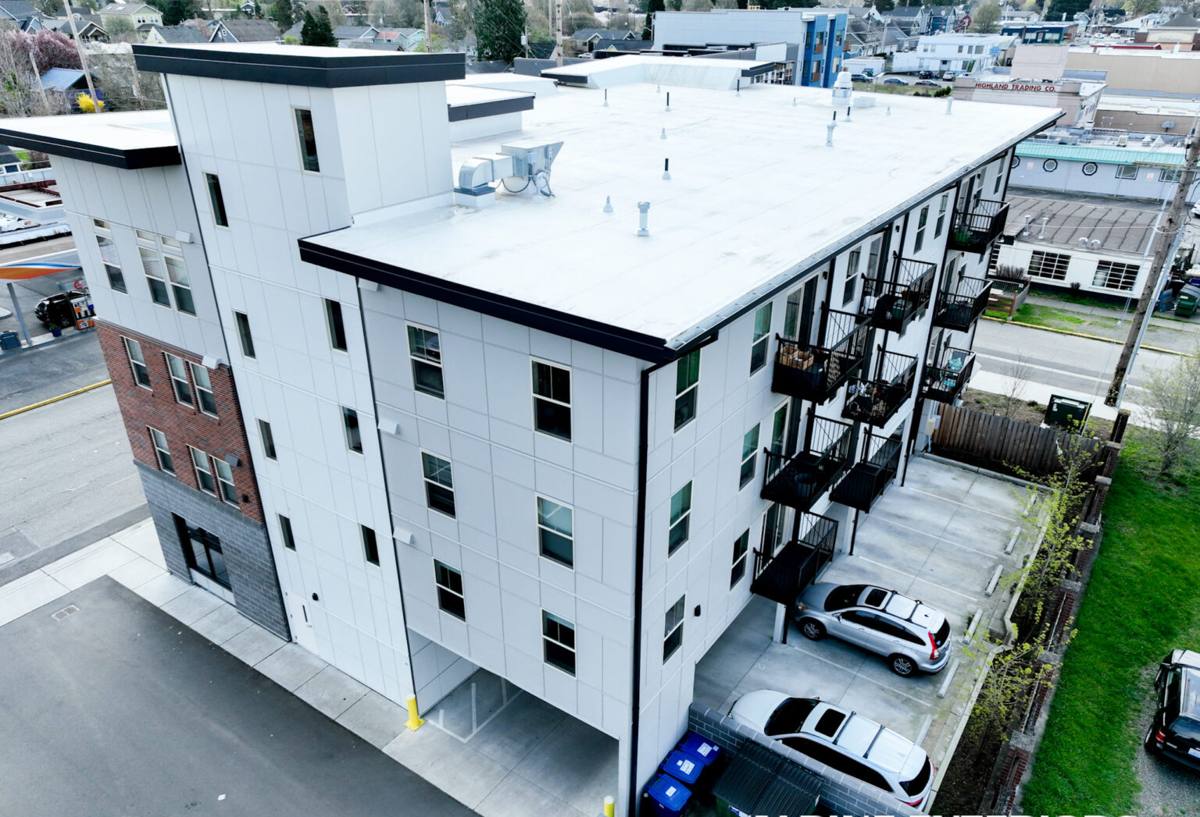
Whatcom County sits right up against the Salish Sea, with Bellingham Bay and the broader Puget Sound airshed feeding a steady drift of salt-laden moisture onto homes anywhere near the water — and even well inland, prevailing westerlies carry enough of it to matter over decades. Add to that a rainy season that runs long and comes in sideways more often than people from drier climates expect, plus enough shade, humidity, and mild winters to grow moss on almost anything that holds still long enough. That combination — salt exposure, wind-driven rain, and a moss season that can run eight or nine months out of the year — is a tough environment for any exterior product, but it's a particularly bad match for vinyl's specific vulnerabilities.
Salt and UV Together
Vinyl siding is a PVC product, and PVC degrades under sustained UV exposure by a process called photodegradation — the surface gets brittle and chalky over time. On its own, that's a slow process. But salt air accelerates the breakdown of surface coatings and finishes generally, and it works into the gaps, laps, and fastener slots of vinyl panels in a way that plain rainwater doesn't. Homes near the water in Whatcom County see this show up as premature fading and a chalky residue years before it "should" happen by the manufacturer's own aging charts.
Moss Doesn't Care What You're Made Of
Moss and algae growth is a fact of life on any north-facing or shaded wall in this part of Washington, regardless of siding material. The difference is what happens underneath. Vinyl's overlapping panel design creates narrow channels and J-channels where moisture, pollen, and organic debris collect and stay damp for days after a storm — exactly the conditions moss needs to take hold. Once it's established in those channels, pressure-washing it off risks driving water behind the panels, which creates a second problem entirely.
The Expansion and Contraction Problem
Vinyl siding is engineered to expand and contract with temperature swings — that's by design, and it's why panels are hung loosely on nail slots rather than fastened tight. In a stable climate that works fine. Whatcom County's weather isn't wildly extreme, but it is inconsistent: cold snaps, sudden warm spells, and big day-to-night temperature swings are common, especially inland toward Deming and Acme. Over many cycles, that constant movement works fasteners loose, distorts panels, and opens gaps at the corners and trim.
The result, ten or fifteen years in, is the wavy, slightly buckled look that's common on older vinyl-clad homes — panels that no longer sit flat because the expansion joints have done exactly what they were designed to do, over and over, for a decade and a half. It's not a manufacturing defect. It's the product working as intended, in a climate where "as intended" eventually looks bad.
What's Happening Behind the Panels
Vinyl siding is not a water barrier — it's a rain screen that's supposed to shed the bulk of the water while a weather-resistant barrier underneath handles anything that gets through. That system depends entirely on correct installation: proper overlaps, correctly lapped flashing, and a drainage plane that actually drains. In a region with as much annual rainfall and wind-driven rain as Whatcom County gets, any shortcut in that installation — and we see plenty on remodel tear-offs — turns into moisture sitting against the sheathing for months at a time.
Because vinyl panels are also difficult to fully seal at trim and penetrations without looking obviously caulked, contractors under time pressure often rely on the panel system to do more than it's built for. When we tear old vinyl off a house in this county, what we find behind it varies a lot by how carefully it was installed — but the pattern of water staining, soft sheathing, and mold at corners and windows is common enough that it shapes how we think about the product.
Vinyl vs. Fiber Cement in This Climate
| Factor | Vinyl Siding | James Hardie Fiber Cement |
|---|---|---|
| Material behavior | PVC plastic; expands/contracts with temperature | Cement-based composite; dimensionally stable |
| Salt air / coastal exposure | UV and salt accelerate chalking and brittleness | Factory ColorPlus finish resists fading and salt exposure |
| Fire exposure | Combustible; can melt or deform near heat sources | Non-combustible fiber cement |
| Moss and moisture | Channels trap debris and moisture; pressure-washing risks intrusion | Solid panel profile, less trapping geometry; can be power-washed within guidelines |
| Long-term appearance | Common warping/waviness after 10-15 years | Engineered HZ product line rated for the Pacific Northwest's wet climate zone |
| Warranty | Prorated, often voided by improper installation | Non-prorated, transferable manufacturer warranty when installed to spec |
| Upfront cost | Lowest cost per square | Higher upfront cost, longer service life |
None of this means vinyl is unusable everywhere — it means the specific combination of salt exposure, sustained rain, and moss pressure that defines this county pushes harder on vinyl's known weak points than most parts of the country ever will.
Why We Standardized on James Hardie Instead
We install James Hardie fiber cement siding exclusively, and it's not a marketing decision — it's the product line we've found holds up under this specific set of conditions without needing constant intervention. Hardie's HZ5 product line is engineered for climates with significant moisture exposure, which is exactly the profile Whatcom County fits. Fiber cement is non-combustible, which matters more each year as wildfire smoke and dry-season risk becomes a bigger part of Pacific Northwest summers even in a historically wet county. The ColorPlus factory finish is baked on under controlled conditions rather than field-painted, so it holds color and resists the fading and chalking that UV and salt air cause faster on other products.
Fiber cement is also dimensionally stable in a way vinyl simply isn't — it doesn't expand and contract on the same scale, so it doesn't develop the waviness or gapping that shows up on older vinyl homes. And because we install it to Hardie's published specifications, the manufacturer's non-prorated warranty stays intact and transfers to a future buyer, which matters a lot if you ever sell.
What "Installed to Spec" Actually Means
- Correct nailing pattern and fastener depth — not too tight, not too loose
- Proper clearance from grade, decks, and roof lines to keep moisture away from the bottom edge
- Weather-resistant barrier and flashing installed and lapped correctly before a single plank goes up
- Factory-cut and factory-primed edges used wherever possible, with field cuts sealed per manufacturer guidance
- Caulking only where Hardie's install guide calls for it — not as a substitute for correct flashing
A Practical Checklist Before You Choose a Siding Product
- Ask what climate zone the product line is actually engineered for, not just its national marketing
- Ask how the warranty is structured — prorated versus non-prorated, and what voids it
- Ask what happens to the warranty if you sell the house
- Ask to see the manufacturer's installation manual, not just the contractor's usual method
- Ask how the product performs specifically in wet, moss-prone, coastal-adjacent climates like ours
- Get more than one bid, and be suspicious of a bid that's dramatically cheaper without explaining why
The Honest Bottom Line
If you're set on vinyl siding, we're not the right contractor for that job, and we'll tell you that directly rather than take the work and cut corners on a product we don't believe in for this climate. What we can do is walk your home, look at your sun exposure, drainage, and moss history, and give you a straight answer about what fiber cement would cost and how long it should realistically last on your specific house in Whatcom County. There's no pressure and no sales script involved — just a second opinion from people who've pulled a lot of old siding off a lot of old houses around here and formed real opinions about what holds up. If you'd like that walkthrough, the request form below gets you a free estimate.