 Whatcom County
 Exterior Work in Barkley: Built for Whatcom County's Weather, Not Around It
Barkley sits inside the same weather system that shapes exterior durability across all of Whatcom County, and it's not a gentle one. Salt-tinged air drifts in off the water and settles on everything metal and painted. Rain rarely falls straight down here — wind pushes it sideways into seams, laps, and trim joints that a calmer climate would never test. And moss doesn't take a season off; on shaded or north-facing walls it can hold on nearly year-round. None of these three pressures is dramatic by itself on any given day. What they do add up over years, and that accumulation is what separates a home whose siding looks the same at year fifteen from one that's already showing rot, streaking, and soft spots by year eight.
We work on homes throughout Barkley and the wider Whatcom County area, and every decision we make about materials and installation method is built around this specific combination of salt, wind-driven moisture, and sustained shade — not a generic weather profile pulled from somewhere drier or calmer. Siding is the core of what we do, and we also handle roofing, windows, and decks, because on a real house those four systems fail together far more often than they fail in isolation.
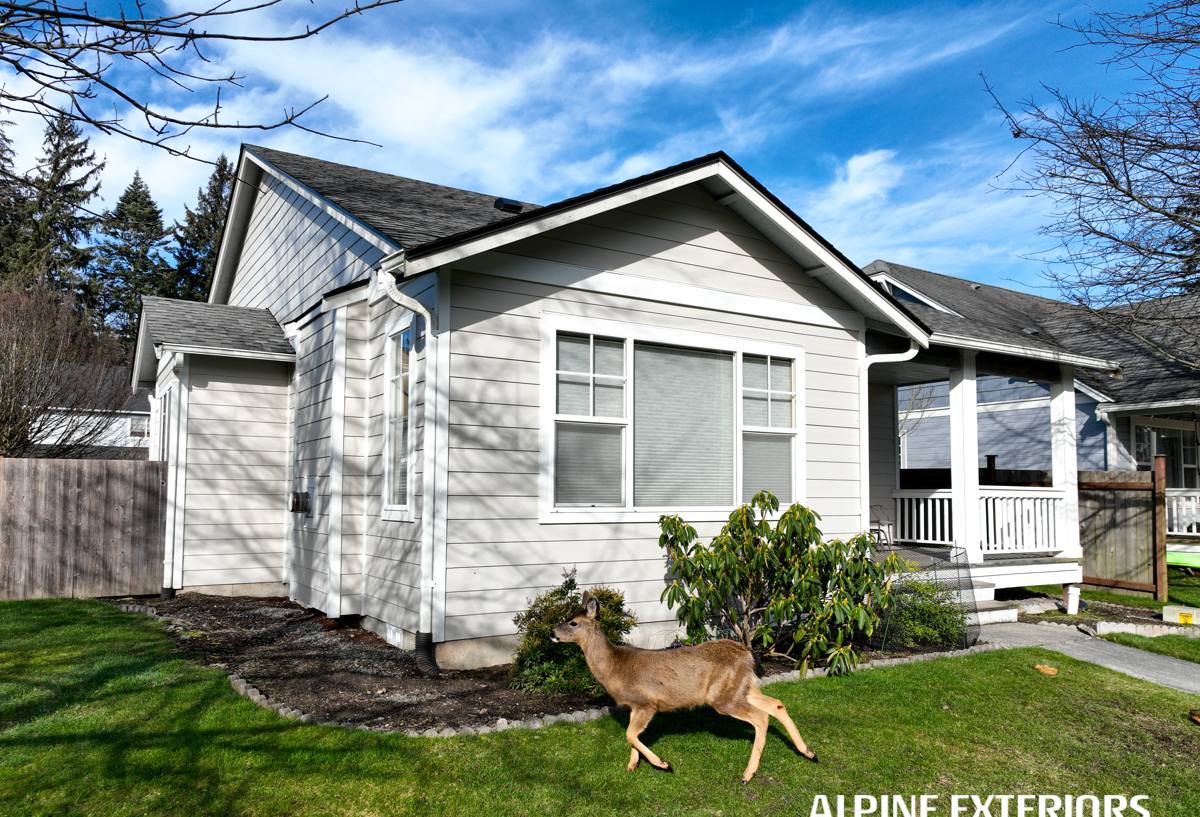
What Salt Air, Driving Rain, and Moss Actually Do to a House
Salt Air
Proximity to the water means Barkley homes take on more airborne salt than towns further inland. Salt is corrosive and hygroscopic — it pulls moisture out of the air and holds it against whatever surface it lands on. Over years, that accelerates rust on fasteners, hinges, and lower-grade trim hardware, and it keeps painted surfaces damp longer than they'd stay in a drier climate. It's a slow process, which is exactly why homeowners tend to underestimate it until rust streaks or loosened trim show up.
Driving Rain
Storms here typically arrive with real wind behind them, and that wind pushes rain sideways into wall assemblies rather than letting it run straight down and off. That matters enormously for how a siding system is detailed. A weather barrier, flashing, and lap sequence that would be adequate in a calm, dry climate can still let water behind the cladding here if it wasn't built with wind-driven moisture specifically in mind. Most of the siding failures we see in this region trace back to water getting behind the siding, not through the siding material itself.
A Long Moss Season
Cool temperatures, consistent humidity, and heavy tree cover across the area give moss and algae a growing window that can run nearly the full year on shaded, north-facing surfaces. Moss isn't just a cosmetic problem — it holds moisture against a wall or roofline far longer than open air would, and on a moisture-sensitive material that constant dampness is what eventually turns into soft spots, swelling, and rot rather than just a green tint that pressure-washes away.
Why We Install Only James Hardie Fiber Cement
Given those three pressures working on a house at once, we made a deliberate decision years ago to install one siding system rather than offer a menu of brands and let price alone decide. Spreading a crew's expertise across several product lines means shallower familiarity with each one. Concentrating on a single system means we install it correctly, consistently, on every job, and we know exactly how it behaves in this climate over time.
James Hardie fiber cement doesn't absorb moisture the way wood-based products do, so it doesn't swell, soften, or feed rot at cut edges and seams the way engineered wood or primed lumber can. It's non-combustible. And its ColorPlus finish is baked on at the factory under controlled conditions rather than applied and cured on-site in Whatcom County's damp air, which matters a great deal in a climate where field-applied paint has a narrow window to properly set before the next rain moves through.
| Product | Trade-off in this climate |
|---|---|
| Vinyl siding | Can warp or crack under sustained wind and temperature swings; panel seams give wind-driven rain a path in |
| LP SmartSide / engineered wood | Wood-strand core is more sensitive at cut edges and fastener points than fiber cement in sustained damp conditions |
| Primed spruce or cedar | Needs ongoing repainting and moss treatment to avoid rot; the upfront savings get spent back over time in upkeep |
| Other fiber cement brands | May not offer a climate-specific HZ formulation or the same depth of factory-finish warranty as James Hardie |
None of that is a claim that these products can't be used anywhere — they have legitimate uses in other climates and budgets. It's a statement of our own professional standard for the specific climate we work in every day. James Hardie's HZ5 formulation, engineered for regions with sustained moisture exposure and freeze-thaw cycling rather than desert heat or hurricane wind, is a close match for what a Barkley home actually experiences across a full year.
How a Siding Project Runs, Start to Finish
Inspection and Estimate
Every project starts with a real look at the house — current siding condition, any signs of trapped moisture, and how sun, wind, and shade exposure differ wall by wall. That inspection is what the estimate is based on, not a flat per-square-foot number quoted sight-unseen.
Tear-Off and Substrate Check
Once the old siding comes off, we check the sheathing underneath for rot or soft spots before anything new goes up. Installing new siding over damaged sheathing just hides a problem that keeps getting worse behind the wall. We'd rather find it now, explain what we found, and price the repair honestly than have it resurface as a bigger, more expensive issue down the line.
Weather Barrier and Flashing
This is the step that's easiest to rush and hardest to inspect once new siding is up, which is exactly why we treat it as the most important part of the job. House wrap, window flashing, and every wall penetration get detailed to shed wind-driven rain outward, not just to look finished under dry conditions.
Installation to Manufacturer Spec
James Hardie publishes specific fastening patterns, clearances above grade, and gapping requirements at butt joints and trim, and following them precisely is what keeps the manufacturer's warranty valid and the siding performing as engineered. Small shortcuts on nail spacing or clearance don't show up right away in a wet climate — they show up a few winters later.
Finish Detailing
Because the color coat is factory-applied, any touch-up at cut edges uses Hardie's matched touch-up product instead of field-mixed paint. That keeps the finish consistent and avoids putting a weaker, unbaked paint layer at exactly the joints most exposed to weather.
James Hardie Product Lines for Barkley Homes
Hardie makes several distinct siding profiles, and which one fits a given house usually comes down to its architectural style and how much of the exterior wall surface takes direct weather.
| Product line | Typical use |
|---|---|
| HardiePlank lap siding | The most common choice for traditional and craftsman-style homes; horizontal lap profile in multiple widths and textures |
| HardieShingle | A shingle-style profile for a more textured, staggered or straight-edge look |
| HardiePanel | Vertical panel siding, often used for accent walls, gables, or contemporary exteriors |
| HardieTrim | Fiber cement trim used at windows, corners, and fascia to match the siding's durability rather than pairing it with wood trim that weathers faster |
Color runs through Hardie's ColorPlus palette, engineered to resist the fading and chalking that constant UV and moisture cycling causes in field-applied paint within just a few years.
Roofing, Windows, and Decks While We're Already There
Water intrusion at a roofline, a window sill, or a deck ledger board very often shows up a few feet away as siding damage, which is why it makes more sense for one crew to handle all four systems than to coordinate between separate contractors who each only see their own piece of the house. If we're already on the wall replacing siding at a Barkley property, checking roof-to-wall flashing or window opening details adds very little time to the project and can catch a problem before it turns into a larger repair. Deck ledger connections deserve the same attention — they're a common and frequently overlooked source of hidden moisture damage right where a deck meets the house.
Signs a Barkley Home's Exterior Needs Attention
- Soft or spongy siding when pressed, especially near the bottom courses or below windows
- Persistent moss or dark streaking on north-facing or heavily shaded walls
- Paint that's peeling, bubbling, or wearing unevenly — often a sign of moisture trapped behind the surface
- Visible gaps, warping, or separation at seams and corner boards
- Rust staining running down from fasteners or metal trim
- Roofing showing moss buildup or granule loss well ahead of its expected service life
- Drafts or visible daylight around older window frames
What Affects Siding Cost on a Barkley Property
| Factor | Why it matters |
|---|---|
| Home size and wall complexity | More corners, dormers, and cutouts mean more material waste and labor time than a simple rectangular footprint |
| Sheathing condition | Rot found during tear-off adds repair scope that can't be priced accurately until the old siding is off |
| Siding profile and accessories | Lap width, trim detail, and any shingle or panel accent sections affect both material and labor cost |
| Access and site conditions | Steep lots, tight setbacks, or limited staging space can add time and equipment cost |
| Tear-off vs. new construction | Removing and disposing of old siding is an added labor step new-construction siding doesn't require |
We walk through these factors during the estimate instead of quoting a flat number sight-unseen, since two homes with the same square footage can land at meaningfully different costs depending on condition and complexity.
Why a Local Crew Matters
A contractor who works this specific climate regularly, not occasionally, tends to catch the details a generic installation misses: where moss actually accumulates on a given lot, how much clearance a particular wall needs at grade, which flashing details fail first after a wet Whatcom County winter. We handle permitting as part of the project too, which matters in a county where requirements and processing can vary by jurisdiction and scope. A local crew is also easier to reach years later if a warranty question comes up — not a name from an out-of-area lead-generation service that stops answering once the final payment clears.
Maintenance Checklist for Barkley Homeowners
- Rinse siding annually, especially on shaded or north-facing walls where moss builds up fastest
- Keep gutters clear so overflow doesn't run down the siding face or pool at the base of a wall
- Trim back vegetation that keeps a section of wall in constant shade and dampness
- Check caulking at trim joints and penetrations every year or two — gaps let water behind the siding long before any damage is visible on the surface
- Inspect the bottom courses of siding periodically for softness or discoloration, since ground-level moisture is the most common failure point
- Address small issues, like a loose piece of trim or a cracked caulk joint, promptly — they're cheap to fix early and expensive to ignore
If your Barkley home's siding, roofing, windows, or decking are showing wear, or you're just planning ahead, we're glad to walk the property with you and put together a straightforward, honest estimate — no pressure, no hard sell. Use the form below to request a free estimate.