 Whatcom County
 Two Fiber Cement Brands, One Real Question
If you've gotten more than one siding quote in Whatcom County, you've probably heard two names come up: James Hardie and Cemplank. Both are fiber cement siding — a blend of cement, sand, and cellulose fibers pressed into planks and panels. Both are a real step up from vinyl in durability and fire resistance. And on a spec sheet, they can look similar enough that homeowners assume the choice comes down to price.
It doesn't, and we think you deserve the honest version of why. We install James Hardie siding exclusively. This page isn't here to trash Cemplank — it's a legitimate fiber cement product with a place in the market. It's here to explain, plainly, the trade-offs that led us to standardize on one manufacturer, and why that decision matters more in Bellingham, Ferndale, Lynden, and the rest of Whatcom County than it might in a drier, calmer climate.
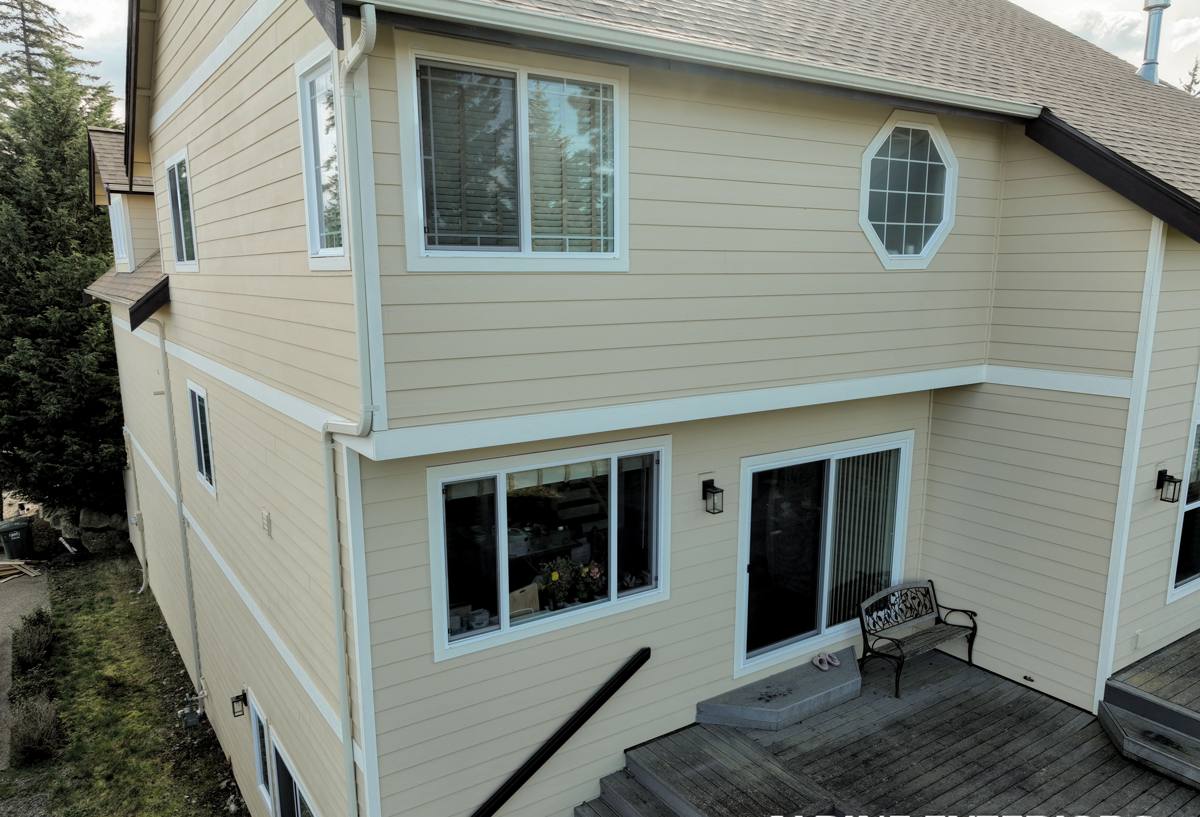
What Cemplank Is
Cemplank is a fiber cement siding line manufactured by Westlake Royal Building Products (the brand traces back to Boral). It's sold largely through ABC Supply as a lower-cost alternative to the market-leading Hardie product line, and it's marketed to installers as a way to bid fiber cement work at a tighter price point. The core material science is genuinely comparable — it's still cement-based lap siding, still far more fire-resistant than vinyl or wood, and still a legitimate improvement over engineered wood products in most respects.
Where the two brands diverge isn't the raw material category. It's everything built around it: the finish system, the product engineering for specific climates, the depth of the accessory and trim lineup, and the manufacturer's track record of standing behind the product decades down the road.
Where They're Genuinely Similar
To be fair to Cemplank, and to any homeowner cross-shopping bids: both products share the same basic strengths over vinyl and wood siding.
- Non-combustible core — both resist ignition and won't melt or warp from radiant heat the way vinyl does
- Resistant to rot, insects, and woodpeckers in a way that untreated wood and engineered wood products aren't
- Rigid enough to hold a straight, clean reveal line when installed correctly
- Available in lap, panel, and some trim profiles for a similar range of architectural looks
If your only criteria were "is it fiber cement," either would clear the bar. The differences show up once you dig into finish technology, climate engineering, and what happens 15 years after installation — which is exactly the stretch of time that matters most on the west side of Whatcom County.
Factory Finish: Where the Real Gap Shows Up
The single biggest practical difference between the two brands is the factory finish system. James Hardie's ColorPlus technology bakes a multi-coat, baked-on finish onto the board at the factory, under controlled conditions, before it ever reaches a jobsite. That finish carries its own dedicated 15-year warranty against fading and peeling, separate from the substrate warranty.
Cemplank's factory-primed and factory-finished offerings exist, but the finish program isn't backed by the same depth of long-term performance data or the same dedicated topcoat warranty structure. In practice, that means more Cemplank installations end up field-painted, which shifts the finish's durability from the manufacturer's controlled process onto whatever paint and prep the installer used on-site — and onto you, as the party who'll be repainting on a normal exterior-paint cycle instead of decades later.
In a climate like ours, where salt-laden air off Bellingham Bay and the Strait of Georgia accelerates finish breakdown, and where driving rain tests every seam and coating for months at a stretch, the quality and warranty depth of the factory finish isn't a cosmetic detail. It's a big part of what you're actually paying for.
Why Climate Engineering Matters Here
Hardie also engineers specific product formulations for different climate zones — its HZ5 and HZ10 lines are built with different moisture and freeze-thaw behavior in mind depending on where they'll be installed. Whatcom County sits in a wet, mixed-marine climate with a long moss season and near-constant humidity swings for much of the year. A product engineered with that reality in mind behaves differently over 20 years than one that wasn't. Cemplank doesn't offer the same climate-zone-specific product segmentation, which means less of that engineering judgment has been made on your behalf before the siding ever reaches your house.
Warranty Structure and Transferability
Both brands offer product warranties, but the length, structure, and transferability differ, and this is worth reading closely rather than taking on faith from a sales sheet. A warranty that's hard to transfer to a new homeowner, or that has narrower coverage on the factory finish, is worth less than it looks on paper — especially if you plan to sell the home within the warranty period, which is common in a market like ours.
| Factor | James Hardie | Cemplank |
|---|---|---|
| Substrate warranty | Long-term, non-prorated in most cases | Offered, shorter track record |
| Factory finish warranty | Dedicated ColorPlus finish warranty, up to 15 years | Limited or none on field-applied finishes |
| Climate-specific engineering | HZ5/HZ10 zone-engineered formulations | Not zone-segmented |
| Regional stocking & parts | Widely stocked, deep trim/accessory match | More limited local distribution |
| Typical installed cost | Moderate-to-higher | Lower-to-moderate |
None of this means Cemplank is a scam or a bad-faith product — it's a legitimate, lower-cost entry in the same category. But "lower cost" and "lower long-term certainty" tend to travel together, and on a 20-to-30-year exterior surface, that trade-off compounds.
Availability and Long-Term Support in Whatcom County
There's a practical, unglamorous reason this matters too: repairs. Siding gets dinged by a falling branch, a ladder, a delivery truck. Ten years from now, whoever repairs your siding needs to source a matching plank, in a matching color and profile, without the patch looking like a patch. James Hardie's distribution network in the Pacific Northwest is deep enough that matching an existing installation is usually straightforward. Cemplank's more limited regional footprint makes that kind of future repair a harder problem to solve — sometimes it means repainting an entire elevation just to blend one replaced board.
We also factor in our own experience as installers. We've built our crew's training, our flashing and moisture-management details, and our warranty backing around one manufacturer's system. That consistency is part of what keeps installation quality high — it's a lot easier to install one product exceptionally well, over and over, than to be equally sharp across several competing systems.
Why We Standardized on James Hardie
Put simply: we install exteriors that have to survive a wet coastal climate for decades, on homes where the owner usually isn't planning to redo the siding again in ten years. Given that, we default to the manufacturer with climate-specific product engineering, a factory finish backed by its own dedicated warranty, and a distribution and repair network that holds up locally. That's James Hardie. It costs more up front than Cemplank in most cases — we won't pretend otherwise — but we think the gap is easy to justify once you account for the finish warranty, the climate engineering, and the long-term repairability.
We're not saying Cemplank is unusable. We're saying that after weighing the trade-offs against what Whatcom County's climate does to a house over 20-plus years, it's not the product we're willing to put our name behind.
What to Ask Before You Compare Bids
Whichever way you lean, a lower bid on "fiber cement siding" isn't an apples-to-apples comparison unless you check what's actually being quoted. Before comparing two proposals, get clear answers on these:
- Which manufacturer and specific product line is being quoted, not just "fiber cement"
- Whether the finish is factory-applied (with its own warranty) or field-painted on site
- What the substrate warranty covers, its length, and whether it transfers to a future buyer
- Whether the product is climate-engineered for a wet, marine environment
- How easily a matching plank or panel could be sourced for a future repair
- What flashing, house-wrap, and clearance details the installer plans to use — the siding brand matters less than correct installation over it
Get an Honest Look at Your Home
Every house in this county carries salt air, driving rain, and moss season a little differently depending on exposure, tree cover, and elevation. If you'd like a straightforward, no-pressure walkthrough of what that means for your siding — and an honest comparison of what we'd install and why — we're glad to put together a free estimate. No pressure, no hard sell, just a clear look at your options.