 Whatcom County
 Why Bellingham Decks Fail Faster Than the Spec Sheet Suggests
A deck built to a generic national standard doesn't always hold up the way it should once it's sitting in Whatcom County weather. Bellingham sits close enough to Bellingham Bay and the Salish Sea that salt-laden air reaches yards that are nowhere near the water, and that air is hard on fasteners, flashing, and any metal hardware that wasn't specified for a coastal environment. Add in the long stretch of driving rain we get from fall through spring, plus a shoulder season on either end where moss and algae take hold on any shaded or north-facing surface, and you've got three separate stresses working on a structure that's outdoors twenty-four hours a day, year-round.
None of this means a deck can't last. It means the details that don't matter much in a dry climate matter a great deal here. Fastener grade, flashing at the ledger, drainage under the joists, and the gap spacing between boards all have a direct effect on how long a Bellingham deck stays solid and how much work it takes to keep it that way.
Salt Air and Metal Fasteners
Standard galvanized screws and joist hangers can start showing corrosion within a few years in a coastal-influenced climate like ours, especially where two dissimilar metals touch or where a fastener head sits exposed to weather. Once a fastener starts to corrode, it loses holding strength quietly — you often don't see the problem until a board lifts or a railing feels loose. We spec stainless or high-grade coated fasteners rated for coastal exposure on the connections that matter most: ledger bolts, joist hangers, and any hardware holding a railing post.
Driving Rain and the Ledger Connection
The single most common failure point on any deck attached to a house — anywhere, not just here — is the ledger board, the piece that bolts the deck to the home's rim joist. In a climate with sustained, wind-driven rain, a ledger without proper flashing will let water track behind the siding and into the wall framing over time. This is slow, hidden damage, and it's one of the most expensive things to fix if it's ignored long enough. Correct ledger flashing is not optional in our book — it's the first thing we check on any deck we're asked to repair or rebuild.
Moss, Shade, and Standing Water
A lot of Bellingham lots have mature trees or sit close enough to neighboring structures that part of the deck stays shaded most of the day. Combine that shade with our wet fall-through-spring stretch and you get ideal conditions for moss and algae, which hold moisture against the decking surface and make boards slicker and more prone to rot at the surface. Board spacing, airflow underneath the deck, and a decking material that doesn't trap moisture all reduce how much moss becomes a maintenance headache.
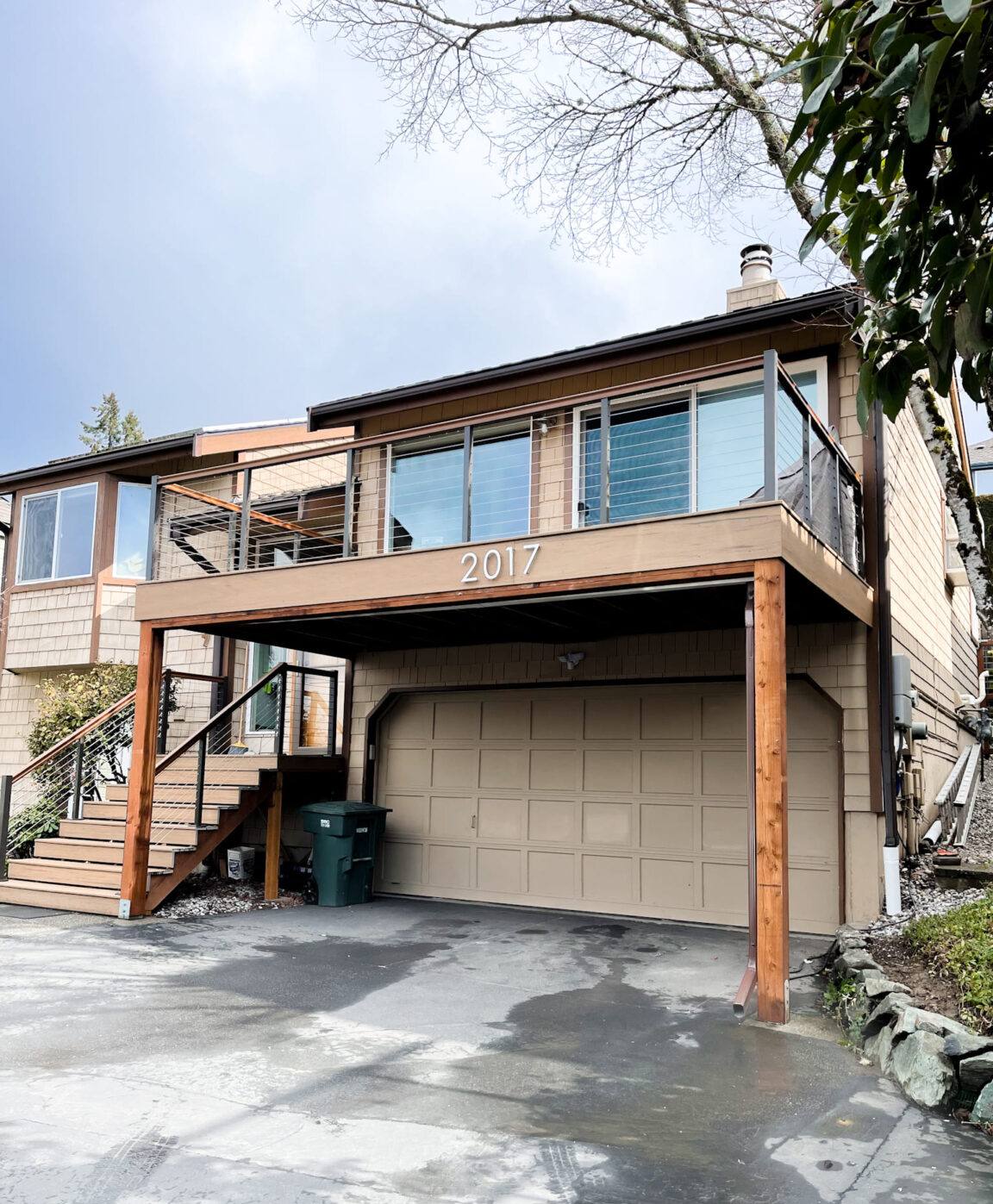
What a Correctly Built Deck Actually Involves
A deck that holds up here isn't about any one flashy detail — it's about getting several ordinary things right, in the right order, with the right materials.
Footings Sized for Our Soil and Frost Depth
Footings need to be sized and set to the depth that matches local frost and soil conditions, not just poured to whatever looks adequate. Undersized or shallow footings are one of the most common problems we find when we're asked to look at an older deck that's started to feel bouncy or has begun to pull away from the house.
Ledger Flashing Done in the Right Order
The flashing has to integrate with the house's existing water-resistive barrier and siding, not just get caulked on top of it. Done correctly, water sheds off the siding, over the flashing, and away from the ledger — never behind it.
Joist Spacing and Hardware Matched to the Decking
Composite and PVC decking generally need tighter joist spacing than solid wood to avoid deflection and warping between supports. Using wood-spec joist spacing under a composite deck is a common shortcut that shows up later as a springy, uneven walking surface.
Drainage Underneath
Especially on lower decks or ones close to grade, the ground underneath needs a way to shed water rather than pond. We grade and, where needed, add gravel or drainage beneath the structure so the framing isn't sitting in standing water through our wet months.
Decking Material Options for This Climate
There's no single "right" material for every yard — it depends on budget, how much maintenance you want to take on, and how exposed the deck is to sun, shade, and moisture. Here's how the common options actually behave in Whatcom County conditions:
| Material | Moisture Behavior Here | Maintenance | Typical Lifespan |
|---|---|---|---|
| Pressure-treated wood | Resists rot when sealed regularly; can cup or check if left unfinished through wet seasons | Needs re-staining/sealing every 2-3 years | 15-20 years with upkeep |
| Cedar | Naturally rot-resistant but still needs sealing in a wet, shaded climate to prevent graying and moss growth | Similar to treated wood — periodic sealing | 15-25 years with upkeep |
| Composite decking | Doesn't absorb water like wood, but lower-quality composites can still grow surface moss in shaded, damp spots | Periodic washing; no staining or sealing | 25-30+ years |
| PVC/capped polymer decking | Fully moisture-resistant surface; best option for heavily shaded or low-airflow areas prone to moss | Occasional washing only | 25-30+ years |
We're honest about trade-offs rather than pushing whatever has the best margin. Wood costs less up front but asks more of the homeowner over time — if you're not going to reseal it on schedule, the maintenance gap shows up fast in a climate this wet. Composite and PVC cost more initially but make sense for shaded lots or homeowners who'd rather not maintain a finish every couple of years.
Our Deck Building Process
1. Site Walk and Assessment
We look at sun and shade exposure, drainage, the condition of the house wall where the ledger will attach, and how the deck will actually get used — entertaining, grilling, a hot tub, side access — before we talk material or layout.
2. Design and Permitting
We lay out a design that fits the lot and the house, then handle the permitting steps that apply to the project. Requirements vary by height, size, and whether the deck attaches to the house, so we confirm what's needed for your specific property rather than assuming.
3. Footings and Framing
Footings go in to the correct depth, ledger flashing gets installed and integrated with the existing siding and water barrier, and the frame is built with hardware rated for our climate.
4. Decking, Railing, and Stairs
Decking is installed with the fastening method and spacing appropriate to the material, railing is set to current code height and baluster spacing, and stairs are built to consistent rise and run.
5. Final Walkthrough
We walk the finished deck with you, cover any maintenance the material requires, and point out things like where drainage is directed and how to keep it that way.
Permits and Local Requirements
Whether a deck needs a permit generally depends on its height above grade, its size, and whether it's attached to the house — the specifics are set by the local jurisdiction and can change, so we confirm current requirements for your address rather than relying on what applied to a different project. Setback requirements from property lines also vary by lot. Part of hiring a local crew is not having to sort this out yourself — we handle the paperwork as part of the job.
Keeping a Bellingham Deck Sound Through the Wet Season
Even a well-built deck needs some seasonal attention in a climate like ours. A little maintenance goes a long way toward avoiding the kind of neglect that turns into a rebuild.
- Clear leaves and debris out of gaps between boards before fall rains set in — trapped debris holds moisture against the wood or composite surface
- Rinse off moss and algae buildup on shaded areas before it gets established; a stiff brush and a deck-safe cleaner usually handles it
- Check that drainage paths under and around the deck are still clear, especially after a heavy storm
- Inspect the ledger flashing area annually for any sign of staining or gaps in the caulk line
- Re-seal or re-stain wood decking on the schedule the product calls for — don't wait until it visibly grays
- Tighten or replace any hardware showing early corrosion before it becomes a structural issue
Why Hiring a Crew That Already Works Bellingham Matters
A deck built by someone unfamiliar with this climate can look fine the day it's finished and still develop problems within a few wet seasons — a ledger without proper flashing, fasteners that weren't rated for salt air, board spacing that traps moisture and grows moss. We work in Bellingham and across Whatcom County regularly, so we're not guessing at how a given material or detail holds up here — we've seen what lasts and what doesn't. That local track record shapes every material recommendation and framing decision we make, not just the ones that are visible once the project is done.
Repairs and Rebuilds on Existing Decks
Not every project starts from bare ground. A lot of what we do in established Bellingham neighborhoods is evaluating an existing deck that's started to feel unstable, show soft spots, or develop staining near the house wall. In many cases the framing and footings are sound and the fix is targeted — replacing decking, correcting ledger flashing, or upgrading hardware — rather than a full teardown. We'll always tell you honestly whether a repair makes sense or whether the structure has reached the point where rebuilding is the more sensible long-term investment.
If you're thinking about a new deck, a rebuild, or just want an honest opinion on the condition of what you have, we're happy to take a look. There's no pressure and no obligation — just a straightforward assessment of what your deck needs and what it would take to do it right. Fill out the form below for a free estimate.