 Whatcom County
 Board & Batten in a Salt Air, High-Rain Climate
Board and batten has become one of the most requested looks for homes around Samish — the vertical lines read as clean and modern on newer builds, and they read as classic farmhouse on older ones. It's a good-looking profile. But in this part of Whatcom County, "good-looking" isn't the hard part. The hard part is keeping that look intact after five, ten, twenty winters of salt-laden wind off the water, driving rain that comes in sideways more often than straight down, and a moss season that can run from October well into spring.
Board and batten siding has more vertical seams and more batten-to-panel transitions than a standard lap profile, which means more places for water to find a way in if the install isn't done correctly. On a home near Samish, that's not a theoretical concern — it's the exact set of conditions that separates a board and batten job that looks great for two decades from one that's showing streaking, soft spots, and failed caulk lines inside of five years.
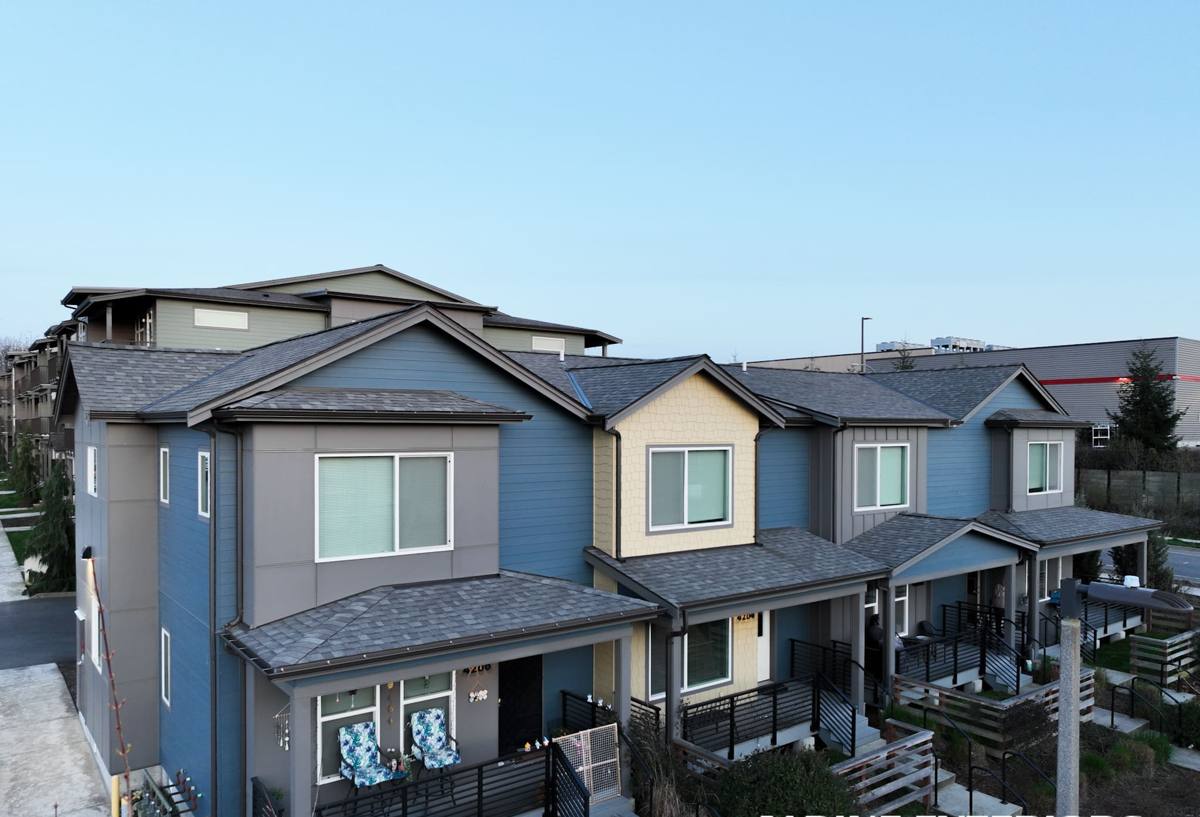
What Local Conditions Do to Board and Batten Siding
Salt Air and Metal Fasteners
Homes closer to the water pick up airborne salt that settles on every exterior surface, including the siding and the fasteners holding it up. Cheap or improperly coated fasteners corrode faster in this environment, and corroding fasteners under a batten strip are hard to spot until you see rust bleed or a batten starting to pull away. It's a detail that matters more here than it would fifty miles inland.
Driving Rain and Wind-Driven Moisture
Whatcom County gets a lot of straight rain, but it also gets a lot of wind-driven rain, and board and batten's vertical battens create narrow channels that can funnel water downward if they're not flashed and gapped correctly. A batten that's caulked tight to the panel on both sides, with no way for trapped moisture to escape, is one of the most common mistakes we see on board and batten jobs done by crews that don't work this look often.
Moss Season and Shaded Exposures
Long, wet falls and winters mean moss and algae have plenty of time to establish, especially on north-facing walls and anywhere a home sits under mature trees — common around Samish. Moss holds moisture against the siding surface far longer than open air would, and on the wrong substrate that constant damp accelerates rot, delamination, or paint failure. The siding material and the finish both need to be able to shrug that off.
Why We Only Install James Hardie for This Profile
We install James Hardie fiber cement exclusively — no vinyl, no LP SmartSide, no Cemplank, no Allura, no primed spruce or cedar board and batten. That's not a marketing position, it's a standard we hold to because of exactly the conditions described above.
Non-Combustible, Climate-Engineered
Hardie's fiber cement is non-combustible and engineered in HZ product lines built for specific climate zones, including the wet, marine-influenced conditions common across Whatcom County. That matters on a profile like board and batten, where the material needs to hold its shape and resist moisture absorption at dozens of seams instead of just a handful.
ColorPlus Factory Finish
Board and batten in particular benefits from Hardie's ColorPlus finish — a baked-on, factory-applied finish that resists fading and holds up to UV and moisture far better than field-applied paint, especially on vertical panels that catch full weather exposure. It also means the cut edges at battens and corners get proper touch-up rather than relying on site-applied primer and paint to seal a critical seam.
Wood, Vinyl, and Engineered Wood Trade-Offs
Real cedar board and batten looks great initially but needs ongoing refinishing and is far more vulnerable to the rot and moss issues above. Vinyl board and batten is low cost but can warp, fade, and doesn't hold paint if you ever want to change the color — and it doesn't offer the same fire performance. Primed wood-composite products like LP SmartSide depend heavily on edge sealing and maintenance discipline to keep moisture out over time. We're upfront with Samish homeowners about all of this before we ever talk about our own product, because the decision should be based on what actually holds up here, not just what looks good on day one.
What a Correct Board & Batten Job Actually Involves
Board and batten is unforgiving of shortcuts. The visual simplicity hides a lot of work that has to happen underneath before the first panel goes up.
Drainage Plane and Rainscreen
A weather-resistive barrier and, ideally, a furred-out rainscreen gap behind the panels gives any moisture that does get past the surface a way to drain and dry out instead of sitting against the sheathing. This is especially important on a profile with more vertical seams than lap siding.
Flashing at Every Penetration
Windows, doors, hose bibs, light fixtures, and any other penetration need proper head flashing and kick-out flashing where rooflines meet walls. On board and batten, flashing details around windows have to account for the vertical batten pattern rather than just tucking under a lap course.
Fastening and Batten Spacing
Fasteners need to be corrosion-resistant and set to Hardie's specified pattern — not just enough to hold the board up, but enough to let the material expand and contract without cracking. Battens need consistent reveal and shouldn't be caulked on both edges, which traps moisture instead of letting it escape.
Field Checklist We Follow
- Weather-resistive barrier lapped correctly, shingle-fashion, with no reverse laps
- Rainscreen gap or drainage mat installed behind panels where the wall assembly calls for it
- Corrosion-resistant fasteners rated for the coastal exposure
- Flashing installed at every window, door, and wall penetration before siding goes on
- Batten spacing and reveal kept consistent across each elevation
- Minimum clearance maintained between siding bottom edge and grade, decks, and roof lines
- Cut edges primed and sealed per Hardie's installation instructions
- Caulk used only where specified — not on both sides of every batten
Board & Batten Material Comparison
| Material | Moisture Resistance in Marine Climate | Fire Rating | Finish Longevity | Maintenance |
|---|---|---|---|---|
| James Hardie Fiber Cement (ColorPlus) | Engineered for wet climates, HZ5-rated | Non-combustible | Factory-baked finish, long fade resistance | Periodic wash, minimal repainting |
| Vinyl Board & Batten | Can warp/expand with temperature swings | Combustible | Fades over time, cannot repaint easily | Low, but replacement often needed sooner |
| Cedar or Primed Wood | Vulnerable to rot without diligent upkeep | Combustible | Field-applied finish, shorter lifespan | Frequent refinishing, sealing edges |
| LP SmartSide / Engineered Wood | Depends heavily on edge sealing | Combustible | Field or factory finish, moderate lifespan | Moderate, edge maintenance critical |
How We Approach a Samish Board & Batten Project
Every project we bid in this area starts with an honest look at the wall assembly, not just the visible siding. We check for existing moisture damage, evaluate what's behind the current siding, and talk through whether a rainscreen assembly makes sense given the home's exposure — a home tucked in among trees with heavy shade behaves differently than one with open water-facing walls. We measure and quote based on actual elevations and detail work, not a flat per-square-foot number that ignores corners, window count, or the flashing work a home actually needs.
Because we work siding in Whatcom County regularly, we already know the local permitting expectations, the typical exposure conditions on both sides of the county, and which detailing choices hold up against the driving rain and moss patterns specific to this area. That's a real advantage over a crew that installs board and batten occasionally and treats it like any other siding job.
Maintenance and What to Expect Over Time
A correctly installed Hardie board and batten system is genuinely low maintenance, but "low" doesn't mean "none." Plan on an occasional gentle wash to knock back algae or moss buildup, especially on shaded or north-facing walls, and a visual check after major storms for any loose battens, caulk failure, or debris buildup at the base of the wall. ColorPlus finish resists fading well, but like any factory finish it has a documented warranty period, and touch-up paint matched to your color is available for any incidental damage — nail pops, scuffs from equipment, and similar.
What Affects the Cost
Board and batten typically costs somewhat more than standard lap siding for the same square footage, mainly because of the extra material (the battens themselves) and the additional labor time for consistent spacing and reveal. Beyond that baseline, the biggest cost drivers on a Samish home tend to be the condition of the existing wall sheathing, how much flashing and moisture-barrier work is needed, the number of windows, doors, and corners, and whether a full rainscreen assembly is part of the scope. We walk through all of this with a written estimate so there are no surprises once the crew is on site.
If you're weighing board and batten for a home near Samish, we're happy to take a look and talk through what your specific walls need — no pressure, no obligation. Use the form below to request a free estimate.