 Whatcom County
 Why Samish Roofs Wear Differently
Samish sits in a stretch of Whatcom County where three things gang up on a roof at once: salt-laden air moving in off the water, long stretches of driving rain, and a moss season that can run most of the year in shaded, north-facing sections of a roof. None of these alone is unusual for Western Washington. Together, over enough years, they change what "normal wear" looks like on a Samish roof compared to a roof thirty miles inland.
Salt air accelerates corrosion on exposed metal — nail heads, flashing, gutter hardware, and any fastener that isn't rated for it. Driving rain, especially when it comes in at an angle during a windstorm, finds every weak lap, undersized flashing, and marginal seal that a straight-down rain would never expose. And moss doesn't just sit on the surface looking unsightly — its root structure lifts shingle edges, holds moisture against the roof deck, and shortens the life of whatever is underneath it. A roof replacement in Samish has to be specified with all three of these in mind, not just built to a generic code minimum.
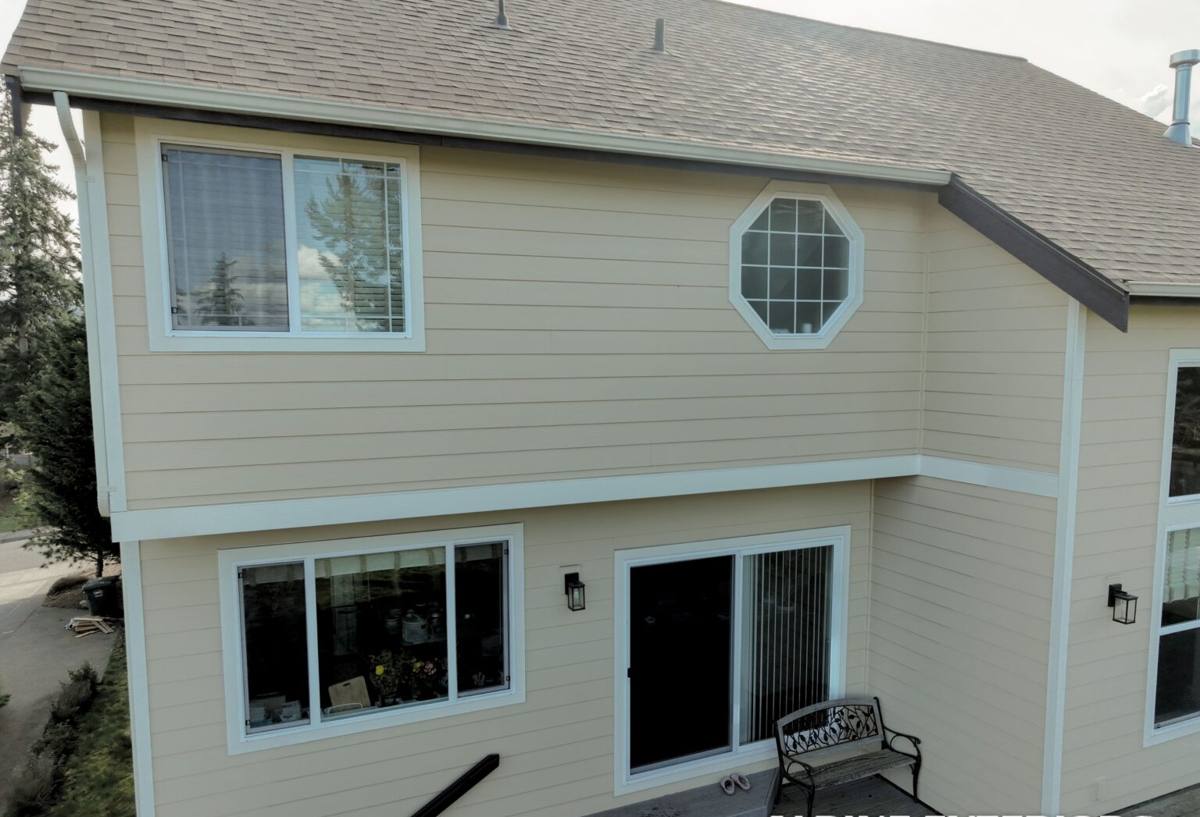
Signs a Samish Roof Is Past Repair
Most homeowners call us after a repair, not before one — and that's fine, repairs have their place. But there's a point where patching stops making financial sense. Some signs we look for during an inspection:
- Granule loss heavy enough that you can see bare shingle mat in multiple spots, not just one weathered patch
- Moss growth that has re-established within a year of cleaning, especially on north or shaded slopes
- Soft or spongy decking felt underfoot in the attic or discovered during a repair
- Rust staining or pitting on flashing, valleys, or exposed fasteners
- Daylight or water staining visible at the ridge, valleys, or around penetrations from inside the attic
- A roof already past or close to the end of its rated lifespan, with two or more of the issues above showing up together
One or two of these on their own often point to a targeted repair. Several at once, especially on a roof that's already 18-25+ years old (for asphalt shingle), usually means replacement is the more honest recommendation — and we'll tell you that directly rather than stack repairs on a roof that's done.
What a Correct Replacement Involves Here
A roof replacement done right in Samish isn't just "strip and re-shingle." Given the climate here, several steps matter more than they would in a drier region:
Full Tear-Off and Deck Inspection
We don't recommend overlaying new shingles on old ones, and we don't skip a full tear-off to save a day of labor. Once the old roofing is off, the deck gets inspected board by board. Any wood that's soft, delaminated, or water-stained from years of moss holding moisture against it gets replaced before anything new goes down. Covering over a compromised deck just moves the problem — and the cost — a few years down the road.
Underlayment and Ice/Water Protection
Given how much driving rain this area sees, we pay close attention to eaves, valleys, and any low-slope transition. A quality synthetic underlayment across the whole deck, with self-adhering ice-and-water membrane at eaves, valleys, and around penetrations, is the difference between a roof that sheds wind-driven rain and one that lets it wick back under the shingle edge.
Ventilation
Attic ventilation is often overlooked, but it directly affects how much moisture builds up under the roof deck — which in turn affects how fast moss and rot take hold from underneath. We check intake (soffit) and exhaust (ridge or roof vents) balance as part of every replacement, not as an upsell.
Flashing and Fasteners
Given the salt air, we use corrosion-resistant flashing and fasteners rather than the cheapest code-minimum option. This matters most at chimneys, skylights, valleys, and wall-to-roof transitions — the places where a roof actually fails first.
Moss-Conscious Details
We can't stop moss spores from landing on a roof — nothing installed correctly prevents that entirely. What we can do is reduce how aggressively moss takes hold: proper shingle sealing, attention to shaded slopes during layout, and honest advice on keeping overhanging branches trimmed back after the job is done.
Material Options for Samish Conditions
There's no single "best" roofing material for every Samish home — it depends on the roof's pitch, exposure, budget, and how the homeowner wants to handle long-term maintenance. Here's how the common options stack up against the specific conditions in this area:
| Material | Moss Resistance | Salt Air / Corrosion | Driving Rain Performance | Typical Lifespan |
|---|---|---|---|---|
| Asphalt composition shingle | Moderate — needs periodic cleaning on shaded slopes | Good with corrosion-resistant fasteners | Good when properly underlaid and sealed | 20-30 years |
| Architectural/laminate shingle | Moderate to good — heavier profile sheds debris better | Good with proper flashing | Very good — thicker mat handles wind-driven rain well | 25-35 years |
| Metal (standing seam or panel) | Excellent — moss struggles to root on a smooth metal surface | Requires marine-grade coatings/fasteners near the water | Excellent | 40-60+ years |
| Cedar shake | Poor without regular treatment — holds moisture and feeds moss | Fasteners need to be corrosion-resistant | Good but maintenance-dependent | 20-30 years with upkeep |
We install and stand behind asphalt and metal roofing as our primary recommendations for this region. We're generally cautious about cedar shake here specifically because of how much upkeep it demands to fight moss and moisture in a climate this wet — it's not that the material is bad, it's that the maintenance burden and moisture behavior don't line up well with a low-maintenance goal for most homeowners.
Cost Factors Homeowners Should Understand
We don't post fake per-square-foot numbers because every roof is different, but the real cost drivers on a Samish roof replacement are consistent:
- Roof size and number of planes — more valleys, dormers, and hips mean more labor and material
- Deck condition — rot discovered during tear-off adds material and labor that can't be known until the old roofing is off
- Material choice — asphalt shingle is generally the lower upfront cost; metal costs more upfront but less over its longer service life
- Pitch and access — steep or hard-to-access roofs take longer and require more safety setup
- Ventilation and flashing upgrades — bringing an older roof's ventilation up to a proper standard is worth the modest added cost
We walk through all of this with you during the estimate, in writing, before any work starts — no surprise change orders for anything we could have caught during inspection.
Our Process
Every Samish roof replacement we do follows the same sequence, whether it's a straightforward gable roof or something with multiple valleys and dormers:
- On-site inspection and honest assessment — repair vs. replace, with photos and explanation
- Written estimate covering material, labor, deck repair allowance, and timeline
- Material selection walkthrough, including trade-offs specific to this property's exposure and pitch
- Tear-off, deck inspection, and any necessary deck repair
- Underlayment, ice-and-water membrane, and ventilation work
- New roofing installation with attention to flashing, valleys, and fastener corrosion resistance
- Final walkthrough and cleanup — including magnetic sweep for stray fasteners
We keep the property protected throughout — landscaping, siding, and gutters covered where needed — and we clean up debris daily, not just at the end of the job.
Why a Crew That Already Works Samish Matters
A roofing crew that works this specific part of Whatcom County regularly already knows which slopes in a given neighborhood hold moss longest through the year, how much wind exposure a given orientation typically sees off the water, and which flashing and fastener specs actually hold up rather than just meeting minimum code. That local pattern recognition doesn't replace a proper inspection of your specific roof, but it does mean fewer surprises and a spec that's realistic for this climate from the first estimate, not adjusted after a problem shows up.
It also means accountability. A crew that's going to keep working in Samish for years has a reason to get the details right the first time — the moss-resistant details, the corrosion-resistant fasteners, the flashing that's sized for driving rain rather than a dry-climate default.
A Quick Homeowner Checklist
Before you decide between repair and full replacement, it's worth walking your own roof through this list:
- Age of the current roof and what material it is
- Whether moss has come back within a year of any past cleaning
- Any staining or daylight visible from inside the attic
- Condition of flashing around chimneys, skylights, and valleys
- How the roof performed in the last major windstorm — any lifted or missing shingles
- Whether gutters and downspouts are keeping up with heavy rain, or overflowing
If several of these raise questions, it's worth getting an inspection before the next wet season rather than after a leak shows up.
If you're weighing repair against replacement, or just want a straight answer on how much life is left in your roof, we're happy to take a look. The estimate is free, there's no pressure attached to it, and you can use the form below to get started.