 Whatcom County
 South Hill's Deck Problem: Rain, Salt Air, and Shade
South Hill sits above Bellingham Bay, which is a great spot for a deck and a hard spot to keep one in good shape. Homes up here catch salt-laden air off the water, long stretches of driving rain through fall and winter, and — because so many lots have mature trees and north-facing slopes — a moss season that can run half the year. Put those three together on a wood deck and you get soft boards, black streaking, and slick spots by the second or third winter, even with regular staining.
Composite decking was built for exactly this combination. It doesn't absorb water the way wood does, it doesn't feed mold and algae the way untreated lumber can, and it holds its color and surface texture through repeated wet-dry cycles. That said, "composite" isn't one product — the boards, the substructure underneath them, and the way they're installed all matter more here than they would in a drier climate. This page is about doing that job right on a South Hill property specifically, not composite decking in general.
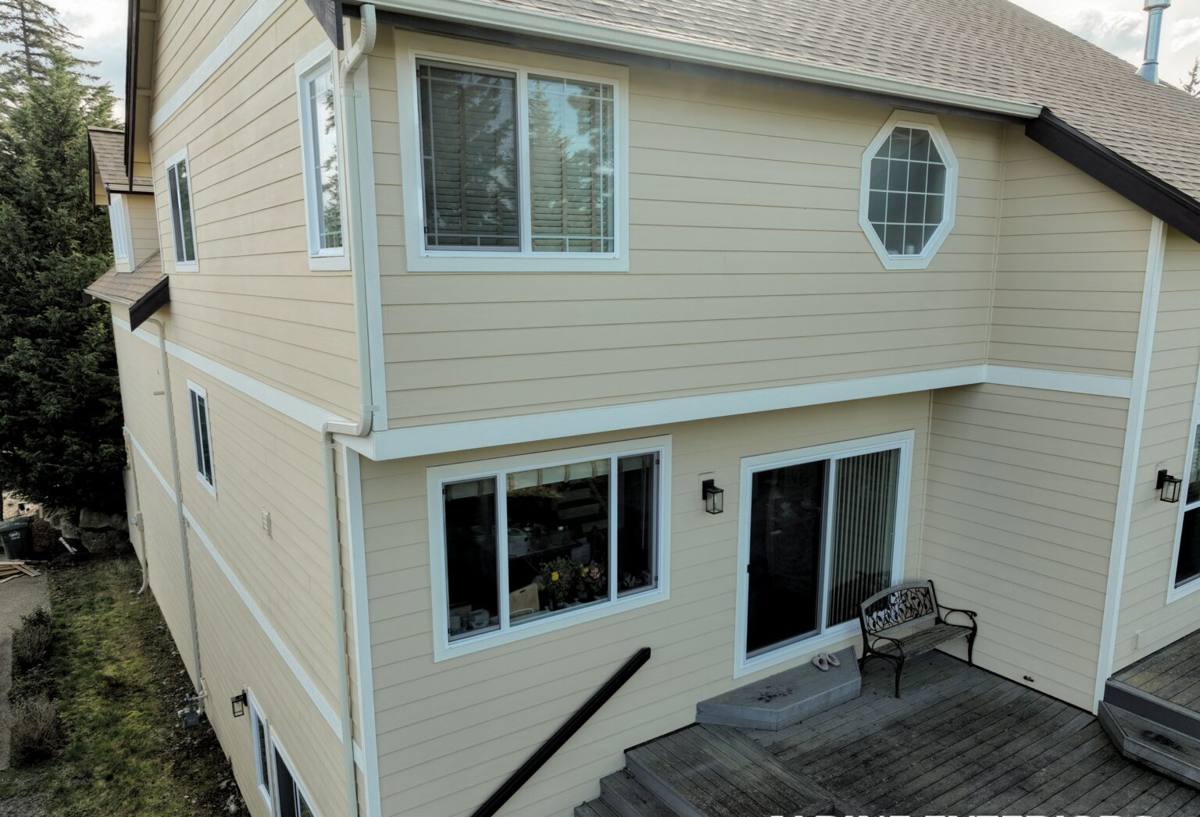
Why Composite Makes Sense for This Neighborhood
We install wood decks too, and for some homeowners a cedar deck is still the right call — it's less expensive up front and some people genuinely prefer the look and the ritual of maintaining it. But for South Hill's climate, composite solves problems that wood can't:
Moisture and Rot
Whatcom County gets sustained rain, not just occasional storms. Wood decking that isn't stripped, sanded, and resealed on schedule starts absorbing water at the fastener holes and board ends first — which is exactly where you can't see it happening until the boards start to cup or soften.
Salt Air
Homes closer to the bay deal with airborne salt that accelerates corrosion on fasteners and hardware and dries out wood surfaces faster than inland lots. Composite boards themselves don't corrode, but this is exactly why the fasteners, brackets, and ledger hardware we use matter as much as the decking material — more on that below.
Moss and Algae
Shaded, north-facing, or tree-covered sections of a deck are where moss gets a foothold first. It's a surface-level problem on composite (a stiff brush and deck wash handle it) but a structural one on wood, where trapped moisture under a moss mat is what actually starts the rot.
What a Correct Composite Deck Build Involves
The board itself is maybe half the job. The other half — the part that determines whether the deck is still tight and dry in ten years — is underneath it.
- Joist protection: Composite manufacturers void warranties over rotted joists just as fast as wood decking does. We wrap or tape the tops of joists so the substructure isn't sitting in standing moisture under the boards.
- Proper ventilation: Composite decking needs airflow underneath to shed the moisture that inevitably gets between and under boards during a Whatcom County winter. Low-clearance or boxed-in framing traps humidity and shortens the life of everything under the decking.
- Ledger flashing: On older South Hill homes, the ledger board attachment to the house is a common point where water has already been finding its way in for years. We check and correct this flashing as part of any deck replacement — it's not an upsell, it's the difference between a dry rim joist and a rotted one.
- Fastener and bracket grade: Given the salt air here, we use fasteners and structural hardware rated for coastal or high-corrosion exposure, not standard interior-grade hardware.
- Hidden fastening systems: Most composite lines are designed for hidden clips rather than face screws. Done correctly this gives a cleaner surface and eliminates the screw-hole water entry points that plague older wood decks.
Hillside and View Lots: What's Different
A lot of South Hill properties are built on a slope, often with the deck cantilevered or elevated to catch a view of the bay. That changes the job in a few practical ways:
Structural Support
Elevated decks carry more wind load and more weight per footing than a ground-level patio deck. Footing depth and post spacing need to be sized for the actual height and exposure, not just code minimums for a flat lot.
Railings
Any deck more than 30 inches off grade needs a code-compliant guard rail, and on a view lot most homeowners want that railing to disappear rather than block the view. Cable rail and glass-panel systems both do that well, but they cost more and need to be planned into the budget from the start, not added on afterward.
Drainage Off the Slope
Hillside lots concentrate runoff. Where a deck sits over grade that slopes toward the house foundation, we address drainage under and around the structure as part of the build — not as a separate problem to deal with later.
Comparing Your Decking Options
Homeowners considering a deck replacement usually land on one of three paths. Here's an honest comparison for a wet, shaded, salt-air climate like South Hill's — not a sales pitch for any one product.
| Material | Upfront Cost | Maintenance | How It Handles This Climate |
|---|---|---|---|
| Pressure-treated wood | Lowest | Annual cleaning, periodic stain/seal | Prone to moss, splitting, and rot without consistent upkeep |
| Cedar | Moderate | Regular stain/seal, moss treatment | Better rot resistance than treated pine but still needs real maintenance in constant rain |
| Capped composite | Higher | Occasional washing | Resists moisture absorption and moss staining well; strong fit for this area |
| PVC decking | Highest | Occasional washing | Fully moisture-proof board, but higher cost and a different look/feel underfoot |
Most South Hill projects we do land on capped composite — it's the point where cost, low maintenance, and moisture performance line up best for this climate. Broadly, and every job varies with substructure condition and railing scope, composite deck replacements here tend to fall in the range of $30–$60 per square foot installed. Hillside footings, extensive railing, or a full ledger and framing rebuild can push a project above that.
Our Process
We keep this simple and we don't skip steps to hit a lower number on a quote:
- On-site assessment: We look at the existing deck or bare ledger area, check the framing and ledger condition, and note slope, drainage, and sun/shade exposure.
- Straightforward proposal: You get a written scope covering board selection, substructure work, railing, and fastener grade — not just a square-footage number.
- Framing and flashing first: Any rot, undersized framing, or bad ledger flashing gets corrected before a single composite board goes down.
- Installation: Boards, hidden fasteners, and railings go in to manufacturer spec, which is also what keeps the material warranty valid.
- Final walkthrough: We go over basic care with you before we consider the job done.
Living With Composite Decking in a Mossy Climate
Composite is low-maintenance, not no-maintenance — especially under trees or on shaded, north-facing sections common on South Hill lots. A simple seasonal routine keeps it looking right:
- Sweep off fallen leaves and debris regularly through fall — trapped organic matter is what feeds moss and algae growth on any surface, composite included.
- Rinse the deck and scrub shaded areas with a stiff-bristle brush and a mild deck cleaner once or twice a year, more often on heavily shaded sections.
- Keep gutters and downspouts near the deck clear so runoff isn't sheeting across the boards during heavy Whatcom County rain.
- Check railing hardware and fastener points annually for any sign of corrosion, particularly on decks closer to the bay.
- Avoid pressure-washing at close range or high PSI — it can strip the cap layer's texture over time even though the boards won't rot.
Why a Crew That Already Works South Hill Matters
A lot of decking problems on this hill aren't decking problems at all — they're framing, flashing, and drainage problems that show up as decking symptoms. A crew that's worked on South Hill's older homes and hillside lots before knows to check the ledger flashing without being asked, sizes footings for real wind exposure instead of flat-lot code minimums, and doesn't get surprised by a slope or a drainage path that a generic quote wouldn't have accounted for. That experience shows up as fewer change orders mid-project and a deck that's still solid a decade from now, not just a lower number on the initial estimate.
If you're weighing a deck replacement or a first-time build on a South Hill property, we're glad to come take a look, walk you through what your specific lot needs, and give you a straight, no-pressure estimate. There's a form below to get that started.