 Whatcom County
 New-Construction Windows in Silver Beach: A Different Job Than a Replacement
Building new on Bellingham Bay near Silver Beach means the windows go in before the siding, before the trim, and often before the house has weathered its first real storm. That's a different job than swapping out an old window in a finished wall. New-construction windows have a nailing flange that ties directly into the wall's weather-resistive barrier (WRB), and the flashing sequence around that flange is what keeps water out of the wall cavity for the next thirty or forty years. Get it right at framing stage and it's invisible. Get it wrong and you won't know until there's rot in the sheathing, usually a few years down the road when it's expensive to fix.
Silver Beach sits close enough to the water that homes here take a harder hit from wind-driven rain and salt-laden air than a build a few miles inland in Whatcom County. That doesn't change what a correct window install looks like on paper, but it raises the stakes for doing every step the same way, every time, on every opening.
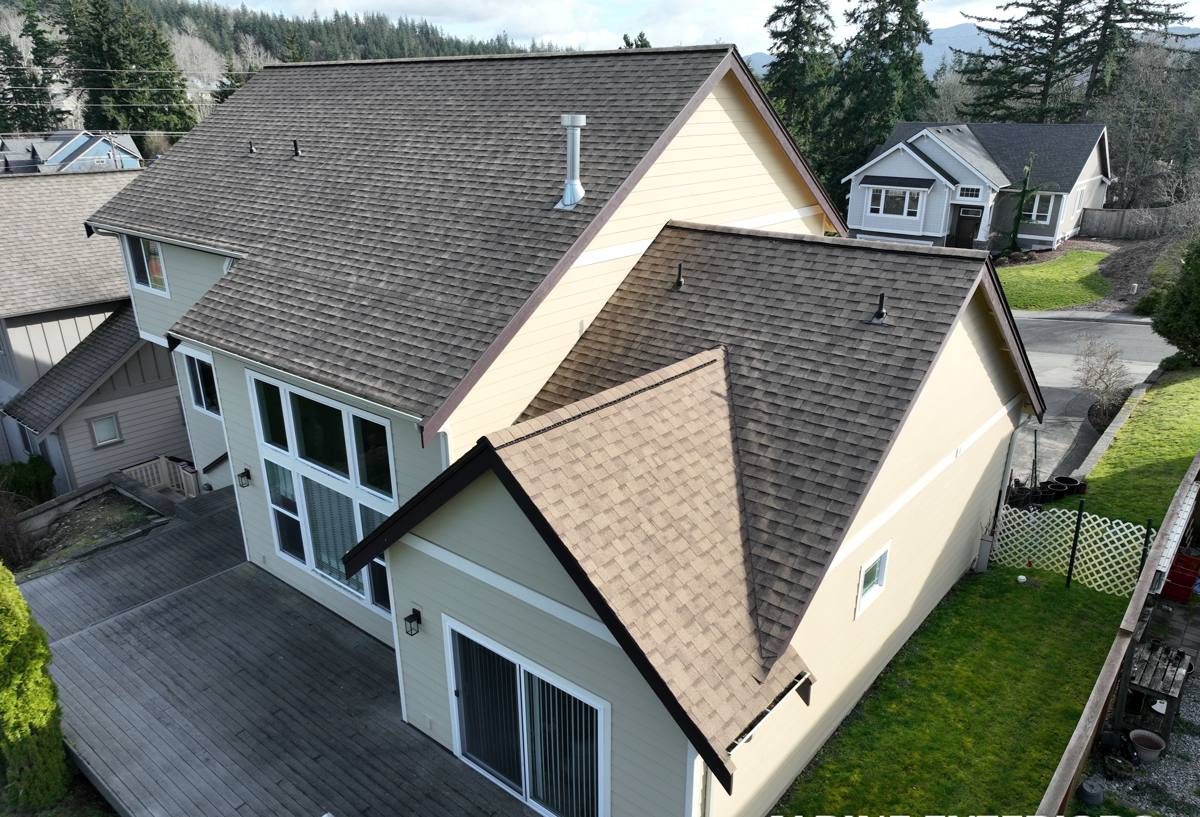
What Whatcom County's Climate Asks of a New Window Install
Salt Air and Corrosion
Proximity to Bellingham Bay means airborne salt reaches fasteners, flashing metal, and hardware faster than it would inland. Galvanized or plain steel fasteners and trim pieces will show rust well before their expected life is up. We spec corrosion-resistant fasteners and flashing components for shoreline-adjacent builds, and we pay attention to which window hardware finishes hold up under salt exposure versus which ones chalk and pit.
Wind-Driven Rain and Flashing
Storms coming off the water don't just fall straight down — they push rain sideways into wall assemblies, which puts real pressure on head flashing and the WRB integration around every rough opening. A flashing detail that would be adequate on a sheltered inland lot can be marginal on an exposed Silver Beach elevation. That's a call we make on site, opening by opening, based on which walls face the water and prevailing weather.
Moss Season and Long-Term Drainage
Whatcom County's wet season runs long, and moss and algae take hold on north-facing and shaded surfaces for much of the year. On windows, that shows up as growth in sill tracks, weep holes, and the bottom of exterior trim if drainage paths aren't kept clear. It's not a structural problem on its own, but clogged weep holes turn a well-flashed window into one that holds water against the sill — which is a structural problem eventually. We design and install with drainage paths that stay clear, and we tell builders and homeowners what to check on their own once the house is finished.
What a Correct New-Construction Installation Actually Involves
The Flashing Sequence
Every rough opening gets a sill pan flashing to catch and direct out any water that gets past the window itself — this is the single most important detail in the whole install and the one most often skipped or done half-heartedly on production builds. From there, flashing tape or a compatible membrane laps in shingle-fashion: sill first, then jambs, then head, each layer overlapping the one below it so water is always directed outward and down, never trapped behind a lap.
Sealing and Insulating Without Trapping Moisture
The gap between the window frame and rough opening gets sealed on the exterior with a compatible sealant and insulated on the interior with a low-expansion foam or backer rod and sealant — never packed solid with a high-expansion foam that can bow the frame. The goal is an airtight, insulated gap that still allows any incidental moisture to drain rather than sit.
Fastening, Shimming, and Alignment
The window gets shimmed plumb, level, and square before a single fastener goes through the nailing flange, then fastened at every location the manufacturer specifies — skipping fastener points to save time is a common shortcut that shows up later as air leaks or operational problems with the sash. On a new build we also confirm rough opening sizing before the window ever arrives, so there's no field-cutting or improvising that compromises the flashing plane.
Choosing the Right Window for a Silver Beach Build
Material choice matters more on an exposed, salt-air site than it does a few miles inland. Here's how the common options compare for a new build in this kind of location:
| Material | How it handles salt air & moisture | Maintenance | Typical fit |
|---|---|---|---|
| Vinyl | Good — won't corrode or rot; UV-stable frames hold up well | Low — occasional cleaning | Most cost-conscious new builds |
| Fiberglass | Very good — dimensionally stable, resists warping and corrosion | Low | Larger openings, energy-code-driven builds |
| Wood-clad | Depends heavily on cladding integrity and joinery — a compromised clad joint lets moisture into the wood core | Higher — clad joints need periodic inspection | Homes prioritizing interior wood aesthetics |
| Aluminum | Conducts cold and can corrode without a quality finish; less common in this climate | Moderate | Specific architectural or commercial applications |
We install vinyl and fiberglass on the large majority of Whatcom County new-construction jobs because they hold up on shoreline-exposed lots with the least long-term maintenance. Wood-clad windows can work well too, but the installation has to protect every clad joint and end cut from the start, since that's where moisture problems begin.
Glazing for a Marine Climate
Double-pane, low-E glass with argon fill is the baseline that makes sense for almost every Whatcom County build, and it's what's needed to meet Washington's energy code on most projects. On west- or water-facing elevations that take direct wind and glare off the bay, we'll talk through whether a different low-E coating or a triple-pane upgrade is worth it for that specific exposure — it's not automatic on every opening, and we'd rather tell you honestly where it does and doesn't pay off than upsell every window in the house.
Our Process, Start to Finish
- Plan review and rough opening check. We confirm window schedule, sizes, and swing/operation against the plans before anything ships, and verify rough openings on site once framing is up.
- Coordination with the builder's schedule. Windows go in after the WRB is on and before siding starts — we work around the general contractor's sequence, not against it.
- Sill pan and flashing installation. Sill pan first, then jamb and head flashing in proper shingle-lap order, integrated into the WRB.
- Setting, shimming, and fastening. Plumb, level, square, fastened at every specified point.
- Sealing and insulating. Exterior sealant, interior low-expansion foam or backer rod, with attention to keeping drainage paths open.
- Final check. Operation, weep holes, and flashing laps confirmed before we sign off, so nothing is hidden behind siding that needs a second look.
What Drives Cost on a New-Construction Window Job
| Factor | Why it moves the price |
|---|---|
| Number and size of openings | More glass and larger units mean more material and labor per opening |
| Material (vinyl vs. fiberglass vs. wood-clad) | Fiberglass and wood-clad units cost more than vinyl for a comparable size |
| Glazing package | Upgraded low-E coatings or triple-pane glass add cost per unit |
| Story height and access | Upper-floor and hard-to-reach openings take more time and staging |
| Flashing complexity on exposed elevations | Water- and wind-facing walls sometimes warrant extra flashing detail |
| Custom shapes or sizes | Non-standard openings cost more than stock sizes and lead times run longer |
Most Whatcom County new-construction window packages land in a broad middle range once you account for these factors — we'll walk through actual numbers once we know the window schedule and count, rather than quoting a figure that doesn't mean much without seeing the plans.
A Pre-Drywall Checklist Worth Running
Whether we installed the windows or another crew did, this is worth confirming before the walls close up:
- Sill pan flashing is present and visible at every opening, not just caulk in its place
- Head, jamb, and sill flashing overlap in the correct shingle-lap order (sill under jamb under head)
- Flashing ties into the WRB with no gaps or reverse laps that could direct water inward
- Fasteners at the nailing flange are corrosion-resistant, especially on water-facing walls
- Windows are shimmed square with no visible racking or binding when operated
- Interior gap is insulated with low-expansion foam or backer rod, not packed solid
- Weep holes and sill tracks are clear and unobstructed
Why a Crew That Already Works Silver Beach Makes a Difference
New-construction window installation isn't complicated in theory — it's a sequence, and every step of that sequence matters. What changes site to site is exposure: how much wind-driven rain a given elevation takes, how much salt air reaches the fasteners, how long moss season keeps drainage paths under pressure. A crew that's worked other Silver Beach and broader Whatcom County builds has already seen which elevations need extra attention to flashing and which material choices actually hold up here, rather than learning that on your house. We also know how to work inside a general contractor's schedule without becoming the trade that holds up the siding crew, which matters on any build with a timeline.
If you're framing a new home in Silver Beach or planning one, we're glad to walk through the window schedule with you and give you a straightforward, no-pressure estimate — just fill out the form below to get started.