 Whatcom County
 Why Ferndale Siding Wears Differently Than Siding Inland
Ferndale sits close enough to open saltwater that homes here deal with a combination most inland Washington towns don't have to think about: salt-laden marine air, long stretches of driving rain blowing in off the water, and a moss season that can run from early fall clear into late spring. None of those three things is dramatic on its own. Together, over years, they're what turns a small siding problem into a bigger one.
Salt air accelerates corrosion on fasteners, flashing, and any exposed metal trim. Driving rain — rain that comes in sideways rather than straight down — finds every gap in caulking, every open seam, and every spot where siding wasn't lapped correctly, and pushes water behind the cladding instead of over it. And moss doesn't just sit on the surface looking bad; it holds moisture against the siding and trim for weeks at a time, which is exactly the condition that causes rot, delamination, and paint failure. A repair strategy that ignores any one of these three factors tends to fail again within a few years.
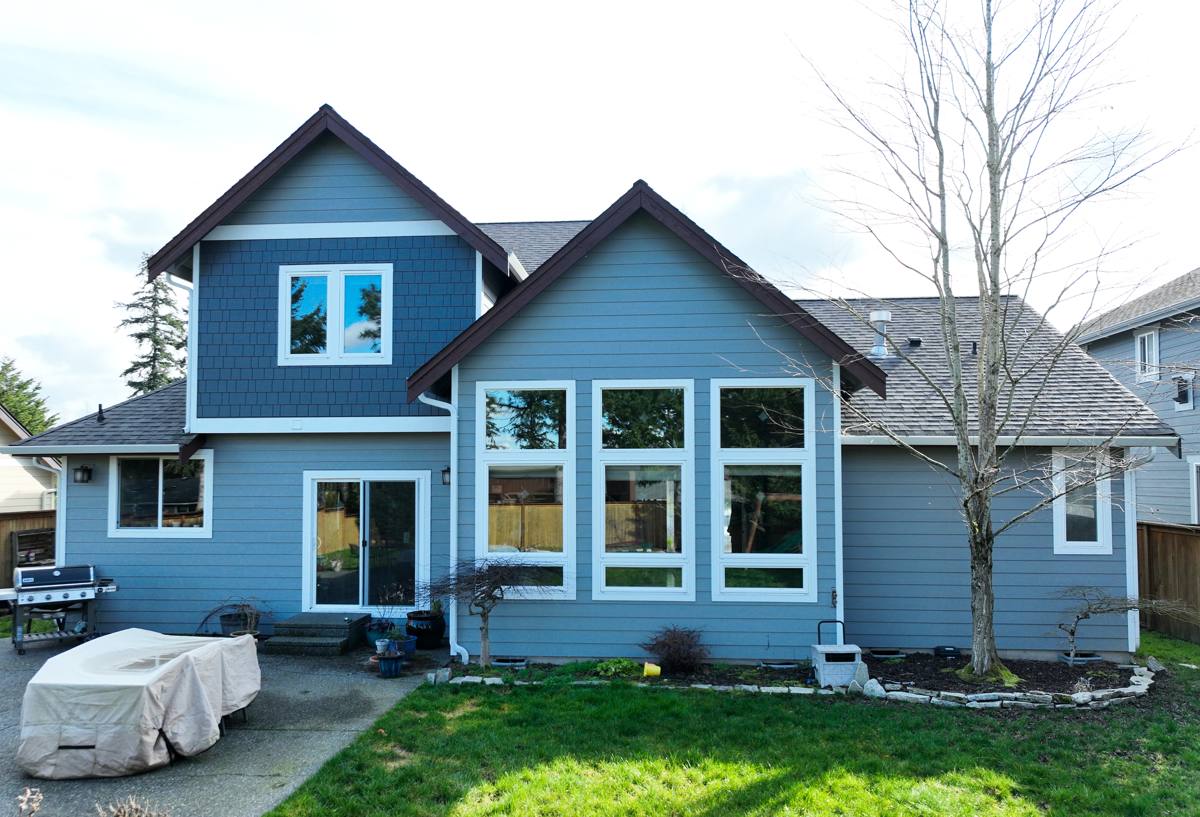
Signs Your Siding Needs Repair, Not Just a Repaint
Homeowners often call about a "paint problem" that turns out to be a moisture problem. Knowing the difference before you hire someone saves time and money.
Moisture Damage
Soft spots, bubbling, staining below seams, or a slightly swollen look to a board are signs water has already gotten behind the siding. Paint alone won't fix this — the damaged material has to come out.
Moss and Algae Growth
Green or black growth on the north side of a house, under eaves, or near tree cover is common in this climate and isn't automatically a red flag. But moss that's established itself in seams or at butt joints, rather than just on the face of the siding, usually means water is sitting there longer than it should.
Impact and Wildlife Damage
Cracked boards from debris, ladders, or falling branches, and pecked or gouged areas from woodpeckers, need to be addressed before the opening lets water in behind the siding — this is a very common repair call in wooded and semi-rural parts of the county.
Caulk and Trim Failures
Cracked or shrunken caulk at trim boards, window returns, and butt joints is one of the first things to fail under repeated wet-dry cycling. It's an easy fix when caught early and a source of hidden rot when it isn't.
What a Correct Siding Repair Actually Involves
Diagnosing the Cause, Not Just the Symptom
Replacing a damaged board without figuring out why it failed just buys a few years before the same spot fails again. A proper repair starts with finding the actual water path — a missing kick-out flashing, a caulk joint that opened up, a downspout dumping water against the wall, or siding that was installed too close to grade or a deck surface.
Matching Material and Finish
A patch that doesn't match the surrounding siding in profile, reveal, or color sticks out and telegraphs that the house has had "repair work" done — which can matter at resale. Getting a clean match means using compatible material and, where the existing siding is prefinished, matching that finish rather than field-painting a mismatched patch.
Sealing and Flashing Detail
The visible board is only part of the job. Housewrap or building paper behind the repair, correct flashing above openings and at horizontal joints, and proper fastener placement all matter more than the patch itself in a climate that gets this much wind-driven rain.
Repair vs. Replacement: How We Make That Call
Not every damaged section needs a full re-side, and not every "small repair" request is actually small once the wall is opened up. Here's generally how the decision plays out:
| Situation | Typical Approach | Why |
|---|---|---|
| Isolated impact damage or a woodpecker hole on otherwise sound siding | Targeted board replacement | Surrounding material and structure are still in good condition |
| Rot at one or two corners or butt joints from a specific water path | Cut back to sound material, fix the water source, replace affected boards | Addresses the cause, not just the visible damage |
| Recurring rot in the same areas after prior patch work | Wider section replacement, sometimes a full elevation | Repeated failure usually means the underlying system, not just the board, has failed |
| Widespread moss, staining, and soft spots across multiple walls | Full re-side discussion | Patching a house-wide moisture problem piecemeal rarely holds up long-term |
Our Process for Ferndale Siding Repairs
- Inspection and moisture check: We look at the damaged area and the ones around it, and probe suspect spots to see how far the water has actually traveled.
- Scope and explanation: You get a plain-language explanation of what's actually wrong, what it will take to fix it correctly, and what it would cost to do it the cheaper, less thorough way — so you can make an informed call.
- Removal back to sound material: We don't stop at the visibly damaged board if the rot or moisture has traveled further.
- Correcting the water path: Flashing, caulking, grading, or drainage issues get fixed as part of the repair, not left for next time.
- Replacement and finish match: New material is installed to match the existing siding's reveal and profile as closely as possible, with attention to color match where the original is factory-finished.
- Final seal and cleanup: Joints, penetrations, and trim returns get properly sealed before we call it done.
Why We Only Repair With — and Recommend — James Hardie Fiber Cement
We install James Hardie fiber cement exclusively, and that shapes how we handle repairs too. When the existing siding on a Ferndale home is already Hardie, repairs are straightforward: we can replace damaged boards with the same product line and, where the original was a factory ColorPlus finish, get a close color match without repainting the whole wall.
When a home has vinyl, LP SmartSide, cedar, or another material and needs repair, we'll still assess it honestly. Sometimes a like-for-like patch is the right, most economical answer for a one-off issue. But if a homeowner is on their second or third round of repairs to the same wood siding, or a vinyl section keeps cracking and warping in the wind and sun exposure this area gets, we'll say so plainly rather than quietly patching it again. Wood siding needs ongoing paint and caulk maintenance to hold up against this much driving rain and moss pressure; vinyl can crack in cold snaps and fade or warp with sun and heat cycling; the composite wood products in this category are more moisture-sensitive at cut edges and butt joints than fiber cement. None of that means those products are junk — plenty of them perform fine when maintained — it's why, when a homeowner is past the point where more patching makes sense, we recommend transitioning that section, or eventually the whole house, to non-combustible fiber cement with a factory finish that isn't relying on repeated repainting to survive this climate.
Why Hiring a Crew That Already Works in Ferndale Matters
Siding repair looks simple from the ground, but a lot of the judgment calls — how far back to cut damaged material, how much flashing correction is actually needed, whether a caulk failure is cosmetic or a sign of something behind it — come from having already worked on a lot of houses in this specific climate. A crew that mostly works drier, inland regions can underestimate how much wind-driven rain and moss pressure a Whatcom County exterior actually takes over a winter. Knowing the local weather pattern, the kinds of failures that show up on homes near saltwater exposure, and how long moss season really runs here changes how a repair gets scoped and sequenced around the weather.
Homeowner Checklist: Is It Time to Call for a Repair?
- Soft, spongy, or slightly swollen boards anywhere on the exterior
- Paint that's bubbling or peeling in the same spot repeatedly, even after repainting
- Moss or algae established inside seams or joints, not just on the surface
- Visible daylight, gaps, or cracked caulk at trim, corners, or butt joints
- Staining or streaking below a seam or window that shows up after heavy rain
- Cracked, split, or impact-damaged boards from debris or wildlife
- A musty smell or visible staining on interior walls that back onto exterior siding
If more than one or two of these sound familiar, it's worth having someone look at it before another wet Whatcom County winter makes the repair bigger than it needs to be.
Get a Straight Answer Before Winter
Every repair call starts the same way: an honest look at what's actually going on, not an upsell. If your home needs a small patch, we'll say so. If the damage points to something larger, we'll explain why and lay out the options plainly. Reach out for a free, no-pressure estimate on siding repair for your Ferndale home — the form below gets you started.