 Whatcom County
 Why Siding Fails Faster in Columbia Than It Does Inland
Homes in the Columbia area sit inside a Pacific Northwest marine climate, and that climate is genuinely hard on exterior building materials. Salt-laden air off the water, long stretches of driving rain, and a moss and algae season that can run most of the year all attack siding in different ways. Salt air accelerates corrosion of fasteners and metal trim. Wind-driven rain finds every gap in flashing and caulking and pushes water sideways, not just down. And moss doesn't just sit on the surface — its root structure holds moisture against the wall, which is exactly the condition that rots wood-based products and lets paint fail early.
None of this means siding in Columbia is doomed to fail. It means the material and the installation both have to be chosen for these conditions, not for a drier or milder climate. A lot of the siding problems we get called out to look at in Whatcom County aren't failures of a bad product so much as a mismatch between the product, the install detailing, and what the local weather actually does to a wall over ten or twenty years.
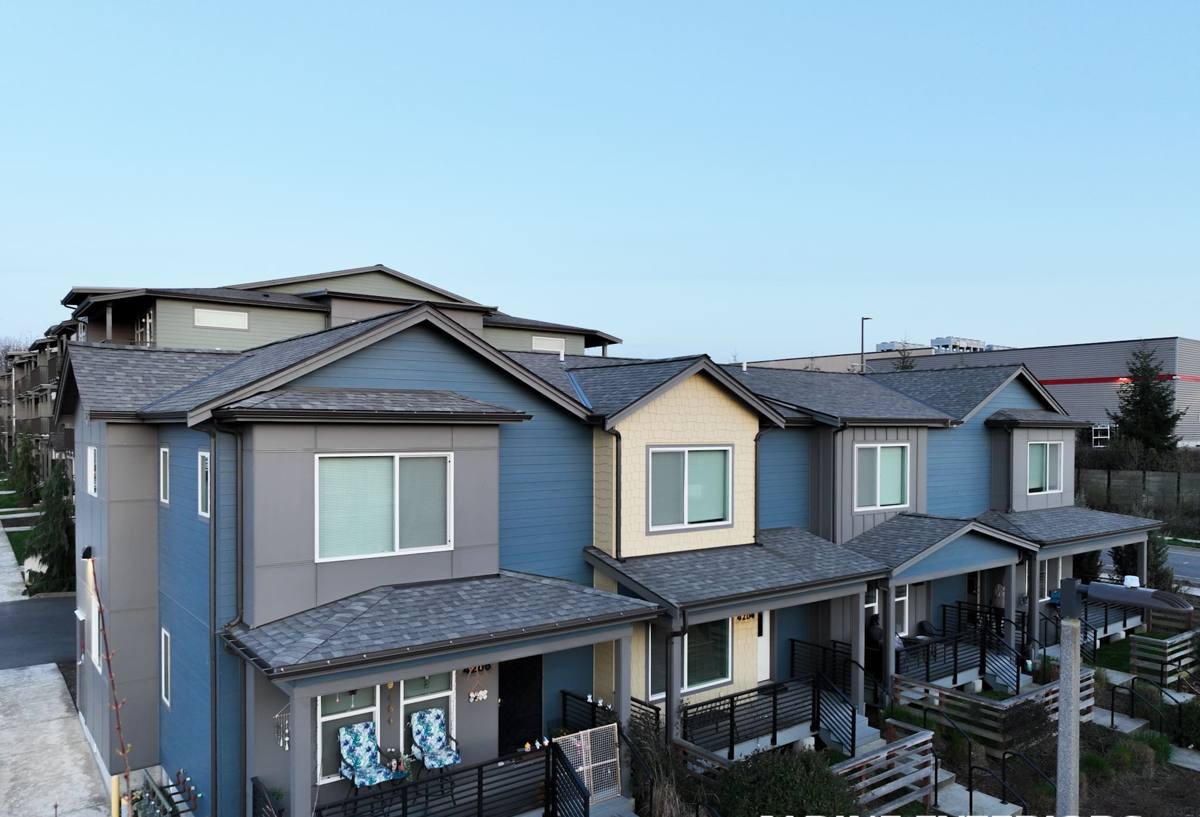
What a Correct Siding Installation Actually Involves
Siding installation is often talked about like it's a cosmetic job — panels go up, house looks new. In a climate like this, the visible siding is really the last layer of a moisture management system. If the layers underneath aren't done right, the new siding will look great for a year or two and then start showing the same problems as what it replaced.
The parts homeowners don't see
- A continuous, properly lapped weather-resistive barrier (housewrap) behind the siding
- Correct flashing at every window, door, deck ledger, and roof-to-wall intersection
- A drainage plane or rainscreen gap that lets any water that gets behind the siding drain and dry out instead of sitting against the wall sheathing
- Fasteners placed at the manufacturer's specified pattern and depth — not just "close enough"
- Correct joint treatment and gapping so panels can move with humidity and temperature without cracking caulk or paint
Skip or rush any one of these steps and you can end up with siding that looks correct from the curb but is trapping moisture behind it. In a wetter climate like Whatcom County's, that hidden moisture problem shows up faster than it would in a drier region — sometimes in as little as a few years.
Why We Install James Hardie Fiber Cement — and Nothing Else
We made a deliberate decision to install only James Hardie fiber cement siding, and we don't install vinyl, LP SmartSide, Cemplank, Allura, primed spruce, or cedar. That's not a marketing line — it's a standard we hold to because of what we've seen these products do, and not do, in this specific climate over time.
Vinyl siding is inexpensive and low-maintenance in mild, dry climates, but it expands and contracts a lot with temperature swings, and driving rain can push moisture behind and around panels more easily than with a rigid, properly flashed fiber cement wall. Wood-based products, including engineered wood siding and traditional cedar, perform well when maintained aggressively, but in a climate with a long moss and algae season, that maintenance burden is real and ongoing — the products need repainting, caulking, and moisture vigilance on a schedule most homeowners can't realistically keep up with for 20-plus years. Cedar in particular looks excellent new but requires the most consistent upkeep of any option to avoid rot, cupping, and insect damage in a wet marine climate.
James Hardie fiber cement is non-combustible, doesn't expand and contract the way vinyl does, holds paint and factory finish far longer than wood products, and is engineered in specific product lines (the HZ5 line, built for climates like ours) for exactly the freeze-thaw, moisture, and humidity conditions Whatcom County sees. The factory-applied ColorPlus finish is baked on under controlled conditions, which gives it a more consistent, longer-lasting bond than field-applied paint on wood siding. It's also backed by a strong, transferable warranty, which matters if you sell the home before the siding's functional life is up.
None of this means the products we don't install are junk — they all have legitimate uses and loyal customers. It means that for the specific combination of salt air, sustained rain, and moss pressure that Columbia homes deal with, we decided fiber cement is the only product we're willing to put our name behind long-term.
Signs Your Columbia Home's Siding Needs Attention
Whatcom County's climate tends to show siding problems in specific, recognizable ways. Before you assume a full replacement is needed, it's worth knowing what to actually look for:
- Soft or spongy spots when you press on siding, especially near the bottom courses or under windows
- Visible moss or dark algae streaking, particularly on north- and west-facing walls that get less direct sun
- Paint that's peeling, bubbling, or chalking heavily rather than just fading
- Gaps opening up at seams, corners, or where trim meets siding
- Warping, cupping, or bowing panels, common on wood-based products after repeated wet-dry cycles
- Rust streaks below fasteners or trim, a sign of corroding metal in a salt-air environment
- Musty smells or visible staining on interior walls that back up to exterior siding
Some of these are cosmetic and can wait. Soft spots, interior staining, and heavy paint failure usually mean moisture has already gotten past the siding and into the wall assembly, which is worth having assessed sooner rather than later.
Comparing Siding Options for Whatcom County's Climate
We only install James Hardie, but homeowners deserve an honest picture of how the common options actually compare under local conditions — not just on price.
| Factor | James Hardie Fiber Cement | Vinyl | Cedar / Wood | Engineered Wood (LP-type) |
|---|---|---|---|---|
| Moisture/moss resistance | High — non-organic, won't rot | Moderate — can trap moisture behind panels | Low without diligent upkeep | Moderate — treated but still wood-based |
| Salt air / corrosion exposure | Handles well; use compatible fasteners/trim | Panels tolerant; trim and fasteners still at risk | Fasteners and hardware at risk over time | Similar exposure risk as other wood products |
| Maintenance burden | Low — factory finish holds for years | Low, but limited repair options if damaged | High — regular painting/sealing needed | Moderate to high |
| Fire resistance | Non-combustible | Melts/deforms under heat | Combustible | Combustible |
| Typical warranty structure | Long-term, transferable | Varies, often prorated | Manufacturer warranty limited; upkeep-dependent | Manufacturer warranty; installation-sensitive |
The pattern that matters most for this specific area is the combination of moisture resistance and low ongoing maintenance — the two factors that determine how a product actually holds up through a long Whatcom County wet season, year after year, without the homeowner having to stay on top of it constantly.
Our Installation Process for Columbia Homes
The steps themselves aren't unique to us, but the level of attention at each one is where quality installs are won or lost, especially in a climate this unforgiving of shortcuts.
- Assessment and measurement — we look at the existing wall assembly, note problem areas (moss buildup, past water intrusion, damaged sheathing), and measure for material.
- Removal and substrate check — old siding comes off and we inspect the sheathing underneath for rot or soft spots before anything new goes up. Hidden damage gets addressed here, not covered over.
- Weather-resistive barrier and flashing — housewrap is installed and lapped correctly, and flashing is set at every penetration and transition.
- Furring or rainscreen application where called for — creating a drainage gap behind the siding so any incidental moisture can drain and dry rather than sit against the wall.
- Hardie panel, plank, or trim installation — installed to James Hardie's fastening and clearance specifications, which is what keeps the manufacturer's warranty intact.
- Joint and trim detailing — caulking, corner treatment, and touch-up painting done to match the ColorPlus finish where field-cutting exposes raw edges.
- Final walkthrough and cleanup — checking reveals, fastener lines, and finish quality before we consider the job done.
We don't skip the substrate check to save time. In a wet climate, siding installed over hidden rot just relocates the problem a few years down the road, and it's far more expensive to fix once new siding is covering it.
Living With Moss and Salt Air After Installation
Even correctly installed fiber cement siding benefits from some basic upkeep in this climate. Rinsing down siding once or twice a year, especially on shaded north-facing walls, keeps moss and algae from getting a foothold. Keeping gutters clear prevents overflow from running down and staining siding or saturating trim. Trimming back vegetation that shades a wall or holds moisture against it goes a long way too. None of this is the heavy maintenance that wood siding demands — it's routine upkeep, not restoration work — but a little attention keeps the finish looking like it did on install day for far longer.
Why a Crew That Already Works in Columbia Matters
Siding installation done to spec anywhere is a technical job. Doing it correctly in Whatcom County means understanding how the local combination of rainfall volume, wind direction, humidity, and moss pressure actually behaves against a wall over time — not just following a generic install manual. A crew that regularly works in and around Columbia has already seen which wall orientations collect the most moss, where driving rain tends to find weak flashing details, and what the county's permitting and inspection process expects for exterior work. That local pattern recognition is what keeps a job from looking right on installation day but failing quietly over the next few winters.
If you're weighing a siding project on a Columbia home, we're glad to take a look and walk you through what we're seeing and why. Reach out for a free, no-pressure estimate — there's no obligation, and you'll get a straight answer about what your home actually needs.