 Whatcom County
 Metal Roofing in Sehome: A Material Suited to a Demanding Climate
Sehome sits on the hillside above downtown Bellingham, close to Sehome Hill and its wooded arboretum, and near enough to Bellingham Bay that salt-bearing marine air reaches homes throughout the neighborhood, not just the properties with a direct water view. It's a mixed setting — older homes on tree-lined streets alongside newer construction closer to Western Washington University — but nearly every roof in the area deals with the same combination of conditions: salt air moving in off the bay, rain that regularly comes in sideways rather than straight down, and shaded sections that hold moisture for most of the year under mature tree canopy. That combination is tough on roofing, and it's tougher on some materials than others.
Metal roofing holds up well against that mix when it's specified and installed with Sehome's conditions in mind. A smooth panel surface gives moss and debris far less to grab onto than a granular shingle, there's nothing to shed as the material ages, and a properly coated panel resists the slow corrosion that salt air causes over the years. But "metal roofing" isn't one product — panel type, fastening method, and detailing at seams and penetrations vary widely, and a metal roof installed without this specific climate in mind can still trap moisture, corrode early, or grow moss in its own low spots just like a shingle roof would. This page covers metal roofing specifically for Sehome homes: what the climate demands, what a correct installation actually involves, and how the work comes together in this part of Whatcom County.
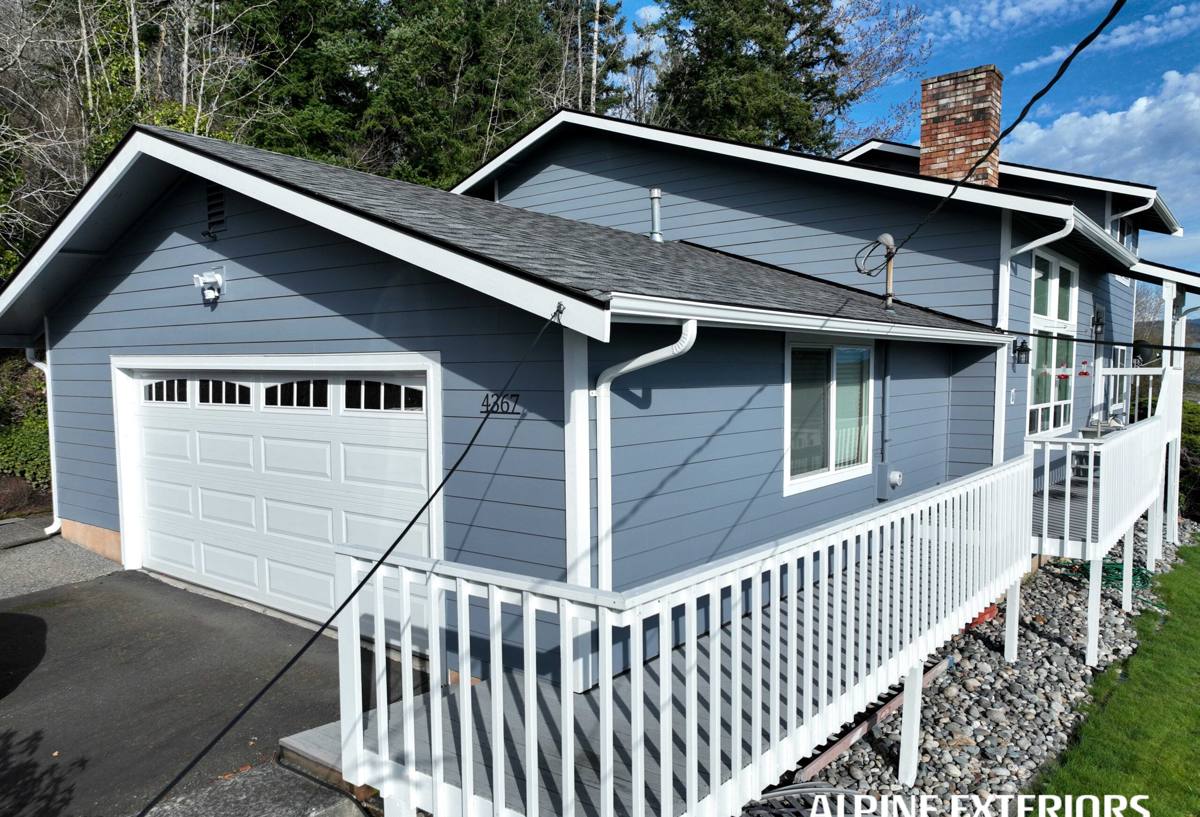
What Salt Air, Driving Rain, and Moss Season Do to a Roof Here
Salt Air Off Bellingham Bay
Sehome's elevation on the hillside doesn't put it right at the waterline, but it's close enough to Bellingham Bay that salt-laden air reaches roofs throughout the neighborhood, particularly on homes with more open exposure to the west and north. Salt accelerates corrosion at cut panel edges, exposed fastener heads, and any spot where a factory coating has been scratched or scuffed during shipping or installation. Given enough years, that slow process is what turns a small scratch into a rust stain, and eventually a point where water starts working its way under the panel.
Wind-Driven Rain Finding the Details
A metal panel sheds straight-down rain without any trouble. What actually tests a metal roof in Whatcom County is rain arriving sideways on the wind, which pushes water up under laps and into ridge, eave, and penetration details rather than running straight off the surface. Nearly every leak we investigate on a metal roof traces back to one of those detail points — a seam, a pipe boot, a wall transition — not the open panel field itself. Correct lapping, closure strips, and underlayment underneath the panels matter more here than the panel material alone.
A Moss Season That Barely Breaks Under Hillside Tree Cover
The mature trees around Sehome Hill and the surrounding blocks are one of the neighborhood's defining features, and they come with a real tradeoff for roofing: shaded sections of a roof stay damp for most of the year, long after open, sun-exposed roofs nearby have dried out. Moss and algae don't just look bad on a roof; they hold moisture directly against the surface, and any spot where debris collects, water stands, or panels meet at a shallow slope becomes a place where growth can establish even on a material that generally resists it better than asphalt shingles.
Standing Seam vs. Exposed-Fastener Panels for a Sehome Home
Metal roofing covers a range of systems, and the differences between them carry more weight in a damp, tree-shaded climate like this one than they would somewhere drier. The table below covers the systems homeowners in this area most often weigh against each other.
| System | Fastening | Performance in Shade and Moisture | Maintenance |
|---|---|---|---|
| Standing seam | Concealed clips; no fasteners penetrate the panel face | Smooth, unbroken surface sheds debris and moss spores well; no exposed penetrations to trap water | Low — no exposed washers or sealant points to inspect over the roof's life |
| Exposed-fastener panel | Screws driven through the panel face into the deck or purlins | Reliable when installed correctly, but every fastener washer is a small spot where debris and moisture can collect | Higher — washers age and compress over repeated wet-dry cycling and need periodic checking |
| Stone-coated steel | Concealed or exposed depending on the profile | Textured surface holds slightly more debris than a smooth panel, though still well ahead of asphalt shingles | Moderate — benefits from periodic clearing on shaded, tree-covered lots |
For most Sehome homes, especially those under heavier tree cover near the hill, we lean toward standing seam. Its unbroken surface gives moss the least to hold onto and removes exposed fasteners from the equation entirely, which matters over decades of salt exposure this close to the bay. Exposed-fastener panels remain a legitimate, more affordable option for a detached garage, an addition, or a budget that calls for it — the trade-off is a maintenance item that standing seam simply doesn't carry. We'll walk through the honest trade-offs for your specific roof rather than steering you toward whichever system is easiest to sell.
Panel Substrate, Gauge, and Coating: The Choices That Actually Matter
Once the system is chosen, three specifications do most of the work in determining how a metal roof holds up in this environment: the substrate metal, the panel gauge, and the coating system.
- Substrate: Galvalume-coated steel is the common, cost-effective choice with solid corrosion resistance. Aluminum is worth discussing for properties with heavier salt exposure since it doesn't rust the way steel can if a coating is ever compromised, though it costs more and dents more easily.
- Gauge: Lower gauge numbers mean thicker metal. A heavier gauge resists denting and oil-canning better and typically carries a stronger wind rating; a lighter gauge costs less but leaves less margin for error, hail, or impact from falling branches, which is a real consideration on tree-lined Sehome lots.
- Coating: A high-quality PVDF (often sold under names like Kynar 500) finish holds its color and chalk resistance far longer than a lower-grade paint system, and it matters more here than in a drier climate because salt air and sustained moisture both work against a weaker finish over time.
We'll spec substrate, gauge, and coating to what your specific property actually faces — a shaded lot with falling branch risk calls for different priorities than a more open lot with heavier direct salt exposure.
The Layers Homeowners Never See
A metal roof is only as good as what's underneath it, and none of it shows up once the panels are down and the roof looks finished. The deck itself needs to be sound before anything new goes on — no soft spots, no delaminated sheathing, nothing that will telegraph movement into the panel system later. Over that deck, a water-resistant underlayment across the full field isn't optional in a climate that sees this much sustained moisture, with a self-adhering membrane at eaves, valleys, and penetrations giving the roof a real second line of defense if wind-driven rain ever gets past the panels themselves.
Closure strips at the eave and ridge seal off the open gaps in a panel's profile that would otherwise let wind-driven rain, debris, and insects into the assembly. Attic ventilation matters just as much — a metal roof over a poorly ventilated attic can trap moisture underneath the deck, and in a climate this damp, that's a slow path to rot that has nothing to do with the panels overhead. None of this is visible in a finished photo, but it's the difference between a roof that holds up through years of Whatcom County winters and one that only looks finished on a dry day.
How a Metal Roofing Project Comes Together
A correct installation follows the same sequence on every job, and each step carries real weight for how the roof performs in this specific climate:
- Tear off the existing roofing down to the deck so it can be properly inspected, rather than installing new panels over old material.
- Inspect and repair the deck, replacing any sheathing that's soft, delaminated, or showing signs of past moisture damage.
- Confirm attic ventilation is adequate for the roof design, correcting it where needed so moisture isn't trapped under the new panels.
- Install a water-resistant underlayment across the field, with extra attention at eaves, valleys, and any low-slope sections where standing moisture is most likely.
- Install drip edge and eave closures to direct water off the roof edge and seal the open profile at the panel ends.
- Lay out and install panels to the correct reveal and alignment, working from a true starting line so the pattern stays square across the roof.
- Fasten to the manufacturer's tested pattern — concealed clips spaced per spec for standing seam, or screws at the correct spacing for exposed-fastener systems, driven into solid framing.
- Flash every penetration, wall, and chimney individually, using purpose-made flashing details rather than relying on sealant to bridge a gap.
- Install ridge cap and closure strips to complete the assembly and close off the last open seams at the peak.
- Clean the site and magnet-sweep the yard for stray screws and metal shavings, then walk the finished roof for a final check.
Where Cheap Metal Roofing Jobs Fail in This Climate
Metal roofing bids can vary widely, and the gap usually comes down to what's happening at the details that don't show up during a walk-through once the roof looks finished.
| Detail | Correct Practice | Common Shortcut |
|---|---|---|
| Fastening pattern | Clips or screws spaced exactly per the manufacturer's tested, wind-rated pattern | Wider spacing to save material and labor, which quietly reduces wind performance |
| Deck inspection | Full tear-off with the deck inspected and repaired before panels go down | Installing over existing roofing or skipping a real inspection to save labor |
| Underlayment | Water-resistant membrane at eaves, valleys, and the full field, sized to sustained local moisture | Minimal or standard felt underlayment not matched to a wet, long-season climate |
| Flashing and closures | Purpose-made closures and flashing at every seam, ridge, and penetration | Generic trim and sealant used to bridge gaps the assembly wasn't designed to have |
| Fastener quality | Coated, corrosion-resistant fasteners matched to the panel substrate | Mismatched or standard fasteners that corrode faster than the panel around them |
None of these shortcuts show up on the invoice, and most aren't visible until years of Whatcom County rain, salt air, and moss season have had a chance to find them.
Signs a Sehome Roof Needs a Closer Look
A well-installed metal roof is low-maintenance, but it isn't maintenance-free, especially on a lot with heavy tree cover near the hill. Worth a call if you notice any of the following:
- Moss or algae establishing in a shaded valley, low-slope section, or anywhere debris has been allowed to collect
- Rust staining or discoloration at cut edges, fastener heads, or scratches in the panel finish
- Panels that look slightly loose, wavy, or lifted at a seam or edge
- Exposed fasteners with cracked, shrunken, or loosened rubber washers
- Streaking or staining at flashing points around vents, pipes, or wall transitions
- Water stains or a musty smell in the attic that could point to trapped moisture rather than a visible leak
- Dents or scuffed coating from falling branches or debris, common on tree-lined Sehome lots
- Debris buildup in valleys or against ridge caps that isn't being cleared during regular maintenance
None of these are necessarily urgent on their own, but catching them early costs a fraction of what it takes to deal with deck rot or interior moisture damage later.
Why a Crew That Already Works Sehome Matters
A crew that installs metal roofing regularly across Whatcom County has a working sense of how homes in this area are actually built — typical deck materials, common roof pitches, and the ventilation setups that show up again and again on Bellingham's older hillside housing stock — which means fewer surprises once a tear-off starts. That local pattern recognition also extends to moss and shade: a crew that's seen how growth establishes on roofs around Sehome Hill and the surrounding neighborhoods knows which slope transitions and shaded valleys need extra attention during installation, not just after the fact. It also carries into corrosion — knowing how far salt-bearing air off Bellingham Bay actually reaches into the hillside changes which fastener and coating specs are worth paying for on a given property.
Permitting and inspection processes vary by jurisdiction, and a contractor who pulls permits in the City of Bellingham and Whatcom County regularly moves through that process without the delays that can trip up a crew working through it for the first time. Local presence also means a shorter response time if a storm or a sudden leak needs attention, rather than waiting on a contractor with no real base in the area.
If you're planning a reroof, weighing metal against another material, or just want an honest read on whether it makes sense for your Sehome home, we're glad to take a look and walk through the specifics with you. Reach out using the form below to schedule a free, no-pressure estimate.