 Whatcom County
 What Lynden's Climate Actually Does to Siding
Lynden sits inland from Bellingham Bay, but that doesn't shield it from the marine air, long wet winters, and humid shoulder seasons that define this part of Whatcom County. Homes here spend a good part of the year damp rather than wet-then-dry, and that slow, sustained moisture is harder on siding than a hard rainstorm. Add in the moss and algae that thrive in shaded, north-facing exposures near the trees and windbreaks common on Lynden properties, and you get a climate that's genuinely tough on the wrong siding material.
We install fiber cement in this area because it's built for exactly this pattern: it doesn't absorb water the way wood-based products do, it doesn't warp or delaminate when it stays damp for weeks, and it holds a factory finish through repeated wet-dry cycles instead of chalking or peeling after a few seasons.
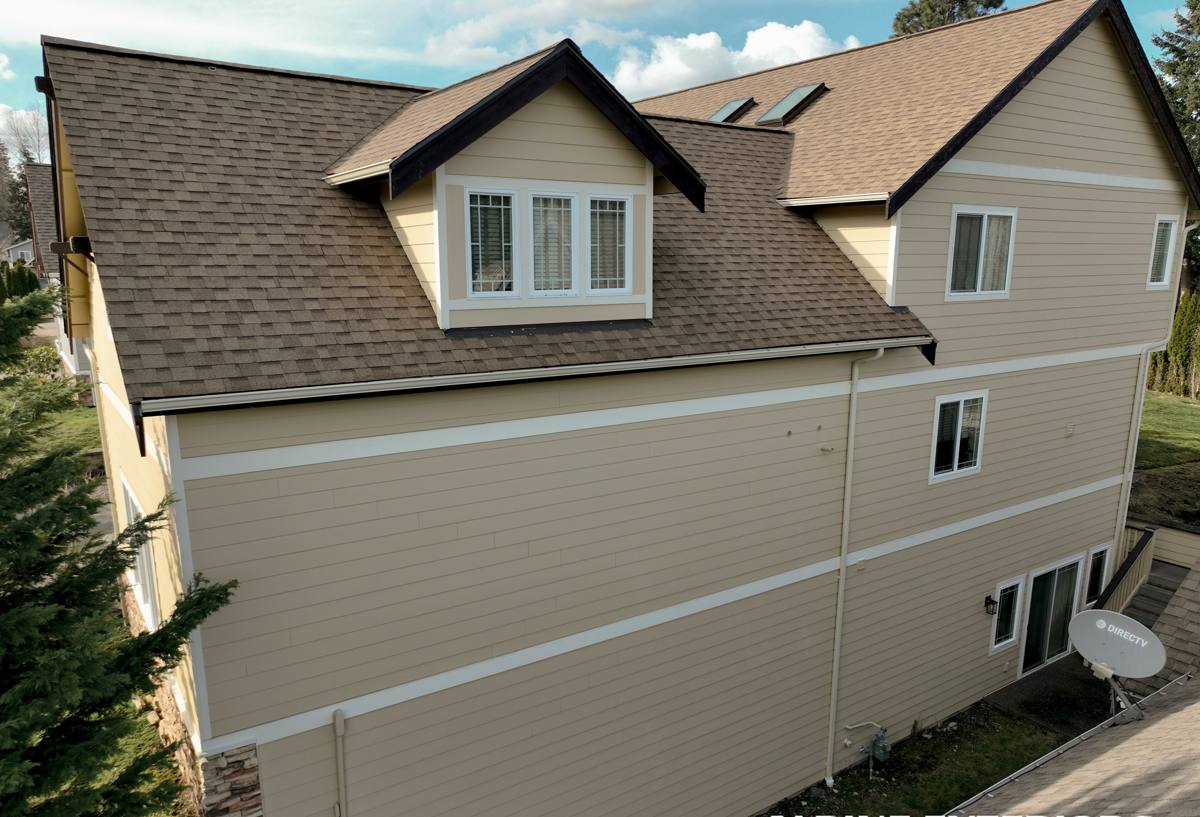
Why Fiber Cement Fits This Area Better Than the Alternatives
Moisture Resistance That Doesn't Depend on Perfect Maintenance
Fiber cement is dimensionally stable — it doesn't swell, cup, or rot when it takes on moisture, which matters in a county where siding can stay damp for days at a stretch during winter storm cycles. That stability is also why we won't install engineered wood siding here: products like LP SmartSide rely on treated wood strand cores and factory sealing to keep moisture out, and once that seal is compromised at a cut edge or fastener hole, water intrusion becomes a real risk. Fiber cement doesn't have that failure point because there's no wood fiber core to protect.
A Factory Finish That Actually Holds Up
James Hardie's ColorPlus finish is baked on in a controlled factory environment, not brushed or sprayed on site. That matters in Whatcom County because field-applied paint has to cure in whatever weather shows up that week — and a finish that doesn't cure evenly is a finish that fails early. ColorPlus is engineered to resist fading and hold adhesion through the freeze-thaw and wet-dry cycling typical of this region, and it comes with a longer, more specific finish warranty than site-applied paint ever will.
Non-Combustible Construction
Fiber cement is non-combustible by composition. That's less about Lynden's fire risk specifically and more about what we'd rather put on any home we work on — it's one more reason we standardized on Hardie rather than treated-wood or vinyl products.
What a Correct Fiber Cement Installation Actually Requires
Fiber cement performs the way it's rated to perform only when it's installed to spec. This is a product that's less forgiving of shortcuts than vinyl, and most of the problems we get called out to fix on other contractors' work trace back to a handful of installation errors.
Clearance and Flashing
Siding needs proper clearance from grade, roof lines, decks, and other horizontal surfaces where water collects and splashes back. It also needs correctly lapped flashing at every window, door, and penetration. Skip either one and you've built a path for water to get behind the siding — which, in a climate that stays wet as long as Whatcom County's does, shows up as rot in the sheathing behind an otherwise fine-looking wall.
Fastening
Fiber cement has specific fastener requirements — type, spacing, and how far from the panel edge each fastener sits. Overdriven or misplaced fasteners crack the material or create entry points for water. This isn't cosmetic; it's the difference between a wall system that sheds water and one that traps it.
Joints, Caulking, and Paint Touch-Up
Every cut edge should be sealed and every butt joint treated correctly — either with a proper joint flashing detail or manufacturer-approved caulk and touch-up paint matched to the ColorPlus finish. Field-cut edges are the one place the factory finish doesn't already protect the board, so this step gets skipped more often than it should.
Quick Reference: What to Ask an Installer
- Are you a James Hardie-approved or certified installer, and can you show it?
- What fastener type and spacing do you use, and does it match Hardie's published specs?
- How do you flash windows, doors, and roof-to-wall transitions before siding goes on?
- What clearance do you leave at grade, decks, and roof lines?
- How do you seal and touch up field-cut edges?
- Do you carry a written workmanship warranty separate from the manufacturer's material warranty?
Our Process for a Lynden Installation
- On-site assessment. We walk the exterior, check the current siding and sheathing condition, and look for existing moisture damage, especially around windows, roof lines, and shaded or north-facing walls where moss and algae tend to establish first.
- Sheathing and moisture barrier check. Before new siding goes up, we confirm what's underneath is sound and that the water-resistive barrier is intact and correctly lapped. If we find damaged sheathing, we address it before covering it back up — not after.
- Product and color selection. We walk through Hardie's plank profiles, textures, and ColorPlus palette so the finished home matches the style you want, not just whatever's easiest to install.
- Flashing and prep detail work. This is where most of the long-term performance is decided — window and door flashing, kick-out flashing at roof intersections, and proper starter strip installation all happen before a single course of siding goes up.
- Installation to manufacturer spec. Correct fastening, clearances, and joint treatment, following James Hardie's published installation requirements rather than shortcuts that speed up the job.
- Final walkthrough. We review the finished exterior with you, confirm caulking and touch-up work is complete, and go over basic care so the siding performs the way it's supposed to for decades.
Fiber Cement vs. Other Siding Options
Homeowners in Whatcom County usually compare a few materials before deciding. Here's an honest look at how they stack up for a climate with this much sustained moisture and moss pressure.
| Material | Moisture Behavior | Finish Durability | Typical Lifespan | Fire Rating |
|---|---|---|---|---|
| James Hardie Fiber Cement | Doesn't swell, rot, or absorb water into a wood core | Factory-baked ColorPlus finish, long warranty | 30+ years with correct install | Non-combustible |
| Vinyl | Sheds water but can warp, crack in cold, and trap moisture behind it if installed loose | Color molded through material but fades and chalks over time; can't be repainted easily | 20–30 years | Combustible |
| LP SmartSide (engineered wood) | Treated wood strand core; performance depends on sealed edges and intact factory coating | Factory finish, but touch-up and edge sealing are critical maintenance points | 25–30 years with diligent maintenance | Combustible |
| Cedar / Primed Spruce | Natural wood; absorbs moisture, needs consistent refinishing to resist rot | Requires repainting or restaining on a regular cycle | 15–25 years, maintenance-dependent | Combustible |
Every one of these products has a legitimate use case. We simply concluded that for the moisture load and moss exposure homes see in this county, fiber cement gives homeowners the best odds of a siding job that still looks and performs well two and three decades out, with the least ongoing maintenance burden.
Living With Fiber Cement in Whatcom County
Fiber cement is low-maintenance, not no-maintenance. A little seasonal attention keeps it performing and looking right for its full service life.
- Rinse the exterior annually with a garden hose or low-pressure wash — avoid high-pressure washers, which can force water behind laps and joints.
- Check shaded, north-facing walls each fall for early moss or algae growth and clean it before it establishes.
- Inspect caulking at trim, windows, and joints every year or two and re-caulk any cracked or separated sections.
- Keep gutters clear and downspouts directed away from the foundation so water isn't running down or pooling against the siding.
- Trim back vegetation and shrubs that hold moisture against the wall or block airflow and sun exposure.
- Touch up any nicks or chips at cut edges promptly with matched paint to keep the factory seal intact.
Why a Crew That Already Works in Lynden Matters
Installation quality is what determines whether fiber cement delivers on its warranty and lifespan — and installation quality is shaped by familiarity with local conditions. A crew that regularly works Whatcom County jobs already knows how much clearance to leave given the rain patterns here, which wall exposures need extra attention for moss, and how the wet season affects scheduling and cure times for caulking and touch-up work. That's not something you get from a crew passing through the area once a year.
It also matters for accountability. A contractor with an ongoing local presence has a reason to stand behind the workmanship warranty years down the road, not just get through the punch list and move on.
Get an Honest Look at Your Home
If your current siding is showing moss staining, chalking, cracked caulk lines, or soft spots near the bottom courses, it's worth getting a straight assessment before those issues get into the sheathing. We'll walk your home, tell you what we actually see, and put together a clear estimate for a James Hardie fiber cement installation done to spec for Lynden's climate — no pressure, no upsell on products we don't believe in.