 Whatcom County
 Why Board & Batten Fits So Many Ferndale Homes
Board and batten has become one of the most requested siding profiles in Ferndale over the last several years, and it's easy to see why. The vertical lines read as clean and modern on newer builds, but the same profile also feels right at home on the farmhouse and craftsman-influenced houses that make up a lot of Whatcom County's housing stock. It works well as a full-house treatment or as an accent on gables, dormers, and entry walls paired with horizontal lap siding elsewhere on the home.
What most homeowners don't realize until they start pricing the job is that "board and batten" describes a look, not a material. You can build that look out of real wood boards, engineered wood, vinyl panels made to mimic it, or fiber cement. The material underneath the battens is what determines whether the siding still looks good in ten years or has started cupping, staining, and rotting at the seams — and in a climate like Whatcom County's, that material choice matters more than almost anywhere else in the state.
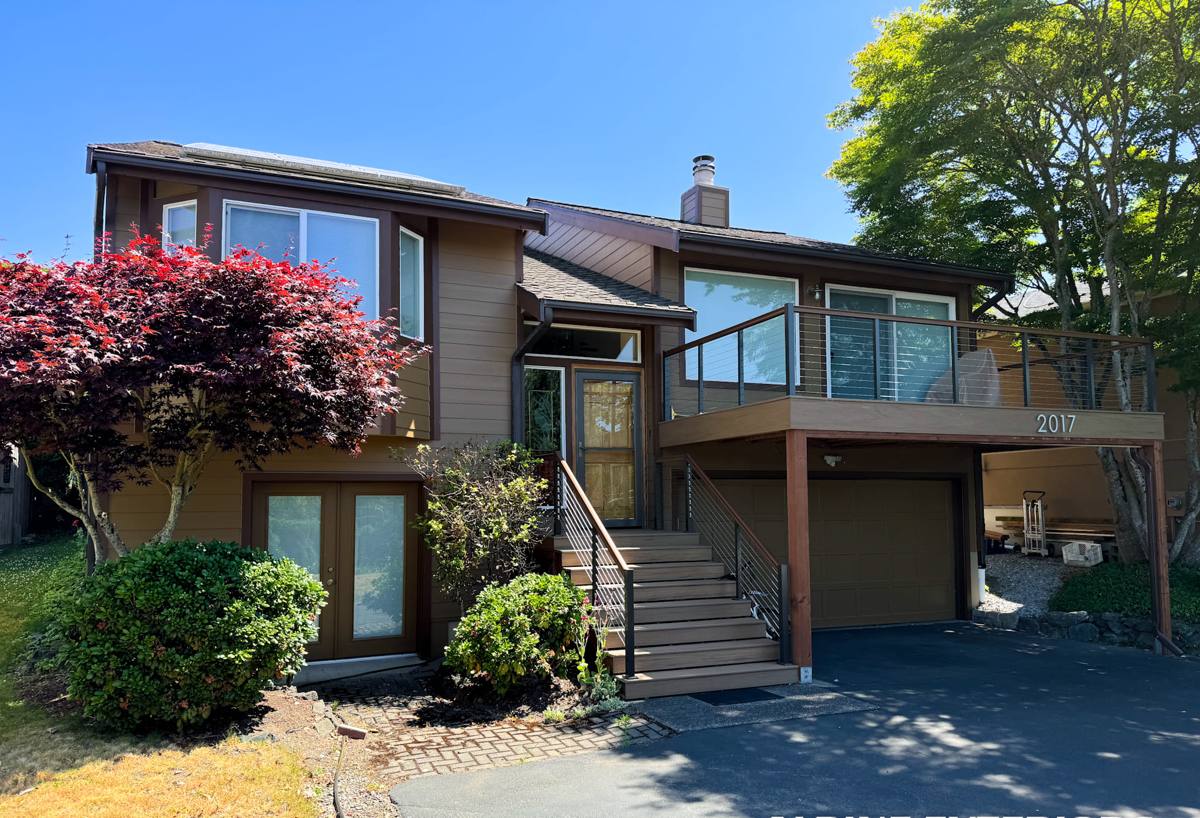
What Whatcom County's Climate Actually Does to Vertical Siding
Ferndale sits close enough to the Salish Sea that salt-laden air is a routine part of the weather, not an occasional event. Combine that with the long, wet stretch of fall-through-spring driving rain typical of northwest Washington, and a lengthy moss season that never fully lets up on shaded north- and west-facing walls, and you have three separate stressors working on a home's exterior at the same time.
Salt Air
Salt-bearing air accelerates corrosion of fasteners, flashing, and any exposed metal trim, and it's hard on finishes that aren't built to shed it. Board and batten has more vertical seams and more exposed batten edges than a standard lap profile, which means more places for salt-laden moisture to sit if the wrong fasteners or finish are used.
Driving Rain
Whatcom County doesn't just get rain — it gets wind-driven rain that hits walls at an angle instead of just falling straight down. Vertical board and batten channels water down the face of the boards and concentrates it at the horizontal joints and the base of the wall, so those details have to be built correctly or they become the first place trouble shows up.
Moss Season
Anything shaded, north-facing, or tucked under an overhang in this county grows moss and algae for a good part of the year. Moss holds moisture against the siding surface far longer than the surface would otherwise stay wet, which is hard on any material that isn't dimensionally stable and resistant to moisture absorption.
Why We Build This Look Only in James Hardie Fiber Cement
We install James Hardie exclusively, and board and batten is actually one of the clearest examples of why that standard exists. Real wood board and batten looks great on day one, but wood moves with moisture — it swells, shrinks, and eventually cups or splits, and in a climate that stays damp as much of the year as Whatcom County does, that movement shows up faster than it would in a drier region. Vinyl versions of the look are low-maintenance but rely on a thin, brittle material that can warp in temperature swings and doesn't hold up well against long-term UV and salt exposure without fading.
James Hardie's fiber cement is engineered specifically to resist that kind of movement. It's non-combustible, doesn't absorb moisture the way wood does, and holds its shape through the wet-dry cycles that define a Pacific Northwest year. Hardie also makes an HZ10 product line engineered specifically for climates like ours — the wetter, more moisture-exposed regions of the Pacific Northwest — rather than a one-size-fits-all product sold everywhere in the country. For board and batten specifically, we build the look using Hardie's vertical panel system with battens installed over it, finished in a factory-applied ColorPlus finish rather than field-applied paint.
That factory finish matters here more than it does in a drier climate. ColorPlus is baked on under controlled conditions and backed by its own finish warranty, so the color holds and the surface resists fading and moisture penetration far better than a coat of paint applied on site in variable weather. In a county where the painting season is genuinely short, that's not a small advantage.
What a Correct Board & Batten Installation Actually Involves
Board and batten fails fastest not because of the material but because of how it's installed. The batten strips create extra fastening points and extra seams, and if those aren't detailed correctly, water finds its way behind the panel instead of running off the face of it. A correct installation in this climate includes:
- A drainage plane and code-compliant weather-resistant barrier installed behind the panel, not just under it
- A rainscreen air gap so any moisture that does get behind the siding can drain and dry instead of sitting against the wall sheathing
- Properly lapped and sealed flashing at every window, door, and horizontal joint, since these are the points where driving rain gets forced sideways into the wall assembly
- Fastener spacing and placement that follows Hardie's published installation specs, using fasteners rated for this material and this climate
- Battens spaced and fastened so they cover the panel seams fully without trapping moisture behind them
- Sealant at the joints that's rated for exterior movement and won't harden and crack within a few seasons
- Factory-cut and factory-primed edges kept intact wherever possible, since field-cut edges need to be properly sealed to match the manufacturer's moisture protection
Skipping any one of these doesn't usually cause a visible problem the first year. It shows up two, three, or five years later as staining, soft spots, or paint failure at the seams — by which point it's a repair job instead of a five-minute install detail.
Board & Batten Material Comparison for This Climate
| Material | Moisture & Salt-Air Behavior | Maintenance | Typical Lifespan Here |
|---|---|---|---|
| James Hardie fiber cement | Dimensionally stable, engineered HZ10 line for wet Pacific Northwest exposure | Occasional wash; factory finish resists fading | Decades, per manufacturer warranty terms |
| Real wood board & batten | Absorbs moisture, prone to swelling, cupping, and rot at joints in constant damp | Regular repainting and caulk upkeep | Shorter, highly dependent on upkeep |
| Vinyl vertical panel | Doesn't rot, but can warp with temperature swings and fade with sun/salt exposure | Low, but color and finish degrade over time | Moderate; appearance often the limiting factor |
We don't install the wood or vinyl versions of this profile. That's not a knock on every homeowner who has one — it's simply not the standard we're willing to put our name behind, given what we see this climate do to those materials over time.
How Our Process Works in Ferndale
We start with an on-site look at the existing wall condition, not just a measurement of the house. On a re-side, that means checking for moisture that's already gotten into the sheathing behind the current siding — something that's more common in this county than homeowners expect, especially on north- and west-facing walls that stay shaded and damp for months at a time. That inspection determines whether we can install over the existing wall assembly or whether the sheathing needs attention first.
From there we sequence the job around the weather instead of around a fixed calendar date. Board and batten installation is more forgiving of a light drizzle than some finish work, but flashing, house wrap, and sealant all need proper working conditions to perform the way they're supposed to. Scheduling around Whatcom County's wetter stretches, rather than pushing through them, is part of why the work holds up.
Maintenance After the Job Is Done
James Hardie board and batten is low-maintenance, not no-maintenance. In a moss-prone, salt-air climate like this one, a periodic soft wash to clear algae and grime before it builds up keeps the ColorPlus finish looking the way it's supposed to and keeps organic growth from holding moisture against the surface. It's also worth a walk-around every year or two to check that caulking at joints and trim is still intact, and that gutters and downspouts are directing water away from the base of the walls rather than letting it run down the siding face.
Why a Crew That Already Works Ferndale Matters
Board and batten done right depends on details — flashing laps, rainscreen depth, fastener choice — that don't change from town to town, but the conditions those details have to hold up against absolutely do. A crew that already works in Ferndale and across Whatcom County has already seen what a full wet season does to a wall that was flashed wrong, and what a summer of salt air and sun does to a finish that wasn't built for it. That's the difference between an installation that looks right at handoff and one that's still performing the same way five winters from now.
If you're weighing board and batten for a Ferndale home, we're happy to walk the property, look at what's there now, and talk through what a correct installation looks like for your specific walls and exposure — no pressure, no obligation. Use the form below to request a free estimate.