 Whatcom County
 Decking in Fairhaven: A Climate That Tests Every Board
Fairhaven sits close enough to Bellingham Bay that its exterior surfaces deal with conditions most inland neighborhoods never see: a steady drift of salt-laden marine air, rain that comes in sideways as often as it falls straight down, and shaded, tree-covered lots that stay damp for months at a stretch. A deck takes this weather harder than almost any other part of a house, because it's horizontal, it's exposed on every side, and it's the one exterior surface people actually walk on barefoot. We build and repair decks throughout Whatcom County, and Fairhaven is one of the areas where we see climate-related deck failures show up earliest, particularly on older wood decks that were never built with this much sustained moisture in mind.
Composite decking has become the standard recommendation for homes in this kind of environment, but "composite" isn't one product. There's a real range in how these boards are engineered, and the difference matters more here than it would in a drier, sunnier climate. This page walks through what Fairhaven's conditions actually do to a deck, what a correctly built composite deck involves, and how our process works from first walk-through to finished build.
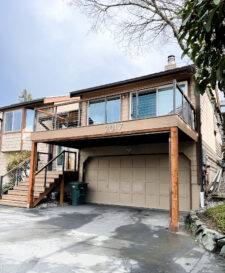
What Salt Air, Rain, and Moss Do to a Deck Over Time
Salt Air and Fastener Corrosion
Marine air carries fine salt particulate that settles on every exposed surface, including the fasteners, brackets, and hardware holding a deck together. Standard galvanized hardware can start corroding years ahead of its rated lifespan this close to the bay. It's rarely visible from the top of the deck; it shows up first underneath, at joist hangers and ledger connections, which is exactly why those details need to be specified correctly at the start rather than discovered as a problem later.
Wind-Driven Rain and Trapped Moisture
Rain here doesn't just fall onto a deck surface, it gets pushed underneath railings, into board gaps, and against the house where the deck meets the wall. On a wood deck, that moisture cycle of wet-then-dry, repeated for months at a time, is what drives cupping, splitting, and rot. On any deck, wind-driven rain finds its way to the ledger connection at the house if that detail wasn't flashed correctly, and that's one of the most common sources of hidden water damage we find on older decks in this area.
Moss and Algae on Deck Surfaces
Mild temperatures and consistent dampness make Whatcom County a long moss season almost everywhere, and shaded or north-facing decks in Fairhaven's tree-covered lots see it worse than most. Moss and algae don't just look bad, they hold moisture against the board surface and turn the deck slick and genuinely dangerous underfoot, especially on stairs. Porous, uncapped wood surfaces give moss more to grip onto than a properly capped composite board does, which is a real practical difference, not a marketing point.
Hillside Framing and Structural Considerations
A fair amount of housing in and around Fairhaven sits on sloped terrain leading up from the waterfront. Decks on these lots often carry more structural responsibility than a flat-lot deck, sometimes serving as the main level access point over a significant drop, which means footing depth, post spacing, and beam sizing all deserve real engineering attention rather than a standard cookie-cutter layout. Drainage on a slope also behaves differently, and water that isn't directed away from posts and footings can undermine them over time.
Why Composite Decking Fits This Climate
Composite decking is a manufactured board, typically a blend of wood fiber and plastic, or in some product lines, a fully synthetic PVC formulation with no wood content at all. Both categories are built to resist the specific failure modes that wood struggles with in a wet, salty, shaded environment: they don't absorb water the way solid wood does, they don't need staining or sealing to stay protected, and a quality board resists moss and mildew far better than an untreated or aging wood surface.
Capped vs. Uncapped Composite
Most composite boards on the market today are "capped," meaning the wood-plastic core is wrapped in a protective polymer shell on some or all sides. That cap is what actually does the work of blocking moisture absorption and resisting staining and fading. Older or budget uncapped composite products let the core surface directly absorb water and are far more prone to mold growth and surface degradation over time, which matters a lot in a climate this consistently damp. We install fully capped boards for exactly that reason.
Wood-Plastic Composite vs. PVC
Wood-plastic composite boards, from brands like Trex, TimberTech, and Fiberon, retain some of the look and weight of real wood and perform well in marine climates when properly capped. Cellular PVC decking, offered by some of the same manufacturers, contains no wood fiber at all, which makes it essentially immune to rot and gives it an edge in the wettest, shadiest spots on a property. PVC tends to cost more and can flex slightly differently underfoot, so the right choice depends on the specific deck, its exposure, and your budget. We'll walk through the real trade-offs for your property rather than pushing one product line by default.
What a Correct Composite Deck Installation Involves
The board you choose only performs as well as the structure underneath it. A composite deck that's going to hold up through Whatcom County winters needs the same attention to structural and moisture detail as a siding or roofing job, not just a nice-looking surface laid over whatever framing already exists.
Substructure and Framing
Composite boards are heavier than wood decking and often call for tighter joist spacing than a traditional lumber deck was framed for. Before any composite goes down, we check whether the existing substructure meets the manufacturer's spacing and load requirements, especially on older decks that were originally built for a wood surface, and we correct it where it doesn't.
Ledger Board and Flashing
The ledger board, where the deck attaches to the house, is the single most common point of hidden water damage on any deck in this climate. A correct installation integrates flashing with the house's existing water management, using a code-compliant ledger flashing detail that sheds water away from the wall rather than trapping it behind the deck attachment.
Fastening and Board Spacing
Composite boards expand and contract with temperature more than wood does, so fastening systems and gap spacing have to account for that movement, or boards can buckle or gap unevenly over a few seasons. We use hidden fastener systems on the visible field of most decks, which also avoids the corrosion-prone exposed fastener heads that stand out fastest in salt air.
Drainage and Airflow Underneath
A deck built tight to grade or without adequate airflow underneath traps moisture against the framing even when the surface boards themselves are moisture-resistant. Proper joist protection tape, ventilation gaps, and grading beneath the deck all matter for keeping the substructure dry, and they matter more on shaded Fairhaven lots where the ground underneath a deck rarely gets direct sun to help it dry out.
Our Process for a Fairhaven Composite Deck
We start every deck project with an in-person walk of the property, not a phone estimate. On a Fairhaven lot, that means checking slope and drainage around the footprint, assessing sun and shade exposure across the deck area, and evaluating whatever structure already exists if this is a replacement rather than new construction. From there we talk through board options, railing systems, and layout based on how you'll actually use the space, and put together a written scope that spells out framing specs, flashing details, and fastening method, not just square footage and a board name.
During the build, footings and framing get inspected before any decking goes down, since that's the point where problems are cheapest and easiest to fix. We finish with a walkthrough of the completed deck so you know what maintenance, if any, the specific board and hardware combination actually needs going forward.
Composite Decking vs. Other Materials
| Material | Moisture Performance in This Climate | Ongoing Maintenance |
|---|---|---|
| Capped composite | Strong resistance to water absorption, mold, and rot when properly installed | Occasional washing; no staining or sealing required |
| Cellular PVC | No wood content, essentially immune to rot; best in the wettest, shadiest spots | Occasional washing; no staining or sealing required |
| Pressure-treated wood | Absorbs moisture readily; prone to cupping, splintering, and rot in sustained damp conditions | Regular staining or sealing, ideally every 1-2 years in this climate |
| Cedar | Naturally rot-resistant but still absorbs moisture over time without upkeep | Regular sealing or oiling to maintain appearance and protection |
Wood decking isn't a bad material, and plenty of homeowners still prefer its look and lower upfront cost. The honest trade-off in a climate this wet is maintenance: a wood deck that isn't sealed on schedule loses its protection faster here than it would inland, and missed maintenance years tend to compound.
What Drives Cost on a Fairhaven Deck Project
| Factor | What It Affects | Why It Matters Here |
|---|---|---|
| Board tier (capped composite vs. PVC vs. wood) | Material cost per square foot | Higher-tier boards carry a higher upfront cost but less long-term maintenance in sustained moisture |
| Structural repair or upgrade | Framing labor and material | Older decks often need joist spacing or beam upgrades to meet composite manufacturer specs |
| Slope and footing depth | Excavation and concrete work | Hillside lots common in Fairhaven can require deeper or additional footings for stability |
| Ledger and flashing detail | Labor time and integration with existing siding | Correct flashing prevents the hidden water damage that's common on older ledger connections near the bay |
| Railing system and stairs | Material and labor | Multi-level or sloped-lot decks often need more stair and railing work than a flat-lot deck |
Real numbers depend on the specific deck, its size, and what's underneath it, which is why we quote from an in-person walk-through rather than a generic per-square-foot number.
Signs Your Current Deck Needs Attention
- Boards that feel spongy, soft, or springy underfoot, especially near the house or stairs
- Persistent moss or algae film that returns quickly after cleaning
- Visible gaps, cupping, or splitting in wood decking boards
- Rust staining around fasteners, brackets, or the ledger connection
- Railings or stair posts that feel loose or wobble under weight
- Standing water on the deck surface after rain instead of draining off
- Discoloration or staining on the siding directly above or behind the ledger board
Why a Local Whatcom County Crew Matters
A crew that builds decks throughout Whatcom County on a regular basis knows how salt air, wind-driven rain, and a long moss season actually behave on a finished deck over several winters, not just how a board performs on a spec sheet. That experience shows up in small decisions: how much airflow to leave underneath a shaded deck, which hardware actually holds up this close to the bay, and where a hillside lot needs extra structural attention that a standard plan wouldn't call for. Fairhaven's proximity to the water and its sloped, tree-covered lots aren't identical to conditions across the rest of Bellingham, and a crew with real local experience accounts for that instead of applying a one-size-fits-all build.
If you're planning a new composite deck, replacing an aging wood deck, or just want an honest look at what's going on underneath your current one, we're glad to take a look. Reach out using the form below to schedule a free, no-pressure estimate.