 Whatcom County
 Building Decks for Edgemoor's Specific Conditions
Edgemoor sits close enough to the water that salt-laden air is part of daily life, and that changes what a deck needs to survive here versus a deck built twenty miles inland. Add in the driving rain that comes sideways off Bellingham Bay through fall and winter, plus a moss season that can stretch six months or more, and you have a set of conditions that punishes shortcuts fast. A deck built to a generic spec sheet might look fine the first year. By year three, fasteners are weeping rust streaks, boards are cupping, and moss is creeping into every joint that wasn't detailed for drainage. We build decks in Edgemoor the way this specific environment demands, not the way a national framing guide assumes.
This page covers what that actually means: material choices, fastening, drainage, ledger and structural details, and how our process works from first call to final walkthrough. It's specific to deck building in this neighborhood, not a generic overview.
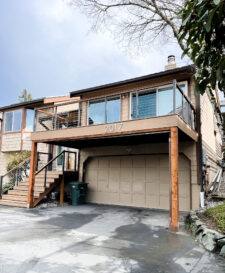
What Salt Air Does to a Deck Over Time
Salt air accelerates corrosion on anything metal — fasteners, joist hangers, post bases, railing hardware. Standard electro-galvanized screws and hangers that hold up fine in a dry inland climate can start rusting within a couple of seasons this close to the water. Once a fastener starts corroding, it loses holding strength before the problem is visible from the surface, which is exactly the kind of failure you don't want in a structure people walk and stand on.
Why We Spec Fasteners the Way We Do
For Edgemoor decks we use stainless steel or heavy hot-dip galvanized fasteners and structural connectors rated for coastal exposure, not the standard-grade hardware that's fine for most interior siding builds. It costs more up front. It's also the single biggest factor in whether a deck's structure is still sound in fifteen years or starting to fail in five. We treat this as a non-negotiable spec on every waterside build, not an upsell.
Driving Rain and Drainage Detailing
Rain that comes in at an angle finds every gap a level, standard installation might leave open. On a deck, the places that matter most are the ledger-to-house connection, the joints between decking boards, and anywhere the deck meets a wall, post, or the house itself.
- Ledger board flashed with a proper drip cap and self-adhering membrane, never just caulked and bolted
- Deck board spacing set for drainage and seasonal movement, not tight-fit appearance
- Joist tops protected with flashing tape so trapped moisture doesn't rot the framing from above
- Post bases set above grade and away from standing water, with proper drainage around footings
- Any wall-adjacent framing detailed so water sheds away from the house, not toward it
Skipping any one of these is invisible on installation day and expensive five years later. This is where most of the "cheap deck that failed early" stories actually start — not with bad lumber, but bad water management underneath good-looking lumber.
The Moss Factor
Whatcom County's long wet season means moss and algae growth on any horizontal wood surface that doesn't get regular sun and airflow, and a lot of Edgemoor lots have exactly that kind of tree cover. Moss holds moisture against the deck surface, which accelerates rot on untreated or poorly ventilated framing and turns boards slick and unsafe underfoot. We build in airflow under the deck wherever the site allows it — proper joist spacing, ventilation gaps, and grading that keeps the underside from turning into a permanently damp, shaded pocket. We also talk through realistic maintenance expectations with every homeowner up front, because no deck material is entirely moss-proof in this climate — some just need far less attention than others.
Decking Material Options for This Climate
There's no single "best" decking material — the right call depends on budget, maintenance tolerance, and how much sun versus shade the deck gets.
| Material | Moisture/Moss Behavior | Maintenance | Typical Lifespan Here |
|---|---|---|---|
| Pressure-treated lumber | Resists rot when properly detailed; moss grows on surface in shade | Needs periodic cleaning/sealing | 15-20 years with upkeep |
| Cedar | Naturally rot-resistant, but surface greys and holds moss in deep shade | Occasional cleaning, optional staining | 15-25 years |
| Composite (capped) | Doesn't rot; can still get slick with algae film in heavy shade | Periodic washing, no sealing/staining | 25-30+ years |
| Uncapped composite (older-style) | More prone to moisture absorption and mold at board edges | More frequent cleaning | Shorter than capped composite |
For Edgemoor specifically, where salt air and shade cover are both common, we lean toward pressure-treated framing paired with either quality cedar or capped composite decking depending on the homeowner's maintenance appetite and budget. We'll walk through the real trade-offs for your specific lot — sun exposure and tree cover make a bigger difference than most people expect.
Structural Details That Matter Below the Surface
The decking boards are what people see. The framing underneath is what determines whether the deck is safe and how long it lasts. A few things we treat as standard, not optional:
Ledger Attachment
The ledger board — where the deck attaches to the house — is the single most important structural connection on most decks, and it's also the connection most exposed to water intrusion if it's not flashed correctly. We use proper structural lag screws or through-bolts rated for the load, plus correct flashing, every time.
Footings and Post Bases
Footings need to be sized and set below frost depth per code, and post bases need to keep the post end grain off wet concrete or soil. In a climate this wet, a post sitting in a puddle at grade is a rot problem waiting to happen, regardless of how good the wood species is.
Joist Hangers and Blocking
Every hanger gets the correct fastener type and full nail/screw pattern — not a partial pattern to save time. Missing fasteners in a hanger is one of the more common corner-cuts we see when replacing failed decks, and it's invisible until there's a real load event.
Our Process for an Edgemoor Deck Project
- On-site assessment — we look at sun exposure, tree cover, drainage patterns, and how close you are to the water, since all of that changes the right spec for your lot.
- Material and design conversation — honest trade-offs between decking options, framing material, and railing choices based on your budget and maintenance preference, not a one-size pitch.
- Permit and code check — Whatcom County and local permitting requirements get confirmed before work starts, not discovered mid-build.
- Framing and structural work — ledger, footings, posts, joists, hangers, all built to the coastal-exposure spec described above.
- Decking, railing, and finish work — installed with drainage-conscious spacing and detailing.
- Final walkthrough — we go over maintenance expectations specific to your deck's material and sun/shade conditions so there are no surprises in year two or three.
Why a Crew That Already Works This Neighborhood Matters
Deck framing specs that work fine in a dry, inland part of the county are the wrong spec for a lot exposed to salt air and driving rain. A crew that already builds regularly in Edgemoor and similar Whatcom County waterside neighborhoods isn't guessing at fastener grade, flashing detail, or drainage layout — it's a known spec we apply consistently, because we've seen what happens when it's skipped. That's the practical value of hiring local and specific, rather than a crew that treats every deck the same regardless of where it sits.
Questions Worth Asking Before You Hire Anyone
- What grade of fasteners and hardware do you use, and is it rated for coastal/salt-air exposure?
- How is the ledger board flashed, specifically?
- What's the plan for drainage and airflow underneath the deck?
- Are footings and post bases set to keep wood off standing water?
- Do you pull the required permit, and is that included in the quote?
- What maintenance will this specific material actually need in a shaded, wet climate?
Any contractor who can't answer these clearly and specifically hasn't thought through what this climate does to a deck over time.
Cost Factors to Expect
Deck project costs vary a lot based on size, decking material, railing type, height off grade, and site access — there's no honest flat number to quote without seeing the lot. Broadly, expect composite decking to cost more up front than pressure-treated lumber but less over a 20-year span once you account for staining, sealing, and earlier replacement. Framing and structural work is where corners get cut to hit a lower number, and it's also the part you can't easily inspect or fix later without tearing the deck apart — it's worth spending on the framing spec even if it means a simpler railing or decking choice to stay in budget.
If you're planning a new deck or replacing one that's showing its age in Edgemoor, we're happy to take a look and give you a straightforward, no-pressure estimate — just fill out the form below and we'll get back to you.