 Whatcom County
 Why Siding Fails Faster in Columbia Than It Should
Homes in the Columbia neighborhood deal with a specific combination of weather that most siding products were never designed for: salt-laden air off the water, wind-driven rain that hits walls sideways instead of falling straight down, and a moss season that can stretch for most of the year. Individually, none of these are unusual for Whatcom County. Together, over ten or fifteen years, they find every weak point in a siding system — every seam, every fastener, every spot where paint has worn thin.
This is the reason we standardized on James Hardie fiber cement and stopped installing vinyl, LP SmartSide, primed spruce, and cedar. It's not that those products don't work anywhere — it's that they don't hold up well to this particular mix of conditions without more maintenance than most homeowners want to sign up for.
Salt Air and Slow Material Breakdown
Airborne salt doesn't just affect metal. It accelerates the breakdown of paint films, softens caulking faster than inland climates, and speeds up the wear on any siding material that depends on a surface coating to stay watertight. Wood and engineered wood siding lean heavily on that coating for protection — once it's compromised, moisture gets underneath, and the underlying substrate starts to swell, delaminate, or rot from the inside out.
Driving Rain and Water Intrusion
Whatcom County's rain rarely falls straight down. Wind pushes it sideways and upward under laps, around trim, and into any gap where flashing wasn't done correctly. Siding that relies on tight, factory-perfect seams to stay dry is only as good as the installation behind it — and even a well-made product will let water in if the flashing details and drainage plane weren't built correctly the first time.
A Long Moss Season
Shade, moisture, and cool temperatures are exactly what moss and algae need to establish themselves, and Columbia has all three for a large part of the year. Moss holds moisture directly against the siding surface far longer than open air would, which is bad news for any material that isn't dimensionally stable and resistant to swelling. It also stains porous or lightly coated surfaces in a way that's difficult to clean without damaging the finish underneath.
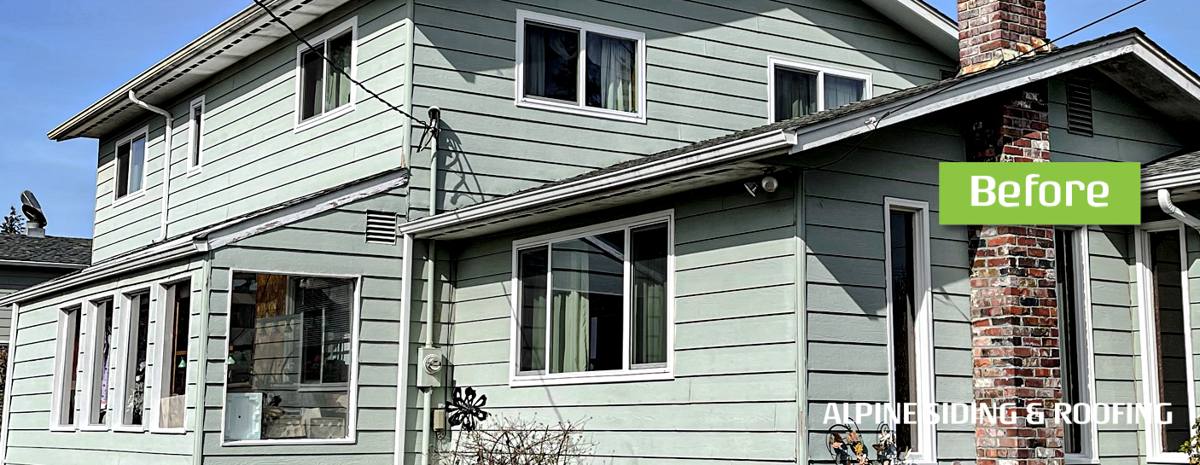
Why We Only Install James Hardie in This Climate
James Hardie fiber cement is engineered from portland cement, sand, and cellulose fiber — materials that don't feed mold or rot, don't expand and contract with moisture the way wood-based products do, and hold paint far longer because the color is baked into a factory-applied finish rather than sprayed on site or left to a field crew. For a neighborhood dealing with salt air, driving rain, and heavy moss, that combination matters more than it does in a drier, inland climate.
HZ5 Engineering for the Pacific Northwest
Hardie's HZ5 product line is formulated specifically for wet, temperate climates like ours, with moisture and impact performance suited to sustained rain exposure rather than dry-heat regions. That's a meaningful distinction — siding engineered for a desert climate and siding engineered for a marine one are not interchangeable, even if they look similar on a spec sheet.
ColorPlus Finish vs. Site-Applied Paint
ColorPlus is a factory-baked finish applied and cured under controlled conditions, which gives it far better fade and wear resistance than paint applied on a jobsite in variable weather. In a climate that's hard on painted surfaces to begin with, that head start matters. It also means touch-up paint is matched and available rather than guessed at years later.
What a Correct James Hardie Installation Actually Involves
The material is only half the equation. A Hardie installation that isn't detailed correctly for this climate will still leak, still trap moisture, and still fail early — just more slowly than a lesser material would. Here's what we consider non-negotiable on every job in this area.
Flashing and Water Management
Every window, door, and roof-to-wall transition needs flashing that directs water out and away from the wall assembly, not just caulk relied on to do a flashing detail's job. Caulk fails; a properly lapped flashing system doesn't depend on caulk to keep the wall dry.
A Drainage Gap Behind the Siding
Any moisture that does get past the outer surface needs somewhere to go. A rainscreen gap between the siding and the water-resistive barrier lets incidental moisture drain and the wall assembly dry out, instead of sitting trapped against the sheathing. This detail matters more in a wet coastal climate than almost anywhere else in the country.
Fastening, Clearances, and Manufacturer Spec
Hardie publishes specific fastener patterns, clearances from grade, decks, and roofing, and gapping requirements at butt joints. Skipping these to save time is the single most common reason a Hardie installation underperforms — the material gets blamed for what was actually an installation shortcut.
Signs Your Current Siding Is Already Losing the Fight
- Dark green or black staining that returns within weeks of being cleaned
- Soft or spongy spots when you press on wood or engineered wood siding
- Paint that's peeling, bubbling, or chalking heavily on sun- or wind-exposed walls
- Visible gaps opening up at seams, corners, or trim boards
- Persistent musty smell along an exterior wall, especially near windows
- Caulk that's cracked, shrunk, or pulled away from joints
None of these are emergencies on their own, but they're all signs that moisture is finding a way in — and in this climate, that process rarely reverses itself without intervention.
Comparing Siding Materials for This Climate
| Material | Moisture & Moss Behavior | Maintenance Burden | Realistic Lifespan Here |
|---|---|---|---|
| James Hardie fiber cement | Dimensionally stable, doesn't feed rot; factory finish resists staining | Occasional washing; no repainting on the standard schedule | Decades, with a strong transferable warranty backing it |
| Vinyl | Won't rot, but expands/contracts with temperature and can trap moisture behind it if not vented properly | Low, but limited repair options if panels fade or crack | Moderate; UV and impact wear vary by grade |
| LP SmartSide (engineered wood) | Treated wood strand product; still wood-based, so edge and seam moisture exposure is a real risk | Needs consistent caulk and paint upkeep, especially at cut edges | Shorter if moisture management isn't kept up |
| Cedar / primed spruce | Natural wood; absorbs moisture, especially where moss holds water against it | Highest — regular refinishing, moss treatment, and rot inspection | Shortest without aggressive, ongoing maintenance |
This isn't a claim that the other products fail outright — plenty of homes have them and get by. It's why, for a climate that stacks salt air, driving rain, and moss season on top of each other, we decided fiber cement was the only material we were comfortable standing behind long-term.
Our Process, Start to Finish
1. On-Site Assessment
We look at what's actually happening on your walls — moisture damage, trim condition, window flashing, and any areas where past repairs were patched rather than properly fixed. This tells us whether it's a full re-side or targeted repair.
2. Detailed Estimate
You get a written scope covering the Hardie product line, profile, and color, along with the flashing and water-management work included — not just a square-footage number.
3. Tear-Off and Inspection of the Wall Assembly
Once old siding is off, we can see the sheathing and framing underneath. Any rot or moisture damage gets addressed before new siding goes on — covering a wet wall with new material just delays the same problem.
4. Installation to Manufacturer Spec
Flashing, rainscreen gap, fastening pattern, and clearances all follow Hardie's published requirements, not shortcuts to move faster.
5. Final Walkthrough
We go over the finished job with you, including what the warranty actually covers and what basic upkeep looks like going forward.
Why Hiring a Crew That Already Works in Columbia Matters
A crew that works this area regularly already knows what marine-climate exposure does to a wall over time, has already seen how moss establishes itself on shaded elevations, and isn't learning wind-driven rain detailing for the first time on your house. That familiarity shows up in the small decisions — where extra flashing gets added, which elevations need extra attention, how much drainage gap to leave — that a generic installation crew from outside the area might not think to make.
- Ask how many Hardie installations they've done specifically in coastal or high-moisture areas of Whatcom County
- Ask to see their standard flashing and rainscreen detail, not just the finished product photos
- Confirm they're a factory-trained or preferred installer for James Hardie products
- Ask what's actually included in writing: tear-off, disposal, trim work, and touch-up paint
- Ask how they handle unexpected rot or damage found once old siding comes off
Living With Hardie Siding in a Wet, Salty, Mossy Climate
Once it's installed correctly, upkeep is genuinely low compared to wood-based alternatives. An occasional gentle wash removes surface grime and slows moss regrowth on shaded walls. Because the color is baked into the ColorPlus finish rather than painted on, you're not on a repainting schedule the way you would be with wood or field-finished siding. Caulking and trim should still get a visual check periodically, since those are the components most exposed to the driving rain this area sees — but that's maintenance measured in minutes a year, not a recurring repainting or refinishing project.
If you're weighing a siding replacement or repair on a Columbia home, we're happy to take a look and walk you through what we're seeing and why — no pressure, no obligation. A free estimate gets you a straight answer on condition, scope, and cost before you decide anything.