 Whatcom County
 Why Decks in Columbia Take a Different Kind of Beating
Columbia sits close enough to the water and the weather patterns that move through Whatcom County that a deck here lives a harder life than the same deck would in a drier inland town. Salt-laden air corrodes fasteners and hardware faster than most homeowners expect, driving rain gets pushed sideways under railings and ledger boards by wind off the water, and a long, damp moss season keeps horizontal surfaces wet for weeks at a stretch. None of that means a deck can't last decades here — it means the build has to account for those conditions from the framing up, not just the decking on top.
We've built and repaired enough decks around Whatcom County to know which shortcuts show up as callbacks two winters later. A deck that looks identical to a well-built one on day one can fail completely differently by year five if the fasteners, flashing, and drainage underneath weren't matched to this climate.
What "Correct" Deck Building Actually Means Here
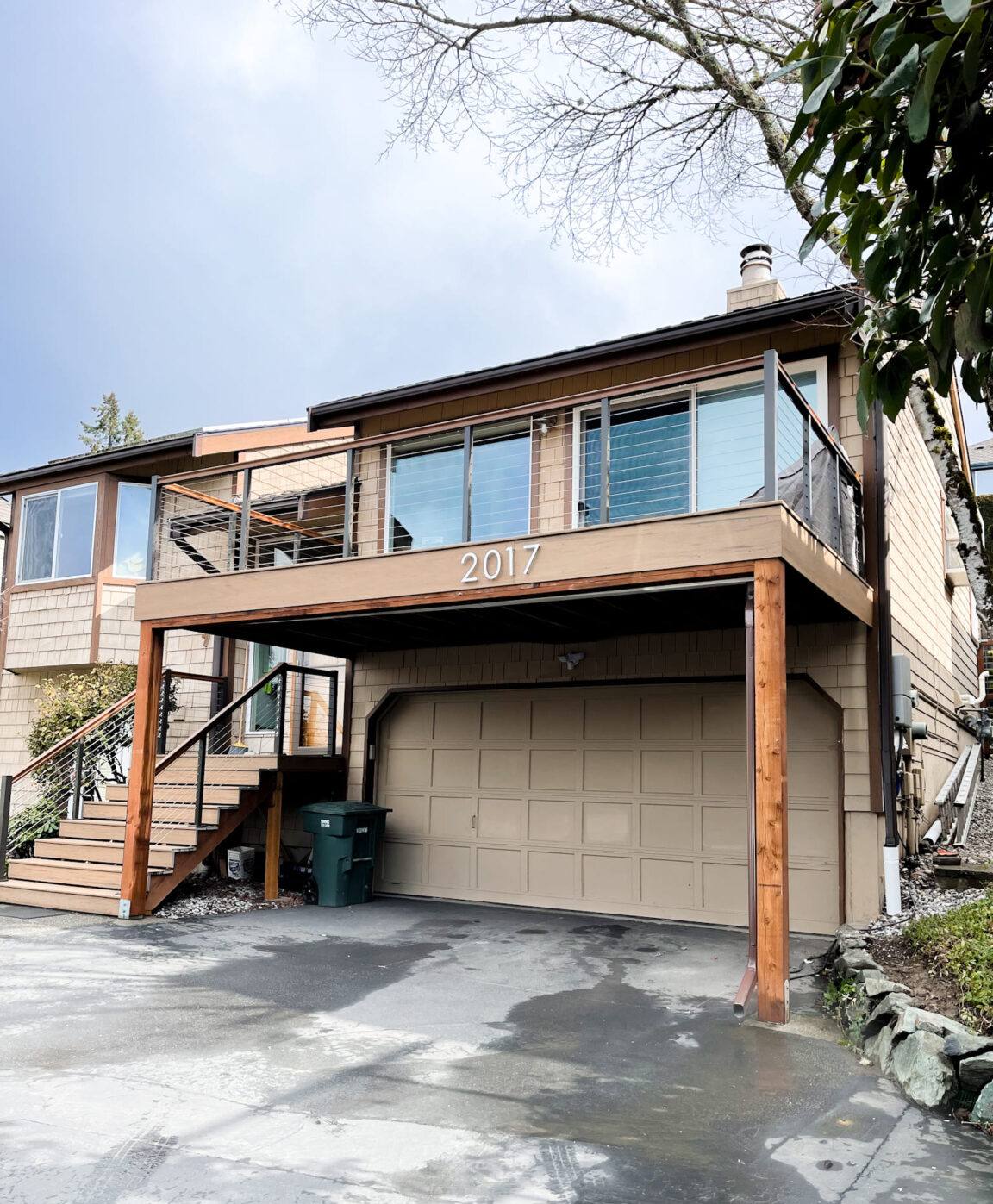
A deck is really three separate systems stacked on top of each other: the structure (footings, posts, beams, joists), the connection to the house (ledger board and flashing), and the wearing surface (decking, railing, fasteners). Each one has its own failure points in a wet, salty climate, and each one needs to be addressed on its own terms rather than treated as an afterthought to the decking choice.
Framing and Fasteners
Standard interior-grade screws and joist hangers have no business on an exterior deck in this region. We use fasteners and structural connectors rated for exterior and coastal exposure — stainless steel or heavy hot-dip galvanized, not the thin electro-galvanized coating that's fine for a dry climate but starts rusting at the head within a season or two of salt air and standing moisture. The same goes for joist hangers, post bases, and any structural hardware: it needs a coating or alloy built for corrosion resistance, because replacing a rusted-through joist hanger means tearing into a deck that otherwise still has a lot of life left in it.
Footings and Posts
Footing depth and post connections need to account for our soil drainage and frost behavior, and posts should sit on bases that keep end grain off wet concrete and out of standing water. Wood posts set directly into or against damp concrete are one of the more common rot points we find on older decks in this area.
Decking Material: What Actually Holds Up
There's no single "best" decking material — there's a best material for a given budget, maintenance appetite, and how much shade and moisture the deck will sit under. In a moss-prone climate like Whatcom County's, shaded and low-airflow decks are harder on every material, so the comparison below assumes typical mixed sun/shade conditions.
| Material | Moisture Behavior Here | Maintenance | Typical Lifespan |
|---|---|---|---|
| Pressure-treated wood | Prone to cupping, splintering, and moss growth if not sealed regularly | Annual cleaning and re-sealing recommended | 10–15 years with upkeep |
| Cedar | Naturally rot-resistant but still needs seasonal care against moss and gray-out | Periodic cleaning and oiling | 15–20 years with upkeep |
| Composite decking | Resists rot and moisture absorption; can still grow surface moss in deep shade | Occasional wash; no sealing | 25+ years |
| PVC/capstock decking | Fully moisture-resistant surface; best performance in wet, shaded spots | Occasional wash | 25–30+ years |
We'll tell you honestly if composite or capstock decking is overkill for a small, sunny deck, and we'll tell you when it's worth the extra cost for a shaded deck under trees where moss and moisture are constant. What we won't do is put real wood decking down over a poorly drained or heavily shaded area and let you find out the hard way that it needs re-sealing every single year to stay ahead of moss.
Drainage: The Part Nobody Sees That Determines How Long It Lasts
Most deck failures we get called out for aren't decking failures — they're drainage failures underneath decking that looked fine on the surface. In a climate with as much driving rain as Whatcom County sees, water management below the deck boards matters as much as the boards themselves.
- Joist tape or flashing tape on top of every joist to keep fastener penetrations from becoming rot points
- Proper gapping between boards so water sheds through instead of pooling
- Grading and a drainage path underneath the deck so water doesn't sit against posts and footings
- Ledger flashing that actually directs water away from the house band board, not just a bead of caulk
- Gutter or drip-edge coordination where a roofline dumps water directly onto or near the deck
Skipping joist tape is one of the most common corners cut on lower-bid deck jobs, because it's invisible once the decking goes down — and it's also one of the fastest ways to end up with rotted joists hiding under a deck that still looks new from the top.
The Ledger Connection: Where Most Serious Failures Start
The ledger board — where the deck attaches to the house — is the single highest-consequence connection on the entire structure, because a ledger failure means the deck can pull away from the house. It's also one of the most common places for hidden water intrusion, since the ledger sits directly against the house's sheathing and siding.
A correct ledger installation includes proper flashing integrated with the house's water-resistive barrier (not just surface-applied over existing siding), lag bolts or through-bolts sized and spaced to code rather than a handful of screws, and a small air gap or flashing detail that keeps water from wicking between the ledger and the house band board. Done wrong, moisture gets trapped behind the ledger and you don't find out until there's visible rot or a soft spot years later. This is one of the areas where we spend real time even though it adds very little to the visible finished product — it's the part of the job that decides whether the deck is structurally sound in year fifteen.
How Our Process Works
We keep the process straightforward and make sure you know what's happening at each stage before we move to the next one.
- Site evaluation: We look at grade, drainage, sun/shade exposure, existing structure condition (for replacements), and how the deck ties into the house.
- Design and material selection: We walk through decking, railing, and fastener options honestly, including trade-offs in cost, maintenance, and how each performs given the deck's specific exposure.
- Permitting: Deck permits and inspections are handled through the local jurisdiction; we manage that process rather than leaving it to the homeowner.
- Demolition (for replacements): Old decking, framing, and any hidden rot get removed and assessed before rebuilding on top of anything questionable.
- Structural build: Footings, posts, beams, and joists go in with corrosion-resistant hardware and proper drainage detailing from the start.
- Decking, railing, and finish work: Surface materials go on with correct gapping and fastening for the chosen product.
- Final walkthrough and inspection: We review the finished deck with you and coordinate any required local inspection sign-off.
Maintaining a Deck Through a Whatcom County Winter
Even a well-built deck needs some seasonal attention in this climate, particularly around moss and standing moisture. A little bit of regular upkeep goes a long way toward getting the full lifespan out of the materials.
- Sweep leaves and debris off the deck surface regularly through fall — trapped organic matter is what feeds moss and holds moisture against the boards
- Check and clear any gaps between boards that have filled with debris, since that blocks the drainage the gapping was designed for
- Look underneath the deck once a year for standing water, soft framing, or hardware showing rust
- For wood decking, plan on cleaning and re-sealing on a regular cycle rather than waiting until it looks gray and weathered
- Keep gutters and downspouts near the deck clear so roof runoff isn't dumping extra water onto the structure
- Wash composite or PVC decking periodically to keep surface moss and algae from getting a foothold, especially in shaded corners
What Affects Cost
Deck pricing varies enough by size, material, and site conditions that we won't quote a number without seeing the site, but these are the main factors that move the price up or down.
| Factor | Why It Matters |
|---|---|
| Decking material | Composite and PVC cost more upfront than wood but need less long-term maintenance |
| Deck height and footing depth | Taller decks and deeper footings mean more structural work and material |
| Site access and grade | Steep or hard-to-reach sites add labor time for excavation and material handling |
| Railing style | Cable, glass, and metal railing systems cost more than standard wood or composite balusters |
| Demolition scope | Replacing an existing deck with hidden rot can require more removal and repair than a straightforward tear-off |
| Permitting requirements | Deck size, height, and attachment to the house determine what permitting and inspection is required |
Why a Crew That Already Works Columbia Matters
A deck built for the wrong climate assumptions doesn't fail on day one — it fails quietly over several winters, usually starting underneath where nobody's looking. Working regularly in Whatcom County means we're not guessing at how much moss pressure a shaded deck will see, how much salt exposure affects hardware near the water, or how much rain a ledger connection needs to shed. Those are things you learn from building and repairing decks in this specific climate, not from a generic build spec.
It also means straightforward answers about local permitting, realistic timelines around our wetter months, and a crew that stands behind the work because we're not driving in from somewhere else for a one-off job. If you're planning a new deck in Columbia or looking at replacing one that's showing its age, we're glad to take a look and give you a straight, no-pressure estimate — no obligation, just an honest read on what your specific site needs.