 Whatcom County
 Why Decks in Blaine Take More Abuse Than Decks Inland
Blaine sits right where Whatcom County meets saltwater, and that location shapes everything about how a deck ages here. Salt-laden air off the water accelerates corrosion on anything metal — fasteners, joist hangers, railing brackets — long before the decking material itself shows wear. Add in the driving rain that comes through this stretch of the Pacific Northwest in fall and winter, plus a moss season that can stretch six months or more under tree cover and on north-facing exposures, and you've got a combination that punishes decks built to a generic, one-size-fits-all spec.
None of this means a deck in Blaine can't last decades. It means the build has to account for the actual conditions instead of copying a plan meant for a drier, inland climate.
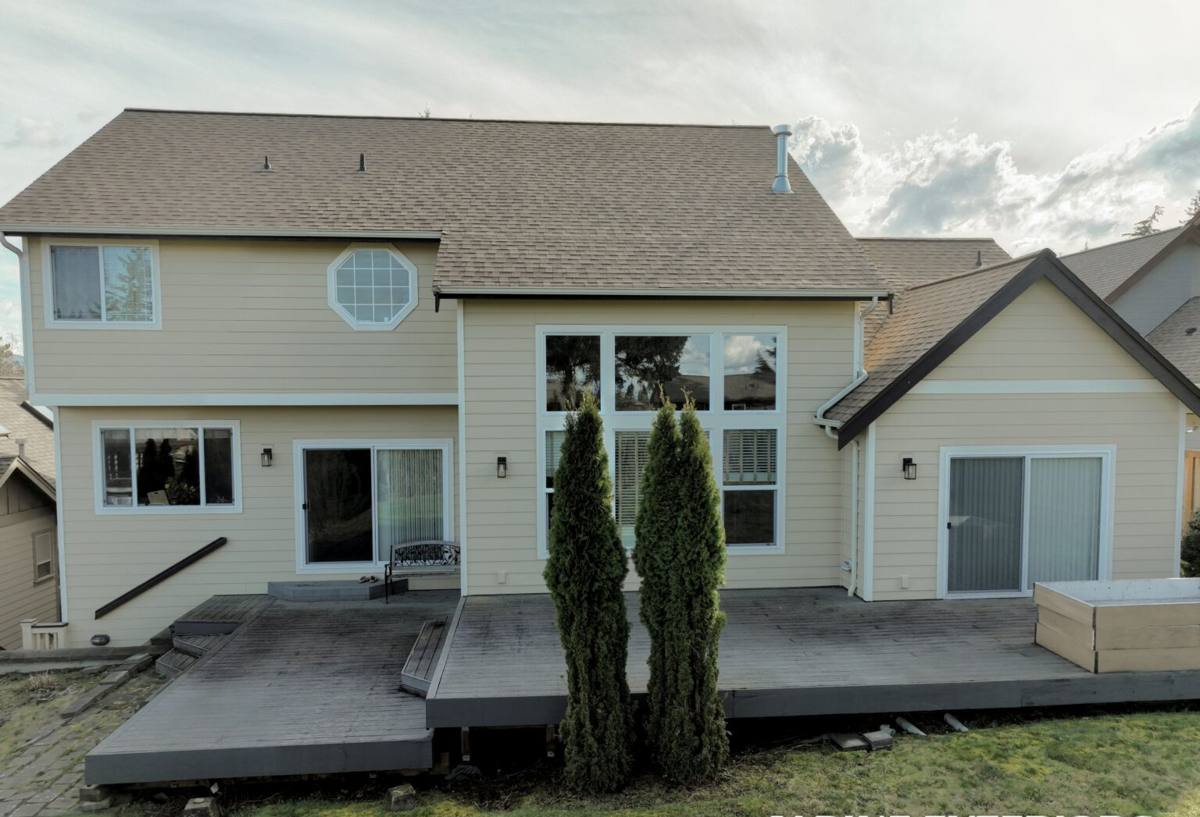
What Composite Decking Actually Solves — and What It Doesn't
Composite decking is a good fit for this climate for specific reasons, not because it's maintenance-free in any absolute sense — no exterior product is.
Where composite helps
- It doesn't absorb water and swell the way wood fibers do, which matters when a deck sits wet for days at a time.
- It doesn't need annual staining or sealing to keep moisture out.
- Modern capped composite resists the kind of surface staining that mildew and organic debris cause on bare wood.
- It won't splinter, cup, or check the way lumber does after repeated wet-dry cycles.
Where it still needs attention
Composite boards can still grow moss, algae, or mildew on the surface if they stay damp and shaded, especially in low-airflow spots near fences or under overhangs. The board itself resists rot, but a dirty or debris-packed surface will still look bad and can get slippery. Composite is also not a substitute for a well-built substructure — the framing underneath still has to manage water correctly, or problems show up at the ledger board and posts long before the decking wears out.
Picking the Right Composite for a Coastal, Wet Climate
Not every composite product performs the same way once it's exposed to years of Whatcom County weather. The main distinction worth understanding is capped versus uncapped composite.
Capped composite
Capped boards have a shell wrapped around the wood-plastic core, which gives much better resistance to moisture intrusion, staining, and fading. In a climate with this much rain and salt air, that outer shell is doing real work — it's the layer keeping water out of the core over the long run.
Uncapped composite
Uncapped composite is generally less expensive up front but more prone to moisture absorption at the core over time, along with more visible surface staining and fading. We're upfront with clients about this trade-off rather than pushing whichever product has the better margin — it's a decision about how much maintenance and how long a lifespan you want, not a right-or-wrong answer.
Color and surface texture
Darker composite boards run hotter in direct sun and can show mineral deposits and water spotting more visibly after rain. Lighter and mid-tone colors tend to hide the fine dust and pollen that collects on any deck surface near mature trees, which is common on Blaine properties with established landscaping.
What a Correct Composite Installation Involves
The decking boards get most of the attention, but the parts that determine whether a deck lasts are mostly hidden once the job is done.
Framing and joist spacing
Composite decking generally requires tighter joist spacing than solid wood decking — most manufacturers call for 16 inches on-center for standard installations, and often less for diagonal patterns or specific board lines. Framing built to a wood-decking spec and then covered with composite is a common shortcut that leads to noticeable flex and bounce over time.
Fasteners and hardware
This is where Blaine's salt air makes the biggest difference. Standard galvanized fasteners corrode faster this close to saltwater than they would twenty or thirty miles inland. We spec stainless steel or coated fasteners rated for coastal exposure on hardware, hidden fastener clips, and joist hangers — the upfront cost difference is small compared to what it costs to deal with rust streaks or hardware failure five years in.
Flashing at the ledger board
Where the deck attaches to the house is the single most common point of hidden water damage. Proper ledger flashing, correctly lapped with the house's water-resistive barrier, keeps driving rain from working its way behind the board and into the rim joist. We treat this as non-negotiable, not an upsell.
Board gapping and expansion
Composite boards expand and contract with temperature more than most homeowners expect. Gapping them incorrectly leads to buckling in warm weather or excessive gaps that catch debris in cold weather — both avoidable with correct spacing at installation.
Drainage, Airflow, and Keeping Moss Off the Surface
Moss doesn't need much to get established — shade, moisture, and still air are enough. A deck design that ignores airflow underneath and around the perimeter is setting itself up for a moss and algae problem regardless of what decking material sits on top.
Underneath the deck
Low-clearance decks with poor ventilation trap moisture underneath, which keeps the underside of boards damp long after the surface has dried. Where grading allows, we build in enough clearance and airflow paths to let the space underneath actually dry out between rain events.
Grading and runoff
Water shed off the decking surface has to go somewhere. If the ground beneath or around a deck doesn't drain, that moisture sits and re-wets the structure from below — one of the more common reasons a deck that looks fine on top has soft framing underneath.
Gaps and debris
Needles, leaves, and moss spores collect in board gaps and around posts. A deck built with slightly wider gaps in shaded, high-debris areas is easier to keep clear with a hose or blower than one built to the tightest possible spec everywhere.
How We Approach a Composite Decking Project in Blaine
1. On-site assessment
We look at sun exposure, tree cover, proximity to water, existing drainage, and the condition of any structure we're building onto or replacing. A deck on a shaded, north-facing lot near the water gets different recommendations than one in full sun set back from the shoreline.
2. Framing evaluation or rebuild
If we're replacing an existing wood deck's surface, we check the substructure before assuming it's reusable. Composite is heavier than most homeowners expect, and framing that's been sitting in wet Whatcom County soil for years often needs sistering, replacement, or additional support before it's ready to carry new decking.
3. Installation
Correct joist spacing, coastal-rated fasteners, proper flashing, and manufacturer-specified gapping — done in that order, not skipped to save time.
4. Walkthrough and care guidance
We show you what routine maintenance actually looks like for your specific board and site conditions, rather than handing over a generic care sheet.
Composite vs. Wood Decking for Blaine Conditions
| Factor | Composite Decking | Wood Decking |
|---|---|---|
| Upfront cost | Higher material cost | Lower material cost |
| Maintenance | Periodic washing; no staining/sealing | Annual sealing or staining recommended |
| Moisture absorption | Low, especially capped boards | Higher; swells and checks with wet-dry cycles |
| Moss/algae on surface | Can occur in damp, shaded spots; cleans off easily | Common; also promotes surface rot over time |
| Fastener/hardware needs | Coastal-rated fasteners still required | Coastal-rated fasteners still required |
| Typical lifespan (well-built, coastal climate) | 25-30+ years with proper substructure | 10-15 years before major refinishing/replacement |
These are general ranges, not guarantees — actual lifespan depends heavily on site conditions, sun and shade exposure, and how well the substructure was built in the first place.
Questions Worth Asking Before You Hire
- Do they check and, if needed, upgrade the framing before installing new decking, or just cover what's there?
- Do they use stainless or coated fasteners rated for coastal exposure, or standard galvanized hardware?
- Do they flash the ledger board where the deck meets the house, and can they explain how?
- Do they follow the manufacturer's joist spacing and gapping specs for your specific composite product?
- Have they worked on decks in Blaine or similar coastal Whatcom County conditions before, and can they speak to what that's changed about how they build?
Maintaining a Composite Deck Once It's Built
Composite decking cuts down on maintenance, but "low-maintenance" isn't "no-maintenance," especially in a climate with a long wet season and salt air.
- Rinse or sweep debris out of board gaps regularly, particularly in shaded areas and near the shoreline.
- Wash the surface a couple of times a year with a soft-bristle brush and mild soap to prevent mildew and moss buildup before it sets in.
- Check hardware and railing connections periodically for early signs of corrosion, even with coastal-rated fasteners.
- Keep gutters and downspouts near the deck clear so runoff isn't dumping extra water onto or under the structure.
If you're weighing composite decking for a home in Blaine, we're happy to take a look at your site and existing structure and give you a straight answer on what it would take to do the job right — no pressure, no generic sales pitch. Fill out the form below for a free estimate.