 Whatcom County
 Why Sunnyland Roofs Wear Out Differently
Sunnyland sits close enough to the water and open enough to the weather that its roofs take a different kind of beating than a roof twenty miles inland. Salt-laden air off the bay accelerates corrosion on anything metal — nail heads, flashing, gutter fasteners, vent caps. Driving rain, pushed sideways by wind off the water, finds gaps that a straight-down rain never would, working its way under shingle tabs and around chimney flashing. And Whatcom County's long, damp shoulder seasons give moss and moisture months at a time to sit on a roof surface without a real dry-out period.
None of that means Sunnyland roofs fail faster than they should. It means they need to be built and replaced with those specific stresses in mind — not with a generic install that would be fine in a drier, calmer part of the state.
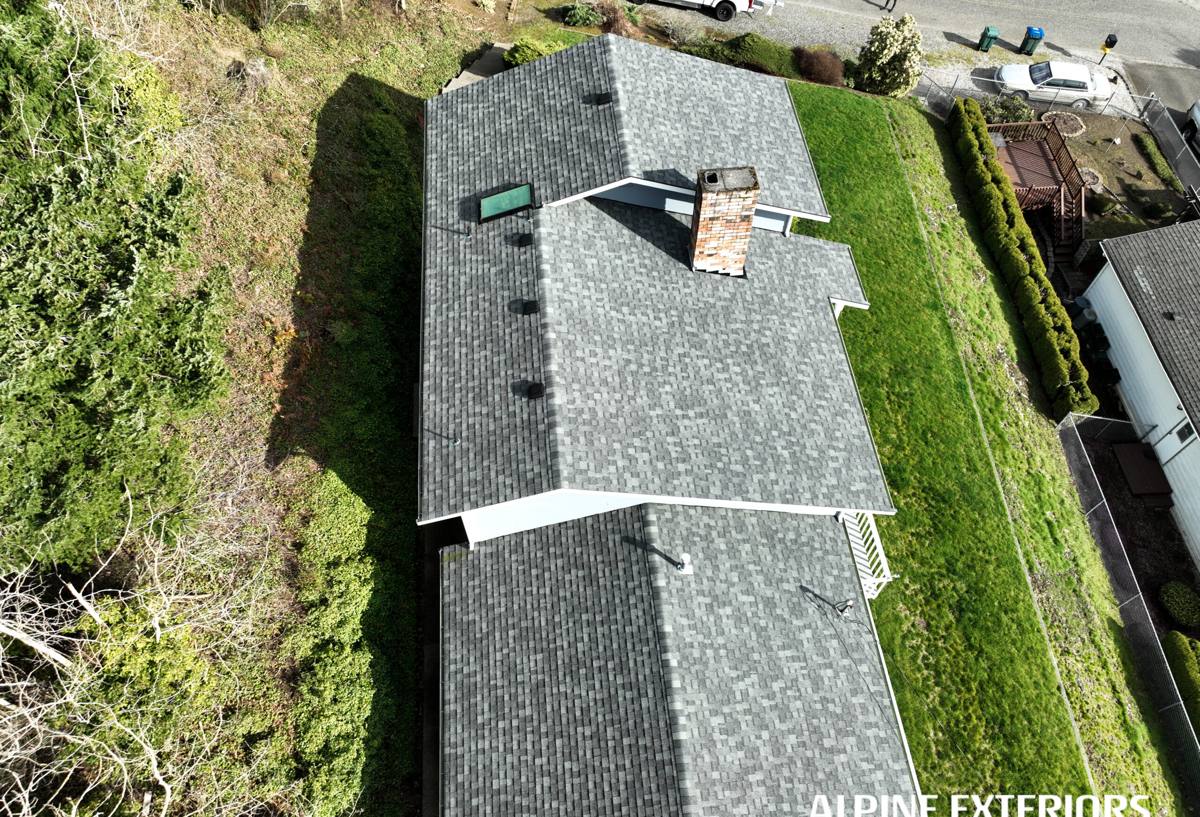
Signs a Sunnyland Roof Needs Replacement, Not Another Repair
Homeowners often ask us to patch a problem that's really a sign the whole roof system is past its useful life. Some patches are the right call. Others just delay a bigger cost and risk water getting into the structure underneath. A few things that usually point toward full replacement rather than another repair:
- Granule loss heavy enough that you can see bare, shiny patches on multiple shingles, not just one or two
- Shingles that are cupping, curling at the edges, or cracking when you press on them
- Moss that keeps coming back within a season or two of cleaning, especially on north-facing slopes
- Soft spots in the decking you can feel when walking the roof, or sagging visible from the ground
- Flashing around chimneys, skylights, or valleys that's rusted, lifted, or was never properly step-flashed
- Repeated interior leaks in different spots after storms, rather than one consistent trouble area
- A roof already at or past 20-25 years old for asphalt products in this climate
If you're only seeing one or two of these, a repair may genuinely be the right move, and we'll tell you that. Replacement makes sense when the underlying system — deck, underlayment, flashing, ventilation — is showing its age together, not just the shingles on top.
What a Correct Roof Replacement Actually Involves
A roof replacement is more than swapping old shingles for new ones. In a climate that mixes salt air, wind-driven rain, and moss pressure, the layers underneath the shingles matter as much as the shingles themselves.
Tear-Off and Deck Inspection
We remove the existing roofing down to the deck rather than layering over it. That's the only way to actually see the wood underneath — soft, delaminated, or water-stained sheathing gets replaced before anything new goes down. Roofing over a compromised deck just hides a problem that will surface again, usually as a leak in a finished ceiling.
Underlayment and Ice/Water Protection
A synthetic underlayment goes down as the roof's secondary water barrier, with self-adhering ice-and-water shield reinforcing the vulnerable spots — eaves, valleys, around penetrations, and low-slope transitions. In a region that gets driving rain rather than just straight-down rain, this layer is doing real work, not just satisfying code minimums.
Flashing
Flashing around chimneys, skylights, sidewalls, and valleys is where most roof leaks actually start, not in the field of the shingles. We use new step flashing, counter-flashing, and valley metal rather than reusing old pieces, and we pay particular attention to material compatibility near the coast — mixing metals that react with each other accelerates corrosion in salt air.
Ventilation
A roof that can't breathe traps moisture in the attic, which shortens shingle life and feeds moss growth from underneath as well as on top. We check intake at the soffits and exhaust at the ridge and correct the balance where it's off, rather than just replacing the roofing over an attic that's already trapping condensation.
Material Comparison for Sunnyland's Climate
There's no single "best" roofing material for every home — it depends on budget, roof pitch, architectural style, and how much long-term maintenance a homeowner wants to take on. Here's how the common options stack up for a coastal Whatcom County property specifically.
| Material | Coastal/Moisture Performance | Maintenance | Typical Lifespan |
|---|---|---|---|
| Architectural asphalt shingle | Good with proper underlayment and flashing; algae-resistant granules help with moss/moss-stain pressure | Periodic moss and debris removal | 25-30 years |
| Standing seam metal | Excellent water shedding on steeper pitches; needs coastal-rated fasteners and coatings to manage salt exposure | Low; occasional fastener and sealant checks | 40-50+ years |
| Cedar shake | Traditional PNW look, but sustained damp and moss pressure demands disciplined upkeep to avoid rot | High; regular treatment and moss control | 20-30 years with upkeep |
| Synthetic composite shingle | Resists moisture absorption and moss better than wood; consistent performance near the coast | Low to moderate | 30-50 years depending on product |
We don't push one product on every roof. A steep, highly visible roofline might be a great candidate for standing seam metal, while a straightforward gable roof on a budget often makes more sense with a quality architectural asphalt shingle. We'll walk through the real trade-offs — not just the sales pitch — for your specific roof.
Our Replacement Process
- On-site inspection. We walk the roof and the attic, not just look from the driveway, and photograph problem areas so you can see what we see.
- Written estimate. A clear scope of work — materials, underlayment, flashing approach, ventilation corrections, and price — with no vague allowances buried in the fine print.
- Scheduling around weather. We plan tear-off days around forecasted dry windows, and we don't leave a roof deck exposed overnight without protection if rain is a realistic risk.
- Tear-off and deck repair. Old roofing comes off, the deck gets inspected, and any soft or damaged sheathing is replaced before anything new is installed.
- Underlayment, flashing, and ventilation. The layers that actually keep water out go in correctly, not just quickly.
- Shingle or material installation. Installed to manufacturer specification, which matters for both performance and keeping your warranty valid.
- Final walkthrough and cleanup. We check the finished roof with you, haul away debris, and do a magnetic sweep for stray nails in the yard and driveway.
Moss and Moisture: The Long Game
Because Whatcom County stays damp for so much of the year, moss isn't a one-time problem you solve during a roof replacement — it's an ongoing condition you manage. A new roof gives you a clean start and, with algae-resistant shingle granules or metal roofing, a real head start against regrowth. But shaded, north-facing slopes near trees will still collect moisture and organic debris over time.
Part of doing this job right is setting a homeowner up to maintain that advantage: keeping gutters clear so water doesn't back up under the shingle edge, keeping overhanging branches trimmed back so the roof gets some sun and airflow, and doing gentle moss removal (not high-pressure washing, which can strip granules) every year or two rather than waiting until it's established.
Timing a Replacement Around Whatcom County Weather
Roofing work depends on dry, workable conditions, and this region doesn't hand those out generously outside of a few months a year. Late spring through early fall typically offers the most reliable stretch of dry days, which is also when most roofing companies are busiest. Replacing a roof in the shoulder seasons is possible and sometimes necessary — especially if a roof is actively failing — but it takes tighter scheduling and more weather contingency planning to do safely. We'll be straightforward with you about the trade-offs of timing your project for peak season versus getting it done sooner.
Why a Crew That Already Works Sunnyland Matters
Roofing crews that work Whatcom County regularly build a practical sense of how homes in this specific area age — which rooflines collect moss fastest, which flashing details tend to fail first near the coast, and how to sequence a tear-off around this region's rain patterns instead of guessing. That local pattern recognition shows up in fewer callbacks and fewer surprises mid-project, not in anything flashy.
It also matters for the practical side of the job: knowing local permitting requirements, being familiar with the area's typical roof access and staging constraints, and being reachable afterward if a question comes up rather than being a crew that worked one job in the neighborhood and moved on.
What to Ask Before You Hire a Roof Replacement Contractor
- Is the estimate a detailed written scope, or a vague one-line price?
- Does it specify underlayment type, flashing approach, and ventilation plan — not just "shingles"?
- Is the contractor licensed and insured in Washington, and will they provide proof?
- Do they tear off down to the deck and inspect it, or offer to roof over the existing layer?
- What manufacturer warranty applies, and does their installation method keep that warranty valid?
- Will they walk you through material options and trade-offs, or just quote one product?
- Do they have a plan for weather delays and deck protection if rain moves in mid-project?
If your Sunnyland roof is showing its age or you just want an honest read on where it stands, we're happy to take a look. A free estimate comes with a real inspection and a clear, written scope — no pressure, and no surprise line items later. Fill out the form below and we'll get in touch.