 Whatcom County
 Edgemoor Roofs Face a Different Kind of Wear
Edgemoor sits close enough to the water that homes here take on a mix of stresses most inland Whatcom County neighborhoods don't deal with in the same combination. Salt-laden air off the bay accelerates corrosion on fasteners, flashing, and any exposed metal. Driving rain off winter storms doesn't just fall straight down — it gets pushed sideways under eaves and around chimneys, finding gaps that a calmer rain would never reach. And the tree cover that gives the neighborhood its character also means a long moss season that keeps roof surfaces damp for weeks at a stretch.
None of that damage happens all at once. It's usually one storm that loosens a ridge cap, followed by months of moisture working into that opening before anyone notices a stain on a ceiling. Storm damage repair in this part of Whatcom County is as much about catching what a storm started as it is about the storm itself.
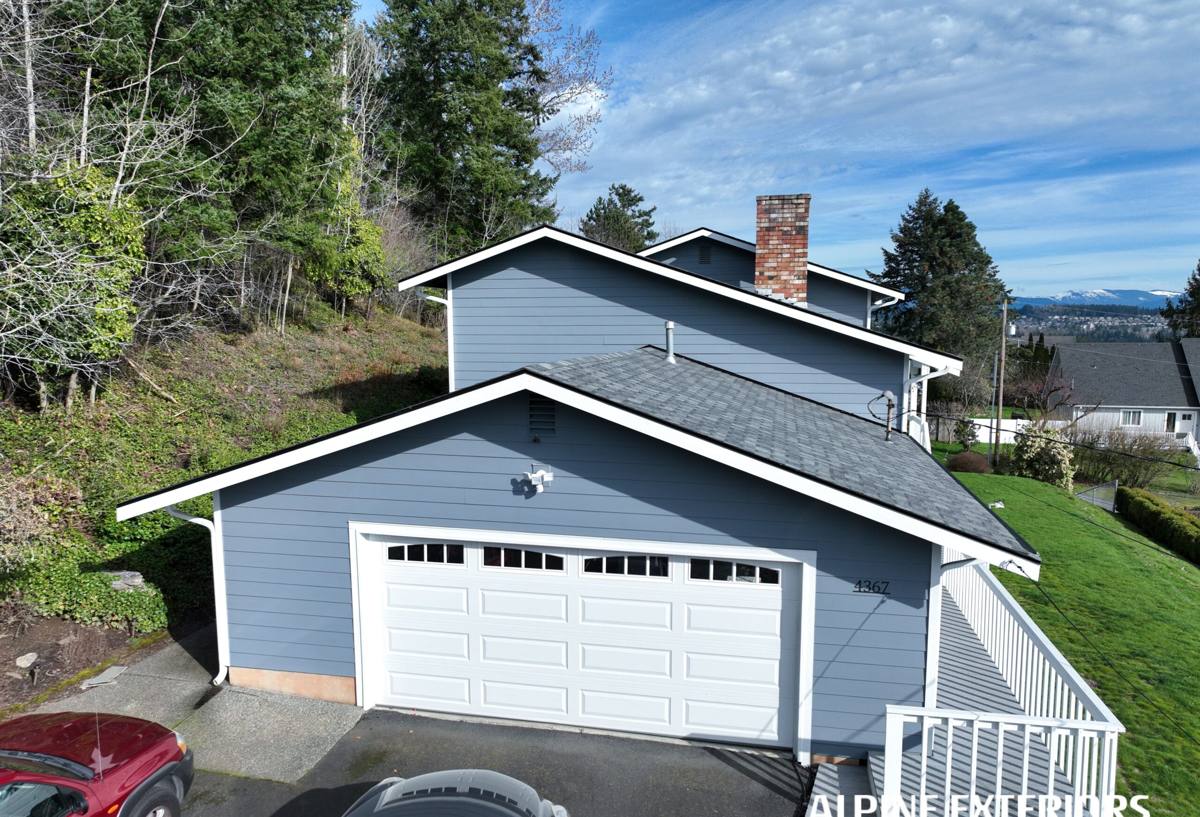
What Actually Counts as Storm Damage
The Damage You Can See
Missing or torn shingles, bent or lifted metal flashing, a cracked ridge vent, or debris punched through the roof deck are the obvious signs. After any windstorm strong enough to drop branches in the yard, it's worth a look at the roofline from the ground for anything out of place — shingles that look darker or lighter than the surrounding field usually mean the surface granules were stripped off or the shingle itself shifted.
The Damage You Can't
The more expensive kind of storm damage is the kind that doesn't show up until later. Wind can lift the seal strip on a shingle without tearing it loose, leaving a gap that rain drives into during the next storm. Flashing around a chimney or skylight can pull away from its fasteners just enough to let water track down the inside of the wall rather than the outside. On a moss-prone roof, storm-loosened shingles give moss and moisture an entry point they wouldn't otherwise have, which is why a roof that "made it through the storm fine" can still develop a leak two or three rains later.
Signs It's Time to Call Someone
- Water stains on a ceiling or upper wall, especially after a wind-driven rain
- Shingles or shingle fragments in the yard or gutters after a storm
- Visible daylight through the attic roof deck
- Flashing that looks bent, lifted, or separated at a chimney, skylight, or wall intersection
- A sagging or soft spot anywhere on the roof plane
- Granules collecting in gutters or at downspout outlets in unusually large amounts
- Moss that has thickened noticeably in the weeks following a storm, especially near a repaired or disturbed area
What a Correct Storm Damage Repair Involves
Stopping Further Damage First
If a roof has an active leak or exposed deck, the first job is mitigation — tarping the affected area and making sure water isn't getting into the attic or walls while a full repair is scheduled. This isn't the fix itself, but skipping it while waiting on materials or an insurance adjuster is how a manageable repair turns into a much larger one.
A Real Inspection, Not a Guess From the Ground
A proper assessment means getting on the roof, not just looking at it from the driveway. That includes checking the attic from the inside for water tracking, staining, or wet insulation, since the entry point on the roof surface and the spot where water actually shows up inside a house are often several feet apart. We also check surrounding shingles, flashing, and fasteners for storm stress that hasn't failed yet but is close to it — replacing one shingle while ignoring three others that are about to lift is a repair that doesn't last.
Matching Materials and Proper Flashing Work
Repaired sections need to tie into the existing roof correctly — matching shingle profile and color as closely as possible, and reinstalling flashing with proper laps and fasteners rather than just sealing over a gap with roofing cement. Caulk and sealant have their place, but they're not a substitute for flashing that's mechanically correct. A patch that relies on sealant alone tends to fail again in the next hard rain, which in this area isn't a rare event.
How Our Process Works
- Initial call and photos if available — we get a sense of the damage and urgency before we arrive.
- On-site inspection — roof surface, attic interior, flashing points, and surrounding areas that took the same storm exposure.
- Written scope and honest options — what needs to happen now, what can reasonably wait, and what a full replacement would look like if the roof is past the point of patching.
- Emergency mitigation if needed — tarping or temporary sealing to stop active water intrusion.
- Repair work — matched materials, correct flashing, and a final check for anything else the storm may have loosened nearby.
- Documentation — photos and a written summary you can hand directly to an insurance adjuster if you're filing a claim.
Repair or Replace: What Actually Tips the Decision
Not every storm-damaged roof needs to come off. But a roof that's already near the end of its service life often makes replacement the more honest recommendation once storm damage is factored in.
| Factor | Points Toward Repair | Points Toward Replacement |
|---|---|---|
| Age of roof | Under 12-15 years, in otherwise good condition | Near or past manufacturer's expected service life |
| Extent of damage | Isolated to one section or a few shingles | Spread across multiple slopes or repeated storm hits over time |
| Underlying deck condition | Solid, no rot or soft spots found | Soft decking, staining, or rot found during inspection |
| Moss and moisture history | Minor moss, roof has been maintained | Heavy moss growth with signs of long-term moisture retention |
| Insurance coverage | Claim covers a targeted repair | Adjuster's scope supports full slope or full roof replacement |
An honest contractor will tell you when a repair is genuinely the right call — pushing every job toward a full replacement isn't a service to the homeowner, and it isn't how we approach a roof that doesn't need it.
Salt Air, Moss, and the Long Game
Metal Components Wear Faster Near the Water
Nails, flashing, and vent components corrode faster with regular salt-air exposure than they would further inland. When we repair a section of roof in Edgemoor, we default to fasteners and flashing rated for that exposure rather than whatever would be fine on a roof twenty miles east, because a repair that corrodes prematurely just means a second repair down the road.
Moss Isn't Just Cosmetic
Whatcom County's wet, mild climate and Edgemoor's tree cover make moss close to unavoidable without regular maintenance. Left alone, moss holds moisture against the shingle surface, works into seams and under tab edges, and accelerates the exact kind of granule loss and shingle lifting that makes a roof more vulnerable the next time a storm comes through. Keeping moss knocked back — physically removed, not just chemically browned — is one of the more cost-effective things a homeowner here can do between storms.
Why It Matters That We Already Work This Area
A contractor who regularly works Edgemoor and the surrounding Bellingham waterfront neighborhoods already knows what a house exposed to this much salt air and rain has usually got going on before we even climb the ladder — which fastener types tend to be under-spec'd for the exposure, which flashing details tend to fail first, and how aggressive the moss growth typically is by the time a homeowner calls. That's not a substitute for a real inspection, but it means fewer surprises and a scope that's accurate the first time, rather than one that grows once work is underway.
It also means we're not learning Whatcom County's storm patterns from scratch. Wind direction, typical storm timing, and how a given roof pitch and orientation tend to hold up here all inform how we prioritize a repair and what we flag as worth watching, even if it isn't urgent yet.
Working With Your Insurance Claim
Most storm damage repairs in this area involve an insurance claim, and the process goes more smoothly when the documentation is thorough from the start. We provide photos of the damage, a written scope of the repair, and are available to walk an adjuster through what we found if that's helpful. We don't inflate a scope to chase a bigger payout, and we won't downplay damage to make a job look simpler than it is — our job is to give you and your insurer an accurate picture so the claim gets resolved fairly.
If a recent storm has you wondering whether your Edgemoor roof came through it clean, we're glad to take a look. The estimate is free, there's no pressure to move forward, and if the answer is "you're fine," we'll tell you that too — just fill out the form below.