 Whatcom County
 Why Silver Beach Homes Take a Different Kind of Beating
Silver Beach sits in a part of Whatcom County where a home's siding rarely gets an easy year. Depending on where a house sits, it might be dealing with salt-laden air drifting in off the water, wind-driven rain that hits the wall assembly sideways instead of straight down, and a moss season that can start in October and not really let go until June. None of those things are dramatic on their own. The problem is that they stack, week after week, for decades, and most siding products were never engineered with that combination in mind.
Wood siding swells and shrinks with every wet-dry cycle. Vinyl doesn't rot, but it doesn't stop moisture either — it just directs it, sometimes into places you can't see until there's a problem. Composite panels that use wood fiber as a core material are chasing the same moisture math wood always has, just with a different marketing story. In a climate like this one, the siding material itself has to be the thing that resists water, not the paint on top of it or the caulk between the joints.
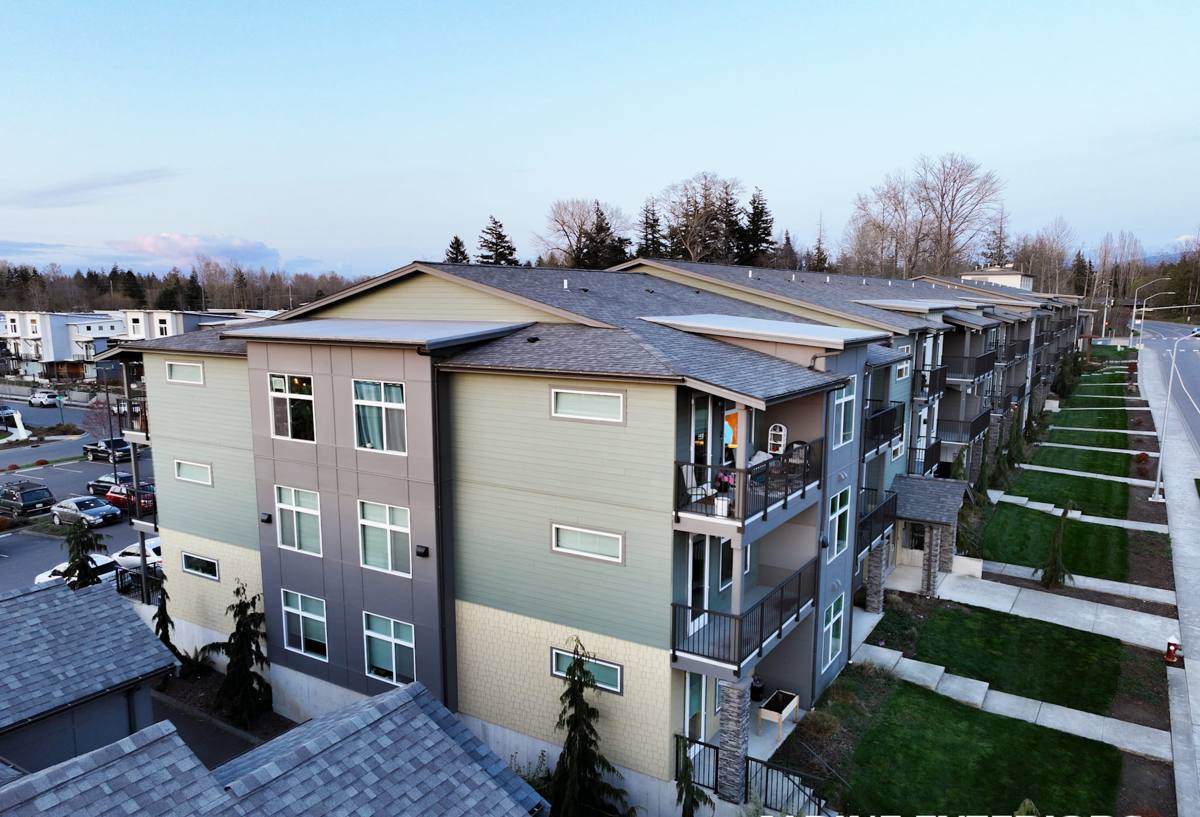
What "Fiber Cement" Actually Means for a House Like Yours
Fiber cement siding is made from cement, sand, and cellulose fiber, cured into a dense, stable board. It doesn't absorb water the way wood does, it doesn't expand and contract with temperature the way vinyl does, and it's non-combustible — a real advantage during the dry stretches of late summer even in a generally wet county. For a Silver Beach property, the practical benefits show up in a few specific ways:
- Dimensional stability: fiber cement doesn't cup, warp, or telegraph seams the way wood lap siding can after a few wet winters.
- Moisture resistance at the material level: the board itself sheds and resists water instead of relying entirely on paint film to keep it out.
- Better footing for a factory finish: a stable substrate holds a baked-on finish far longer than a substrate that's still moving.
- Salt air tolerance: unlike bare wood or unprotected metal accents, fiber cement doesn't corrode, and a factory-cured finish holds up better against airborne salt than field-applied paint.
- Fire resistance: not the main reason most homeowners call us, but a real difference from wood-based products.
Why We Only Install James Hardie
"Fiber cement" isn't one product — it's a category, and the boards in it aren't interchangeable. We install James Hardie exclusively, and we turn down LP SmartSide, vinyl, Cemplank, Allura, and primed wood siding, not because those products have no place in the market, but because we've standardized our crews, our detailing, and our warranty conversations around one system that we trust to perform in this exact climate.
HardiePlank and the HZ5 Engineered Line
James Hardie engineers its siding by climate zone, and the Pacific Northwest falls under the HZ5 category — formulated for a wet, moderate-temperature climate rather than a dry or freeze-heavy one. That's a meaningful distinction in Whatcom County, where the challenge isn't extreme cold, it's sustained moisture exposure.
ColorPlus Technology
Most Hardie products we install use ColorPlus, a factory-applied finish baked onto the board in a controlled environment rather than sprayed or brushed on-site after installation. In a salt-air, high-moisture environment, that matters: a factory finish resists fading and chalking far better than field-applied paint, and it means touch-up, not a full repaint, when something scuffs.
The Warranty Behind It
James Hardie backs its siding with a long, transferable limited warranty, and ColorPlus finishes carry their own separate finish warranty. Warranty terms and coverage details are set by the manufacturer and worth reading directly rather than taking secondhand — we're glad to walk through the current documentation during an estimate.
What a Correct Installation Actually Involves
Fiber cement siding is only as good as the assembly behind it. We've seen plenty of Hardie siding fail early, not because the product was wrong, but because it was installed like vinyl or like wood, without respecting what the manufacturer's instructions actually call for. In a climate that sends rain sideways for months at a time, the details behind the siding matter as much as the siding itself.
- A continuous, correctly lapped water-resistive barrier behind the siding — not just tar paper stapled up quickly.
- Proper flashing at every window, door, and roofline intersection, integrated with the barrier so water sheds outward, not inward.
- Correct fastener type, spacing, and placement per Hardie's published installation guide — not a generic nail schedule.
- Minimum clearance between the bottom of the siding and roof lines, decks, and grade, so splashback and standing water don't sit against the board.
- Properly caulked and primed cut ends at every joint, since a factory finish only protects the face of the board — field cuts need to be sealed on site.
- Ventilation behind the cladding where the wall assembly calls for a rainscreen, which matters more in a consistently damp climate than in a dry one.
Skip any one of those steps and you can still end up with moisture problems behind a product that's rated to resist them. The board doesn't fail — the installation does.
How We Approach a Silver Beach Project
Every home is different, but the sequence we follow doesn't change:
- On-site assessment: we look at existing siding, sheathing condition where accessible, trim, flashing, and any signs of past moisture intrusion before quoting anything.
- Tear-off and inspection: once old siding comes off, we check the sheathing and framing underneath. Hidden rot or past water damage gets addressed before anything new goes up — covering a problem is worse than finding it.
- Water-resistive barrier and flashing: this is the layer that actually keeps water out of your walls. We treat it as the most important step in the job, not a formality.
- Hardie installation to spec: correct fastening, spacing, clearances, and sealed cut ends, following James Hardie's published details for our climate zone.
- Trim, caulking, and touch-up: finish details that determine how clean the job looks and how well it sheds water at every joint.
- Final walkthrough: we go over the finished work with you before calling the job done.
Cost Factors for Fiber Cement Siding in Silver Beach
Every quote is specific to the house, but the variables that move the number are consistent. We'd rather explain what drives cost up or down than throw out a number that doesn't mean anything until we've seen the house.
| Factor | Why It Matters |
|---|---|
| Tear-off complexity | Multiple layers of old siding, or siding over original wood lap, take more labor to remove and dispose of properly. |
| Sheathing and framing condition | Hidden rot found during tear-off needs repair before new siding goes up — this is the most common reason a quote changes mid-project. |
| Home shape and trim detail | Dormers, multiple gables, and heavy trim work all add cutting, fitting, and flashing time. |
| Product line and profile | Lap width, panel vs. plank, and shingle-style siding carry different material and labor costs. |
| Color and finish | Standard ColorPlus colors vs. custom field-painted finishes affect both material cost and long-term maintenance. |
| Access and site conditions | Steep lots, limited driveway access, or tight lot lines near neighboring homes can add setup and staging time. |
Living With Fiber Cement in a Moss-Heavy, Salt-Air Climate
One of the appeals of Hardie siding for homeowners here is how little it asks of you once it's up. It doesn't need repainting on the schedule wood does, and it doesn't need the periodic replacement panels vinyl sometimes does after impact or sun damage. That said, "low maintenance" isn't "no maintenance," especially in a climate with an eight-month moss season:
- Rinse siding periodically, especially on north-facing walls and areas shaded by trees, where moss and mildew get the most footing.
- Keep gutters clear so water isn't sheeting down the face of the siding during heavy rain events.
- Trim back vegetation that keeps a wall section shaded and damp — airflow does more to prevent moss than any cleaning product.
- Recaulk trim joints if you notice cracking or gaps over the years, since caulk has a shorter service life than the siding itself.
- Inspect after major windstorms for any dislodged trim or flashing, common in exposed areas closer to open water.
Why Hiring a Crew That Already Works This Area Matters
Whatcom County's mix of coastal exposure, lake-adjacent neighborhoods, and heavy tree cover means installation details that work fine in a drier climate can fall short here. A crew that installs siding across different regions of the country brings general competence, but a crew that works Whatcom County week in and week out has already seen how water moves on homes in this specific area — where moss builds up fastest, which wall orientations take the worst weather, and what flashing details actually hold up over a full wet season, not just on a technical spec sheet.
That local pattern recognition is part of what you're paying for when you hire a siding contractor. It's the difference between a crew that follows a manual and a crew that's watched what happens to that manual's details after five Whatcom County winters.
Get a Straight Answer for Your Home
If your siding is showing its age, or you're planning ahead before a small problem becomes a bigger one, we're happy to take a look and give you an honest read on where things stand. There's no pressure and no obligation — just a straightforward assessment and a written estimate for James Hardie fiber cement siding built for your specific home and its exposure. Use the form below to request a free estimate.