 Whatcom County
 Sehome sits close enough to Bellingham Bay that the weather off the water shapes how a home ages. Salt-laden air, wind-driven rain off the Sound, and a moss season that can stretch from October through May all work against exterior materials that weren't built for the Pacific Northwest. For homeowners in Sehome planning a siding project, the material and the installation matter more than the color chart — because whatever goes on the wall next has to survive years of the same conditions that wore out what's there now.
This page covers what siding installation actually looks like for a Sehome home: what the local climate demands, how a correct installation is built, and what our process looks like from first estimate to final walk-through.
What Whatcom County's Climate Does to Siding
Whatcom County's marine climate is mild compared to a lot of the country, but "mild" doesn't mean easy on a house. A few specific conditions do the real damage over time:
- Salt air: Proximity to Bellingham Bay means airborne salt settles on exterior surfaces, accelerating corrosion of fasteners, trim, and any metal components, and breaking down lesser paint and coating systems faster than in inland areas.
- Driving rain: Storms off the Sound don't just fall straight down — wind pushes rain sideways into wall assemblies, seams, and butt joints. A siding system that isn't detailed correctly at those points will eventually let water behind the cladding.
- Long moss season: Cool, damp conditions for much of the year create ideal growing conditions for moss and algae on north-facing walls, under eaves, and anywhere airflow is limited. Moss holds moisture against the surface, which is a problem for wood-based and wood-composite products in particular.
- Freeze-thaw cycling: Whatcom County doesn't get brutal winters, but it does get enough freeze-thaw swings to stress any siding material that absorbs and holds water.
None of these conditions are unusual for the region — every siding job in Sehome deals with them. The difference between a siding job that looks good for five years and one that holds up for decades comes down to the material chosen and how carefully it's installed.
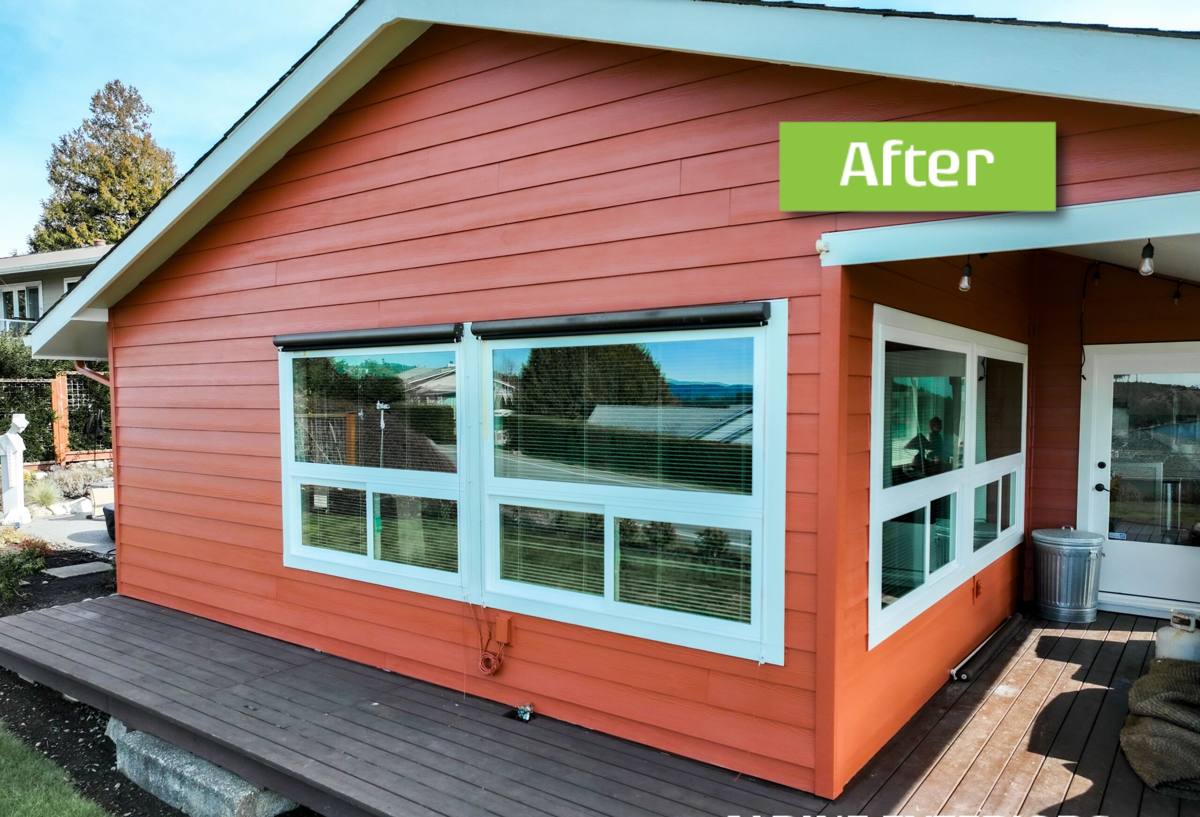
Why We Install James Hardie Fiber Cement Only
We install James Hardie fiber cement siding exclusively. We don't install vinyl, LP SmartSide, primed spruce, cedar, or other fiber cement brands like Cemplank or Allura. That's a deliberate standard, not a sales pitch, and it's worth explaining why.
Fiber cement is non-combustible, dimensionally stable, and doesn't feed moss or rot the way wood-based products can. James Hardie's ColorPlus factory-applied finish is baked on under controlled conditions, which gives it more consistent coverage and better fade resistance than field-applied paint — a real advantage in an area with this much rain exposure and UV cycling. Hardie also engineers specific product lines (their HZ5 line, for example) for climate zones like ours, accounting for moisture and temperature patterns rather than using a one-size-fits-all formulation.
We've looked at the alternatives and, for a Sehome home facing salt air and a long wet season, we don't think they hold up as well over the life of the siding. That's why we've standardized on one product line we can stand behind, backed by a strong transferable warranty, rather than offering several options with different long-term outcomes.
What a Correct Siding Installation Involves
Siding is a system, not just a surface. A proper installation in Sehome's climate involves several layers working together:
Removal and Inspection
Old siding comes off first, which exposes the sheathing underneath. This is the point where hidden problems — soft sheathing, past water intrusion, failed flashing — get found and addressed instead of covered up. Skipping this step is one of the most common shortcuts in the industry, and it's the one most likely to cause expensive problems later.
Water-Resistive Barrier
A correctly lapped weather-resistant barrier goes over the sheathing before any siding. In a driving-rain climate, the barrier is what stops incidental moisture that gets past the cladding from reaching the structure. Laps, seams, and penetrations (outlets, hose bibs, vents) all need to be sealed and shingled correctly — water needs a clear downward path to the outside.
Flashing at Every Transition
Windows, doors, rooflines, decks, and any place siding meets a different material need flashing detailed so water sheds outward, not inward. This is where a lot of failures actually originate — not from the siding material itself, but from a transition point that wasn't flashed correctly.
Rainscreen or Proper Ventilation Gap
Furring strips or a rainscreen system create an air gap behind the siding, letting any moisture that does get behind the cladding drain and dry out instead of sitting against the wall assembly. This matters more in a climate with Whatcom County's humidity and rainfall totals than it does in a dry region.
Fastening and Clearances
James Hardie specifies fastener type, spacing, and penetration depth, along with minimum clearances from grade, roof lines, and decks. Following those specs isn't optional — it's what keeps the warranty valid and what actually keeps water out.
Caulking, Trim, and Finish Details
Butt joints, trim boards, and corners get sealed with a caulk rated for the movement and exposure involved. ColorPlus-finished pieces get matching touch-up paint at cut edges so the factory finish isn't compromised.
Moss, Algae, and Long-Term Maintenance
Given how much of the year Sehome spends damp, homeowners should expect some level of moss and algae growth on any exterior surface, including fiber cement, particularly on shaded north walls and under overhangs. Fiber cement doesn't feed moss growth the way wood does, and its factory finish resists staining better than field-applied paint, but it isn't immune to surface growth. Periodic gentle washing (a garden hose and soft brush, not a pressure washer aimed directly at seams) keeps moss from building up and keeps the ColorPlus finish looking like new. Trimming back vegetation that shades walls and limits airflow also helps — the less time a wall surface stays wet, the less moss it grows.
Our Process, Start to Finish
- Free on-site estimate. We walk the exterior, assess the existing siding and sheathing where visible, and talk through what's driving the replacement — moisture damage, age, appearance, or a mix.
- Detailed proposal. You get a scope of work covering removal, sheathing repair allowances, water barrier and flashing details, product line and color, and a firm price — not a vague estimate.
- Scheduling. We plan around Whatcom County's weather windows; siding installation needs dry conditions for the barrier and flashing work to go in correctly.
- Tear-off and inspection. Old siding comes down, sheathing gets inspected and repaired as needed, and we flag anything unexpected before covering it up.
- System installation. Water barrier, flashing, rainscreen, and Hardie siding go in to manufacturer spec, in the sequence described above.
- Final walk-through. We go over the finished job with you, cover basic care, and provide warranty documentation.
Why Local Experience in Sehome Matters
A crew that already works in and around Sehome and greater Whatcom County knows the practical realities of the local weather pattern — which walls take the worst of the wind-driven rain, how much moss growth to expect on shaded exposures, and what water intrusion typically looks like when it's found behind old siding here. That local pattern recognition shortens the inspection phase and helps catch problems before they're covered up again. It also means realistic scheduling around the wetter months rather than a generic timeline that ignores the region's rain patterns.
Cost Factors to Understand
Every siding job is priced around the specifics of the house, but a few factors consistently move the number up or down. Rather than quoting a number that won't reflect your home, here's what actually drives the price:
| Factor | Why It Matters |
|---|---|
| Sheathing condition | Rot or water damage found during tear-off adds repair scope before new siding can go on |
| Home size and wall complexity | More corners, dormers, and trim details mean more labor and material waste |
| Siding profile chosen | Lap width, shingle-style panels, and board-and-batten each have different material and labor costs |
| Story height and access | Multi-story walls and limited access (tight lots, no driveway staging) increase labor time |
| Trim and detail work | Window and door trim, fascia, and corner treatments add scope beyond the flat wall area |
| Existing moisture damage | Extensive hidden rot found behind old siding can significantly change the scope |
Signs Your Sehome Home May Need New Siding
Some of these signs are obvious; others show up gradually and get dismissed as normal weathering. Worth checking for:
- Soft or spongy spots when you press on the siding, especially near the bottom edge or under windows
- Persistent moss or algae staining that comes back quickly after cleaning
- Paint that's peeling, bubbling, or chalking heavily, particularly on wood or engineered wood siding
- Visible gaps, warping, or buckling in siding panels or boards
- Interior signs like peeling wallpaper, musty smells, or bubbled drywall near exterior walls
- Siding that's original to a home built more than 20-25 years ago, especially wood or older composite products
Getting an Estimate
If you're weighing a siding replacement for a Sehome home, we'll come out, look at what you have, and give you a straight assessment of what's driving the need for new siding and what a correct James Hardie installation would involve for your specific house. There's no pressure and no cost to get that conversation started — just fill out the form below for a free estimate.