 Whatcom County
 Board & Batten in Sehome: A Look That Has to Earn Its Keep
Board and batten siding shows up a lot in Sehome and the surrounding Whatcom County neighborhoods, and it's easy to see why. The vertical lines read as clean and a little more custom than lap siding, it pairs well with the mix of older bungalows and newer infill homes in the area, and it can carry a modern or a classic look depending on the trim and color choices around it. But board and batten is also one of the least forgiving siding profiles when it's installed wrong. The battens create dozens of extra seams, fastener points, and shadow lines compared to horizontal lap siding, and every one of those details is a place where water can get behind the cladding if the install isn't done with care. In a marine climate like ours, that matters more than it would somewhere dry.
This page is specifically about doing board and batten right for homes in Sehome — what the local climate asks of the material, what a correct installation looks like, and why we only put James Hardie fiber cement behind our battens.
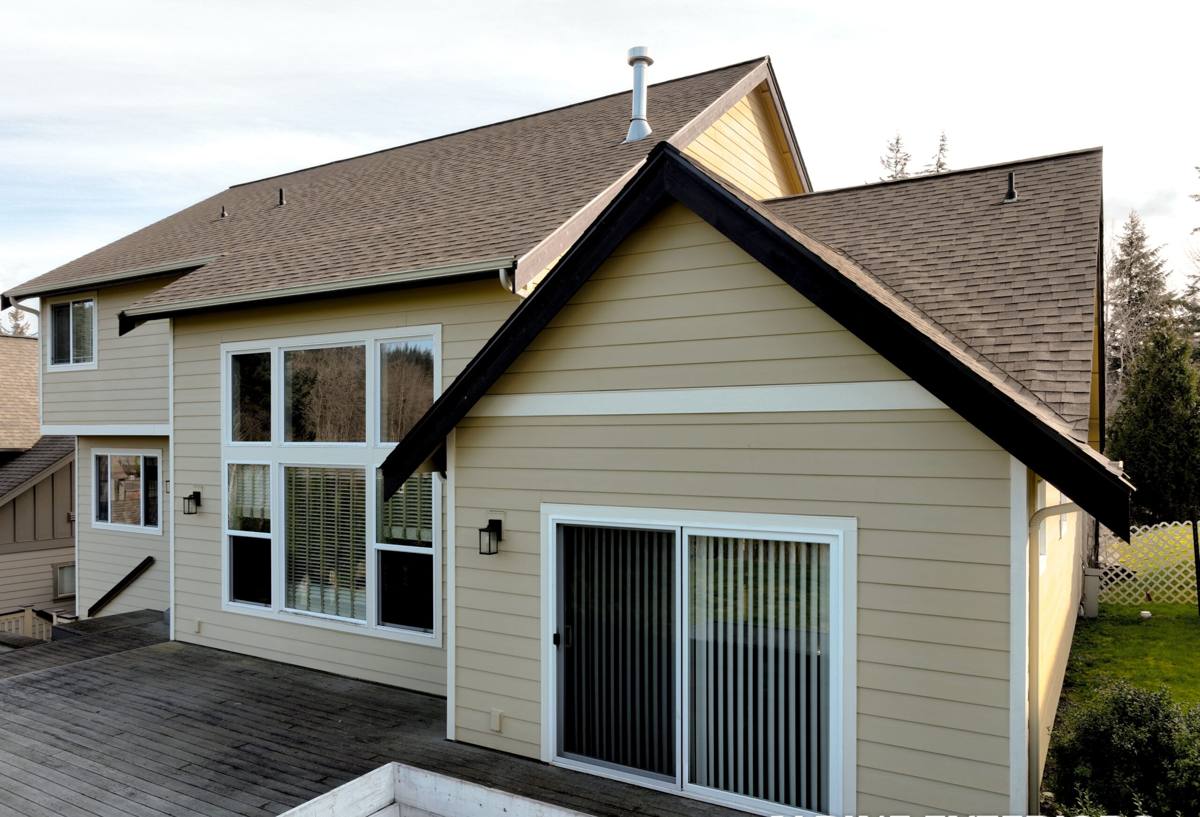
What Whatcom County's Climate Does to Vertical Siding
Sehome sits close enough to Bellingham Bay and the Salish Sea that salt-laden air is a real factor on exterior materials here, not a theoretical one. Add in the long stretches of driving rain that come off the water through fall and winter, plus a moss season that can run several months on shaded north- and west-facing walls, and you've got a combination that punishes any siding system with weak points.
Board and batten siding is particularly exposed to a few specific failure modes in this environment:
- Batten-edge wicking — the vertical strips that cover the panel seams are thin and have a lot of exposed edge grain (on wood-based products) that can pull in moisture during wind-driven rain.
- Moss and algae bridging — moss doesn't just sit on the surface; over time it holds moisture against the siding face and can work into any gap at a batten edge or fastener head.
- Salt-accelerated fastener corrosion — cheap or under-spec fasteners near the water can corrode faster, which shows up as rust streaking and eventually a loose batten.
- Freeze-thaw and swelling cycles — Whatcom County doesn't get brutal winters, but the repeated wet-dry, occasional-freeze cycle is hard on any material that absorbs water and expands.
None of this means board and batten is a bad choice for Sehome. It means the material and the installation method both have to be chosen with this specific climate in mind, not with a generic "any siding will do" mindset.
Why We Only Install James Hardie for This Profile
We install James Hardie fiber cement exclusively — for board and batten and every other siding profile we do. We don't install LP SmartSide, vinyl, Cemplank, Allura, primed spruce, or cedar, and that's a deliberate standard, not an oversight.
For a vertical, seam-heavy profile like board and batten, the case for Hardie comes down to a few things:
- Non-combustible fiber cement core — it doesn't rot, and it isn't a food source for the organic growth that thrives in our wet, shaded microclimates the way wood-based products can be.
- Factory-applied ColorPlus finish — the color and protective coating are baked on in a controlled factory process, which holds up better against salt air and UV than field-applied paint, and it means far less repainting over the life of the siding.
- HZ5 engineering for our climate zone — Hardie manufactures region-specific product lines, and the HZ5 formulation is engineered for wetter, harsher climates like the Pacific Northwest, rather than a one-size-fits-all national product.
- Dimensional stability — fiber cement expands and contracts far less with moisture than wood or wood-composite siding, which matters enormously on a profile with this many seams and fastener points.
- A strong transferable warranty — backed by a large manufacturer with decades in fiber cement, not a smaller company relying on field performance data.
We're not going to tell you every other product is worthless — cedar has real appeal, LP SmartSide has its market, vinyl is cheap and widely used. But for the specific combination of a vertical seam-heavy profile and a salt-air, high-rainfall climate, we made the call years ago that Hardie is the only product we're willing to put our name behind.
Hardie Board & Batten Product Options
Depending on the look a Sehome homeowner wants, board and batten can be built a couple of ways with Hardie products:
- HardiePanel vertical siding with HardieTrim battens — the most common approach, using a smooth or stucco-textured panel as the field with trim boards installed over the seams at a set spacing.
- Artisan-series accent applications — sometimes used for a feature wall, entry, or gable rather than the whole home, paired with a different Hardie profile elsewhere.
Comparing Board & Batten Materials for This Climate
| Material | Moisture Behavior in Salt Air / Rain | Moss & Algae Resistance | Maintenance Over 15+ Years |
|---|---|---|---|
| James Hardie fiber cement | Dimensionally stable, doesn't absorb and swell like wood | Doesn't feed organic growth; still needs periodic washing | Occasional cleaning; factory finish resists fading |
| Cedar | Absorbs moisture at edges and end grain; needs sealed cuts | Organic material, more prone to moss/algae anchoring | Regular refinishing or staining, more frequent inspection |
| LP SmartSide | Engineered wood strand product; performance depends heavily on sealed edges and correct install | Better than raw wood but still an engineered-wood substrate | Field-applied or factory finish maintenance varies |
| Vinyl | Doesn't absorb water, but battens are thin and can distort with heat/cold cycling | Doesn't feed growth but growth can sit on the surface | Low maintenance but limited repair options if damaged, fades over time |
What a Correct Board & Batten Installation Involves
Most board and batten problems we get called out to inspect in this area trace back to a handful of installation shortcuts. Here's what we hold every job to, in Sehome and everywhere else we work:
Rainscreen Gap Behind the Siding
A drainage gap between the siding and the water-resistive barrier lets any moisture that does get past the cladding drain and dry out rather than sitting against the sheathing. In a climate with this much sustained rain, we treat this as standard practice, not an upgrade.
Correct Batten Spacing and Fastening
Hardie specifies exact fastener placement, spacing, and edge clearances for board and batten assemblies. Battens fastened too close to their edges, or spaced incorrectly over the panel seams beneath them, are one of the most common causes of premature cracking and water intrusion we see on poorly installed jobs.
Flashing at Every Horizontal Transition
Window heads, door heads, roof-to-wall intersections, and the base of the wall all need proper flashing detail. Board and batten's vertical lines can make it tempting to run panel straight past these transitions — that's exactly where water finds its way in during driving rain.
Sealed and Primed Cut Edges
Every field cut on fiber cement exposes raw material that needs to be sealed per manufacturer spec before it's installed. Skipping this step is invisible on install day and shows up as staining or degradation years later.
Caulking Only Where It Belongs
Board and batten shouldn't rely on caulk to do a flashing detail's job. We use sealant at the joints Hardie specifies, not as a substitute for proper water management underneath.
Our Process for a Sehome Board & Batten Project
- On-site assessment — we look at wall orientation, existing moisture damage, shade and moss patterns, and how the home's design will read with vertical siding before recommending it.
- Product and layout plan — batten spacing, panel layout, and color selection from Hardie's ColorPlus palette, planned around the home's actual dimensions rather than a generic template.
- Tear-off and sheathing check — removing existing siding lets us catch any hidden moisture or sheathing damage before it's covered up again, which is common on older Sehome homes.
- Water-resistive barrier and rainscreen installation — done to current best practice for our rainfall totals, not just code minimum.
- Flashing at every penetration and transition — windows, doors, roof lines, and the wall base.
- Panel and batten installation to manufacturer spec — correct fastener type, spacing, and edge sealing throughout.
- Final inspection and cleanup — walking the whole job before we call it done.
Living With Board & Batten in a Salt Air, Moss-Prone Climate
Even correctly installed Hardie board and batten benefits from a little seasonal attention in this climate. None of it is heavy work, but skipping it lets moss and grime build up faster than it should.
- Rinse siding annually with a garden hose and soft brush, focusing on shaded north- and west-facing walls where moss takes hold first.
- Keep gutters clear so overflow doesn't run down the siding face during heavy rain events.
- Trim back landscaping and tree limbs that keep a wall shaded and damp longer than the rest of the house.
- Walk the exterior once a year and check caulk joints at windows, doors, and trim for cracking or separation.
- Address any moss growth early with a gentle wash rather than pressure-washing, which can drive water behind the siding at seams.
Why It Matters That We Already Work in Sehome
A siding crew that regularly works Sehome and the rest of Whatcom County isn't guessing about how this climate behaves — we've seen what a decade of salt air and rainy winters does to different products and different installation quality on homes like yours. That means we know which wall orientations in this area tend to hold moss longest, how driving rain off the bay behaves against a west-facing gable, and where sloppy flashing work tends to fail first in this specific climate. It also means we're a known, local business if you ever need a warranty question answered or a follow-up visit years down the road — not a crew that came through once from out of the area.
If you're weighing board and batten siding for a home in Sehome, we're happy to walk the property, talk through what correct installation looks like for your specific walls and orientation, and give you a straightforward, no-pressure estimate using the form below.