 Whatcom County
 Siding Built for Nooksack's Weather, Not Just Its Curb Appeal
Nooksack sits in the part of Whatcom County where marine air off the Salish Sea meets the moisture funneling down the Nooksack River valley. That combination means long stretches of damp weather, driving rain that comes in sideways during winter storms, and a moss season that can run from early fall through late spring. Siding here doesn't just have to look good — it has to survive being wet more often than it's dry.
We install James Hardie fiber cement siding exclusively, and Nooksack is a good example of why. Wood-based and foam-backed siding products struggle in this climate because they're built around the assumption that a house gets to dry out between rain events. In this part of Whatcom County, that assumption doesn't hold for months at a time.
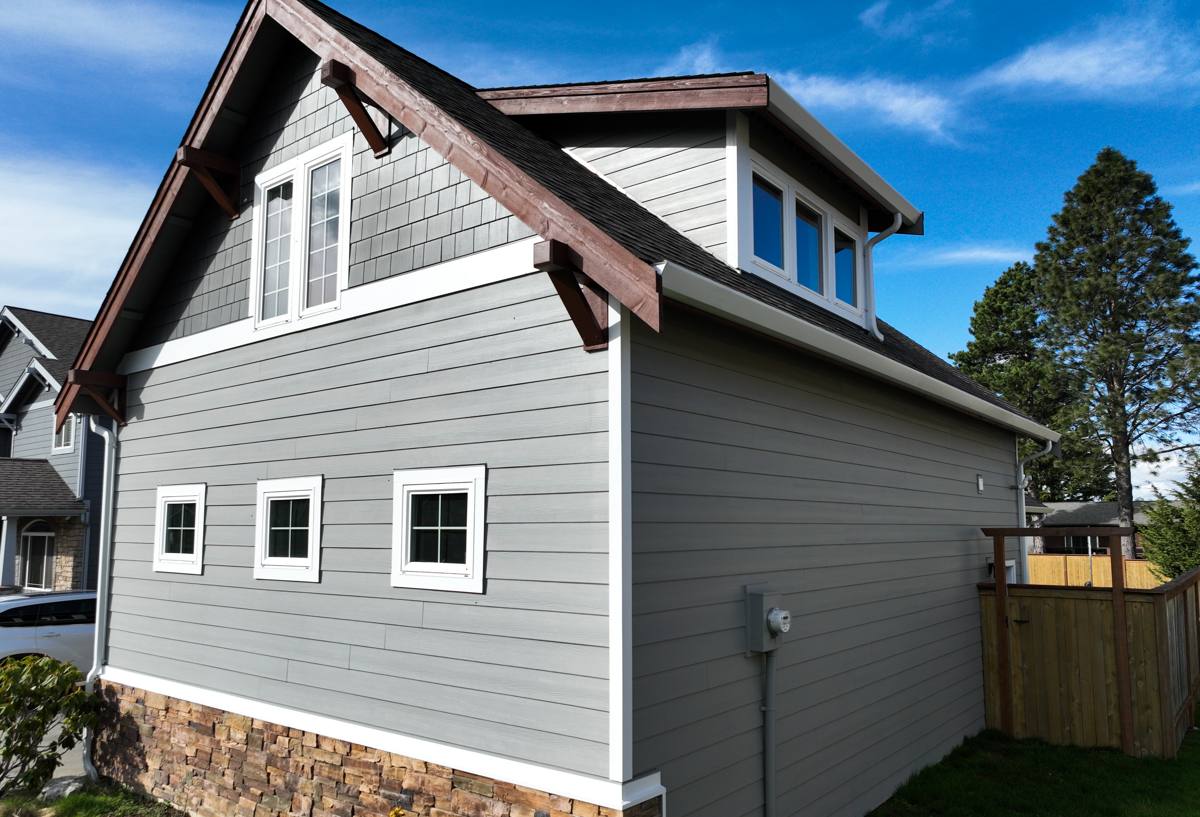
What Nooksack Homes Actually Deal With
Driving Rain and Wind-Driven Moisture
Winter storms coming off the Salish Sea don't just drop rain straight down — wind pushes it sideways into wall assemblies, gable ends, and anywhere the siding meets a window, door, or corner trim. Any gap, unsealed seam, or poor flashing detail becomes an entry point. Over years, that's how water gets behind siding and starts rotting sheathing before a homeowner ever sees a stain on the outside.
Salt Air and Fastener Corrosion
Even inland from the immediate coastline, Whatcom County's marine air carries enough salt to accelerate corrosion on unprotected metal — fasteners, flashing, and trim screws included. Siding systems that rely on exposed or lower-grade fasteners age faster here than the same product would in a dry inland climate. It's a slow problem, which is exactly why it's easy to ignore until streaking and loose panels show up.
Moss, Algae, and Prolonged Dampness
Shaded north and east walls in Nooksack, especially those backed by trees or close to the river corridor, stay damp longer after a rain than a full-sun wall does. That extended dampness is what moss and algae need to take hold. On porous or absorbent siding materials, that moisture doesn't just sit on the surface — it works its way in, and the siding stays wet even after the weather clears.
Why We Standardized on James Hardie for This Climate
James Hardie fiber cement is engineered from cement, sand, and cellulose fibers — a composition that doesn't absorb and hold water the way wood-based or wood-derived products do. It doesn't swell, delaminate at the edges, or provide the organic material that moss and mildew feed on. For a climate that stays wet as long as Nooksack's does, that's not a marginal advantage — it's the difference between siding that ages gracefully and siding that needs constant upkeep.
We specifically use Hardie's HZ5 product line, which is engineered for regions with cold, wet winters like the Pacific Northwest, rather than the HZ10 line built for hot, humid climates. That distinction matters: a product engineered for the wrong climate zone can perform worse than one properly matched to conditions, even if both are technically "fiber cement."
We don't install LP SmartSide, vinyl, Cemplank, Allura, or primed wood siding. Each of those has legitimate uses elsewhere, but in a climate like Whatcom County's — with this much sustained moisture and salt-laden air — we've seen the maintenance burden and moisture risk outweigh the upfront savings. Hardie's factory-applied ColorPlus finish and non-combustible composition are why we put it on every home we side, Nooksack included.
What Correct Installation Actually Involves
Fiber cement siding is only as good as the installation behind it. Hardie's own warranty is tied to installation meeting their published specifications — not just the product being on the wall. In a high-moisture climate like Nooksack's, the details that get skipped on a rushed job are exactly the details that cause failures.
- Weather-resistant barrier installed and lapped correctly before any siding goes up, with no gaps at seams or penetrations
- Proper flashing at windows, doors, and all roof-to-wall intersections, directing water outward and down rather than behind the siding
- Correct fastener type, spacing, and depth per Hardie's published fastening schedule — over-driven or under-driven nails are one of the most common causes of early siding failure
- 1/4-inch minimum clearance between the bottom of the siding and roofing, decks, and walkways to prevent wicking
- Proper gapping and sealing at butt joints, trim, and corners, using materials rated for exterior exposure
- Field-cut edges primed and sealed, since factory-finished edges are protected but cut edges are not unless treated
Every one of these steps takes time. Skipping any of them might not show up as a problem in year one — but in a climate that keeps walls wet for months at a stretch, the shortcuts show up eventually, usually as moisture damage that's expensive to trace and repair.
Our Process for a Nooksack Siding Project
1. On-Site Assessment
We walk the exterior with you, looking at existing siding condition, moisture staining, trim and flashing details, and any areas — like shaded walls or ground-level sections — that are showing early signs of moss or dampness. This is also when we talk through Hardie product lines, profiles, and ColorPlus color options that fit the house and the neighborhood.
2. Removal and Substrate Check
Old siding comes off and we inspect the sheathing underneath before anything new goes up. Nooksack's damp climate means hidden water damage isn't rare — if we find soft or compromised sheathing, we address it before installing new siding over it, since covering a moisture problem doesn't solve it.
3. Weather Barrier and Flashing
This is the step that determines how the house performs in wind-driven rain for the next several decades. We install and lap the weather-resistant barrier correctly and detail flashing at every window, door, and wall penetration before a single piece of Hardie board goes up.
4. Installation to Hardie Spec
Panels, planks, or trim go up following James Hardie's fastening schedule, clearance requirements, and joint treatment — the details covered above. We don't deviate from spec to save time, because that's exactly what puts the manufacturer's warranty at risk.
5. Final Walkthrough
We inspect the completed exterior with you, check caulking and trim lines, and make sure everything meets both our standard and Hardie's installation requirements before we call the job done.
Comparing Siding Options for Nooksack's Climate
| Factor | James Hardie Fiber Cement | Wood-Based / Vinyl Alternatives |
|---|---|---|
| Moisture absorption | Does not absorb water into the material itself | Wood-based products can swell or delaminate; vinyl can trap moisture behind panels |
| Moss and algae resistance | Non-organic composition doesn't feed growth | Organic or porous surfaces are more hospitable to moss and mildew |
| Salt air / fastener exposure | Designed with corrosion-resistant fastening practices | Performance varies widely by product and fastener grade |
| Finish longevity | Factory-baked ColorPlus finish, warrantied against fading/peeling | Field-applied paint or factory color coats, variable warranty terms |
| Fire resistance | Non-combustible | Combustible (wood) or can deform under heat (some vinyl) |
This isn't a knock on every alternative product across every use case — it's specifically why, given Whatcom County's climate, we made Hardie the only thing we install.
Why It Matters to Hire a Crew That Already Works This Area
Siding installers who don't regularly work in Whatcom County can underestimate how much moisture management matters here, because they're used to climates that dry out between storms. A crew that already works Nooksack and the surrounding area knows which wall orientations tend to hold moss, how local permitting works, and how to sequence a project around a wet forecast instead of getting caught mid-installation with panels exposed to rain. That local familiarity isn't a luxury — it directly affects how well the finished siding performs ten and twenty years down the road.
Response time matters too. If a flashing detail needs a follow-up visit or a warranty question comes up years later, a local crew can actually show up, rather than a company that installed once and moved on to the next region.
Maintaining Hardie Siding in a Wet Climate
James Hardie siding is low-maintenance compared to most alternatives, but "low-maintenance" isn't "no-maintenance" — especially with Nooksack's moss season.
- Rinse siding annually with a garden hose and soft brush attachment — avoid high-pressure washing, which can force water behind panels and damage the finish
- Check and re-caulk joints and trim intersections every few years, since caulk degrades faster than the siding itself
- Keep gutters clear and functioning so overflow doesn't run down the siding face
- Trim back vegetation and tree cover on shaded walls where possible to reduce how long those sections stay damp
- Address any moss or algae growth promptly with a gentle cleaning solution rather than letting it establish
None of this is difficult, but it's worth doing consistently — a house in Nooksack's climate rewards regular light maintenance far more than it punishes neglect for a year or two and then requires a major intervention.
What This Costs to Get Right
Every Nooksack project is different depending on square footage, the number of stories, trim complexity, and how much substrate repair is needed once old siding comes off. Rather than quote a number that won't reflect your specific house, we walk the property, identify what's actually needed, and give you a clear, itemized estimate before any work starts. What we won't do is quote a lower number by skipping flashing details, using off-spec fasteners, or rushing the weather barrier — those are the corners that cause the moisture problems this climate is already prone to creating.
If you're weighing siding options for a home in Nooksack, we're happy to walk the property, explain what we're seeing, and put together a straightforward estimate — no pressure, no obligation. The form below gets you started.