 Whatcom County
 Deck Building in Nooksack: Why Local Conditions Change the Job
Nooksack sits in the part of Whatcom County where wet weather isn't an occasional inconvenience — it's the baseline. Long stretches of driving rain, short dry windows in summer, and a moss season that can run from fall through spring all put steady pressure on anything built outdoors. A deck built to a generic national spec might look fine the day it's finished and still start showing problems within a few years: soft spots near the house, green film on the boards, fasteners bleeding rust, or a railing post that's gone spongy at the base.
A deck that's going to hold up in Nooksack needs to be built around drainage, airflow, and material choices that assume it will spend most of the year damp. That's a different set of priorities than a deck built for a dry climate, and it shows up in almost every decision — from how the footings are set to which screws get used to hold the boards down.
What Driving Rain and Moss Season Actually Do to a Deck
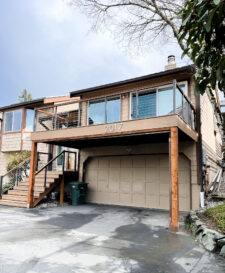
Two things drive most of the deck failures we see in this part of Whatcom County: standing moisture and organic growth. Driving rain doesn't just fall straight down — wind pushes it sideways into ledger connections, under railings, and into any gap where wood meets wood. If water gets in and has nowhere to drain or dry out, it sits there. Wood that stays damp for weeks at a time is exactly what rot fungus and moss need to establish themselves.
Moss is more than cosmetic. A layer of moss on decking holds water against the wood surface even on the rare dry day, which stretches out how long the boards stay wet after every rain event. On stair treads and ramps it also becomes a slip hazard, which matters for a structure people walk on in wet socks or work boots.
The spots that fail first
- Ledger board connection where the deck attaches to the house — the single most common source of hidden rot if it isn't flashed correctly
- Joist tops, where end grain and cut edges soak up water unless they're sealed or taped
- Post bases sitting in or near standing water at grade
- Board gaps that have closed up over time, trapping debris and blocking drainage
- Railing post connections, which take on water from the top down through end grain
Framing and Footings Built for This Ground and This Weather
Footings below the frost line
Whatcom County code requires deck footings to be set below the local frost depth so seasonal freeze-thaw cycles don't heave the structure over time. We size and set footings to meet that requirement rather than guessing at a shortcut depth, because a footing that's too shallow can telegraph movement into the whole deck — doors that stick where the deck meets the house, gaps that open at the ledger, railings that go slightly out of plumb.
Ledger flashing done properly
The ledger board is where a deck is most likely to cause hidden damage to the house itself, not just the deck. Correct flashing directs water away from the house wall and off the top of the ledger instead of letting it wick behind the siding or sheathing. This is the step that's easiest to shortcut and the most expensive to fix later, since a failure here can mean opening up siding and framing to find out how far rot has spread. We treat ledger flashing as a non-negotiable step, not an upsell.
Joist protection
Joist tape or a comparable sealed barrier over the top edge of each joist keeps water from soaking straight down into the framing lumber through screw holes and cut ends. It's a small material cost relative to the labor of reframing a deck a few years early because the joists rotted from the top down.
Choosing Decking Material for a Wet Climate
There's no single "best" decking material — there's a best fit for the homeowner's budget, maintenance appetite, and how the deck will be used. Here's how the common options actually perform under Whatcom County conditions:
| Material | Moisture behavior | Maintenance | Typical lifespan here |
|---|---|---|---|
| Pressure-treated lumber | Resists rot with proper sealing; can cup or split if left unsealed | Needs re-staining/sealing every 1-3 years | 15-20 years with upkeep |
| Cedar | Naturally moisture- and insect-resistant; still needs a finish to hold color and shed water | Re-oil or re-stain every 1-2 years in this climate | 15-25 years with upkeep |
| Composite/PVC boards | Doesn't absorb water like wood; sheds surface moisture well | Periodic washing to clear moss/algae film; no staining | 25+ years, varies by product warranty |
Composite and PVC boards have become popular here specifically because they don't take on water the way solid wood does, which matters when a deck sits under moss-friendly conditions for months at a time. That said, composite decking still needs proper airflow underneath and correct fastening — it isn't maintenance-free, just lower-maintenance. Cedar and pressure-treated lumber remain solid choices for homeowners who want a wood deck and are willing to keep up with sealing on a schedule; skipping that maintenance is what shortens their lifespan in a climate like this one.
Fasteners and Hardware: The Detail That Gets Skipped
Standard hardware-store screws and nails corrode faster in a consistently wet climate, and once a fastener starts rusting it can weep stains into the surrounding decking and lose holding strength. We use corrosion-resistant fasteners and structural hardware rated for exterior, ground-contact, or coastal-grade exposure depending on the connection — ledger bolts, joist hangers, post bases, and the visible deck screws all get matched to what they're holding and how exposed they are to standing water. It costs more up front than mixed-bin hardware. It's also one of the cheapest ways to add years to a deck's life, because the fasteners are what keep the framing acting as one structure instead of individual boards working loose.
Permits and Whatcom County Requirements
Most decks above a certain height or attached to the house require a permit and inspection in Whatcom County, and the requirements cover footing depth, ledger attachment, guardrail height, and stair geometry. Skipping the permit process might save a little time up front, but it leaves the homeowner without an inspection record if there's ever a question about the deck's safety, and it can complicate a home sale down the line. Part of what a crew that regularly works in this county brings to the table is knowing what the local building department expects to see, so the project doesn't stall waiting on corrections after the fact.
How Our Deck Building Process Works
- On-site evaluation — We look at drainage on the lot, how the deck ties into the house, sun and rain exposure, and what the ground does after a heavy rain before we design anything.
- Design and material selection — We walk through material trade-offs honestly, including maintenance expectations, so the choice matches how the homeowner actually wants to use and care for the deck.
- Permitting — We handle the permit submission and coordinate inspections so the project meets code without the homeowner having to manage that process themselves.
- Footings and framing — Footings set to the required frost depth, ledger flashed correctly, joists protected, hardware matched to exposure.
- Decking, railing, and finish work — Board spacing set to allow drainage and airflow, railings built to code height and spacing, finish work sealed or capped as appropriate to the material.
- Final walkthrough — We go over the finished deck and what maintenance it needs, so there are no surprises about upkeep once the crew leaves.
Maintenance That Actually Matters in This Climate
A well-built deck still needs some seasonal attention here. This isn't a long list, but skipping it is how a solid deck starts losing years off its life:
- Sweep leaves and debris out of board gaps before they trap moisture through the winter
- Wash off moss and algae film at least once a year, more often on shaded sections
- Check and re-seal wood decking on the schedule the material calls for — don't wait for visible graying or cupping
- Look at the ledger flashing and house connection point once a year for any sign of water tracking
- Keep gutters and downspouts near the deck clear so runoff isn't dumping directly onto or under it
- Check railing post connections for movement, especially after a hard winter
Why a Crew That Already Works Nooksack Makes a Difference
Deck-building advice that's written for a dry climate doesn't hold up here, and a crew that mostly works elsewhere may not default to frost-depth footings, ledger flashing, or corrosion-rated hardware unless a homeowner specifically asks. A crew that regularly builds in Nooksack and the surrounding Whatcom County lowlands treats those details as standard practice, because they've seen what happens to decks that skip them — and because they're familiar with what the local building department expects during permitting and inspection. That local familiarity tends to mean fewer surprises, both in how the deck performs a few winters in and in how smoothly the permit process goes.
If you're planning a new deck or replacing one that's showing its age, we're happy to take a look and put together a straightforward, no-pressure estimate — just fill out the form below.