 Whatcom County
 Roofing in Barkley: A Different Climate Than It Looks
Barkley sits close enough to Bellingham Bay and the Whatcom County coastline that homes here deal with a combination of conditions that a lot of roofing crews from outside the area simply don't plan for. It's not one big dramatic weather event that wears out a roof in this part of Washington — it's the steady, year-round grind of salt-laden air, driving rain that comes in sideways off the water, and a moss season that can run eight or nine months out of the year. A roof that would hold up fine in a drier, inland climate can show real problems here in half the time if it wasn't installed with these conditions in mind.
New roof installation in Barkley isn't fundamentally different from roofing anywhere else — the physics of shedding water are the same everywhere. But the margin for error is smaller. Small mistakes in ventilation, flashing, or underlayment choice that might go unnoticed for a decade in a dry climate tend to surface within a few wet Whatcom County winters.
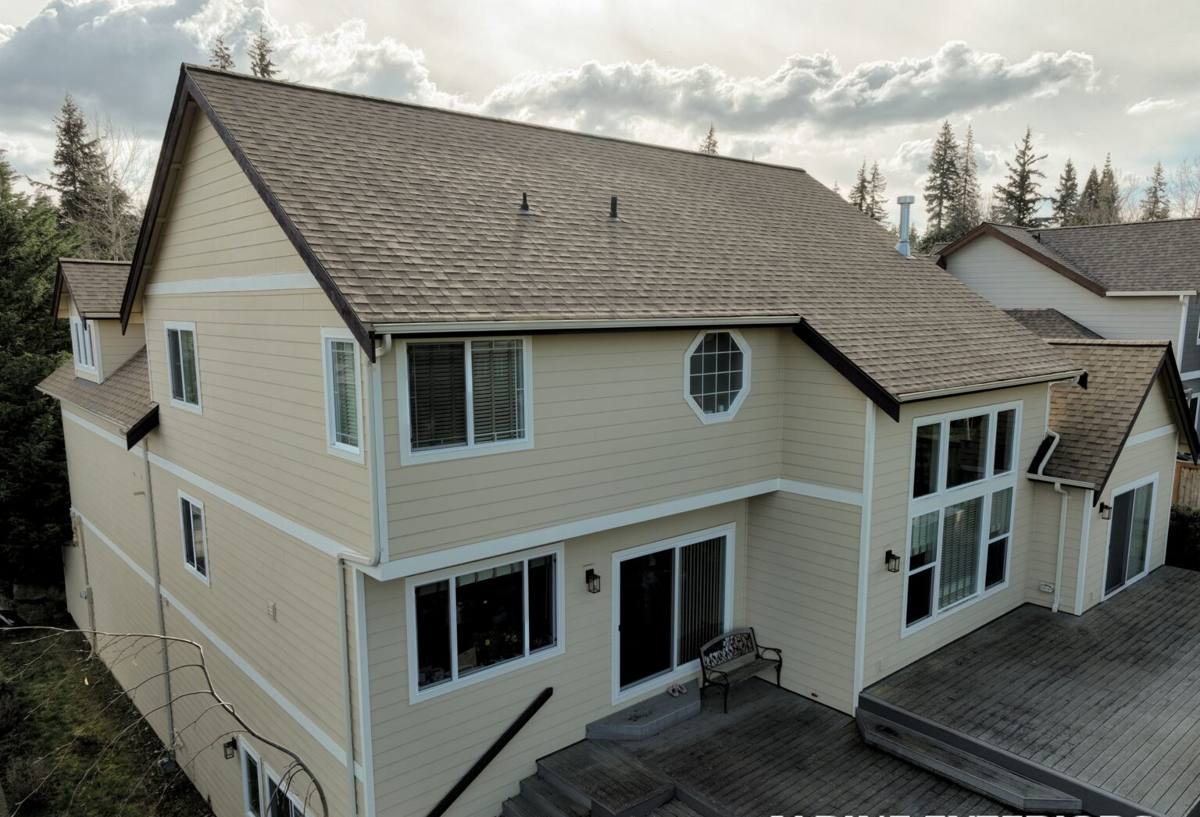
What Barkley's Climate Actually Does to a Roof
Salt Air and Metal Fatigue
Proximity to the bay means airborne salt settles on roofing surfaces, flashing, fasteners, and any exposed metal. Over years, this accelerates corrosion on lower-grade fasteners and cheaper flashing metals. It's rarely dramatic — you won't see a roof fail overnight because of salt exposure — but it's a slow tax on anything that isn't rated for coastal-adjacent conditions.
Driving Rain and Wind-Driven Water
Whatcom County doesn't just get rain — it gets rain pushed sideways by wind coming off the water. That matters because a roof only needs to shed water straight down to satisfy the bare minimum. Wind-driven rain finds its way under shingle tabs, around poorly lapped flashing, and into any gap in the underlayment that a calmer climate could get away with ignoring.
Moss Season
Cool, damp, shaded conditions for most of the year make Whatcom County prime moss territory, and Barkley's tree cover doesn't help. Moss isn't just an appearance issue. As it grows, it lifts shingle edges, holds moisture directly against the roofing material, and works its root structure into seams over time. A roof that's constantly damp underneath its moss growth ages faster than one that's allowed to dry out between rain events.
Signs a Barkley Roof Needs Replacing, Not Patching
Not every roofing problem calls for a full tear-off. But there's a point where repeated repairs stop making financial sense and a full replacement becomes the honest recommendation. Some signs worth taking seriously:
- Granule loss showing up in gutters or downspouts, especially on an asphalt shingle roof more than 15 years old
- Shingles that are cupping, curling at the edges, or cracking in multiple areas rather than one isolated spot
- Moss coverage that's returned within a year or two of cleaning, especially on north-facing slopes
- Soft spots in the decking when walked on, or visible sagging along the roofline
- Daylight visible through the attic sheathing, or consistent moisture staining on interior ceilings
- Flashing around chimneys, vents, or valleys that's rusted, separated, or was never properly stepped in the first place
- An age past 20-25 years for asphalt shingle roofing, which is roughly where materials start losing their ability to perform regardless of how well they've been maintained
Choosing a Roofing System That Fits This Climate
There's no single "best" roofing material for every home — it depends on budget, roof pitch, how much shade and moss pressure the property gets, and how long the homeowner plans to stay in the house. Here's how the common options stack up for Barkley conditions specifically.
| Material | How it handles our climate | Maintenance reality | Typical lifespan here |
|---|---|---|---|
| Architectural asphalt shingle | Good performance when paired with proper underlayment and ventilation; wide manufacturer support for algae-resistant granules | Periodic moss removal recommended; algae-resistant lines reduce but don't eliminate growth | 20-30 years |
| 3-tab asphalt shingle | Lower wind rating and thinner profile; more prone to lifting in driving rain and wind | Same moss vigilance as architectural, shorter margin for error | 15-20 years |
| Standing seam metal | Sheds water and moss growth very effectively on steeper pitches; needs marine-grade or coated fasteners near the coast | Low; occasional inspection of seams and fastener condition | 40-50+ years |
| Cedar shake | Traditional look but holds moisture against wood in our damp season unless well-ventilated and maintained | Higher; regular treatment and moss control needed to avoid rot | 20-30 years with upkeep |
| Synthetic/composite shingle | Resists moisture absorption well; performs consistently in wet, mossy conditions | Low to moderate | 30-50 years depending on product |
For most Barkley homes, a mid-to-upper-tier architectural asphalt shingle with algae-resistant granules offers the best balance of cost and climate performance. Homeowners planning to stay long-term, or with steep, shaded roof sections that fight moss constantly, often find metal or synthetic options pay for themselves in reduced maintenance over the years.
What a Correct Installation Actually Involves
The material on top gets most of the attention, but in a climate like this, what's underneath the shingles matters just as much — sometimes more.
Tear-Off and Deck Inspection
A proper job starts with a full tear-off down to the decking, not a layover on top of existing shingles. This is the only way to actually inspect the sheathing for rot, soft spots, or moisture damage that's often invisible from above — problems that are common on older Barkley roofs that have spent years under moss and shade.
Underlayment
Given how much wind-driven rain this area sees, we don't treat underlayment as an afterthought. Synthetic underlayment generally outperforms traditional felt in wet climates because it resists water absorption and holds up better during the installation window itself, when the deck is exposed to weather. Ice-and-water shield membrane belongs at eaves, valleys, and any roof penetration where water is most likely to find a way in.
Flashing
Flashing failures are one of the most common causes of roof leaks in this region, and they're almost always an installation problem, not a material one. Step flashing at walls and chimneys, properly lapped valley flashing, and corrosion-resistant metal around all penetrations are non-negotiable in a climate that punishes shortcuts.
Ventilation
A roof deck that can't breathe traps moisture from both directions — condensation from inside the attic and dampness working in from outside. Balanced intake and exhaust ventilation keeps the deck drier, which directly slows moss growth and extends shingle life. This is one of the most overlooked parts of a roofing job, and it's often the difference between a roof that performs for its full rated lifespan and one that doesn't.
Fasteners
Given the salt air exposure Barkley homes deal with, fastener quality matters more here than it would further inland. Corrosion-resistant nails and proper nailing patterns (not staples, and not underdriven or overdriven nails) protect against both wind uplift and long-term degradation.
How Our Process Works
A new roof is a significant investment, and homeowners deserve to know what's actually happening at each stage, not just get a crew that shows up and disappears.
- On-site assessment: We inspect the existing roof, attic ventilation, and decking condition in person before quoting anything — not from a satellite photo.
- Written estimate: A clear breakdown of materials, labor, and scope, so there's no ambiguity about what's included.
- Material selection: We walk through the tradeoffs between options based on the specific roof, budget, and how much moss and shade pressure the property deals with.
- Tear-off and deck repair: Full removal of old roofing, with any damaged decking identified and replaced before new material goes down.
- Installation: Underlayment, flashing, ventilation components, and roofing material installed to manufacturer specification and local code.
- Final walkthrough: We review the completed work with the homeowner and go over any warranty documentation.
- Cleanup: Full site cleanup including magnetic sweep for stray nails.
Cost Factors for a Barkley Roof Replacement
Every roof is different, so we won't quote numbers without seeing the property, but the main variables that move the price are worth understanding upfront.
| Factor | Why it matters |
|---|---|
| Roof size and pitch | Steeper roofs take longer to work safely and require more material overlap |
| Number of layers to remove | Multiple existing layers add labor and disposal cost |
| Decking condition | Rotted or soft sheathing found during tear-off requires replacement before installation continues |
| Material choice | Asphalt, metal, and synthetic options carry different upfront costs and lifespans |
| Roof complexity | Valleys, dormers, skylights, and chimneys all add flashing work and time |
| Ventilation upgrades | Older Barkley homes often need ventilation improvements as part of a proper reroof |
Why Hiring a Crew That Already Works Barkley Matters
Roofing crews that work regularly in Whatcom County build habits that don't show up on a spec sheet — they know to treat moss control as part of the job rather than an afterthought, they default to corrosion-resistant fasteners without being asked, and they don't get caught off guard scheduling around the wet season because they've planned around it for years. A crew coming from a drier region might do competent work in ideal conditions, but ideal conditions aren't the norm here for most of the year.
Local knowledge also matters for things like permitting familiarity, understanding how prior mossy-roof and coastal-air issues tend to show up on Barkley homes specifically, and knowing which failure points are common in the housing stock in this part of Whatcom County versus elsewhere in the state.
If your roof is showing its age, or you just want an honest opinion on whether repair or replacement makes more sense for your Barkley home, we're happy to take a look. Fill out the form below for a free, no-pressure estimate.