 Whatcom County
 Why Lynden Roofs Need to Be Built for This Climate
Lynden sits inland from the water but still gets the full package of Whatcom County weather: long stretches of driving rain off the Pacific, salt-laden air that drifts in from the Strait of Georgia and Bellingham Bay, and a moss season that can run eight months out of the year on a shaded roof. None of that is unusual for this part of Washington, but it adds up differently on a roof than it does on siding or windows. Water doesn't just land on a roof once and run off — it sits, pools in low spots, wicks under improperly lapped panels, and freezes and thaws through the shoulder seasons. Moss doesn't just look bad; it holds moisture against the roof surface and, on the wrong material, works into seams and fastener points over years.
Metal roofing handles this climate better than most alternatives when it's installed correctly, which is the operative phrase. A metal roof is only as good as its flashing, fastening, and ventilation details. We've corrected enough poorly detailed metal roofs around Whatcom County to know that the material itself is rarely the problem — the installation is.
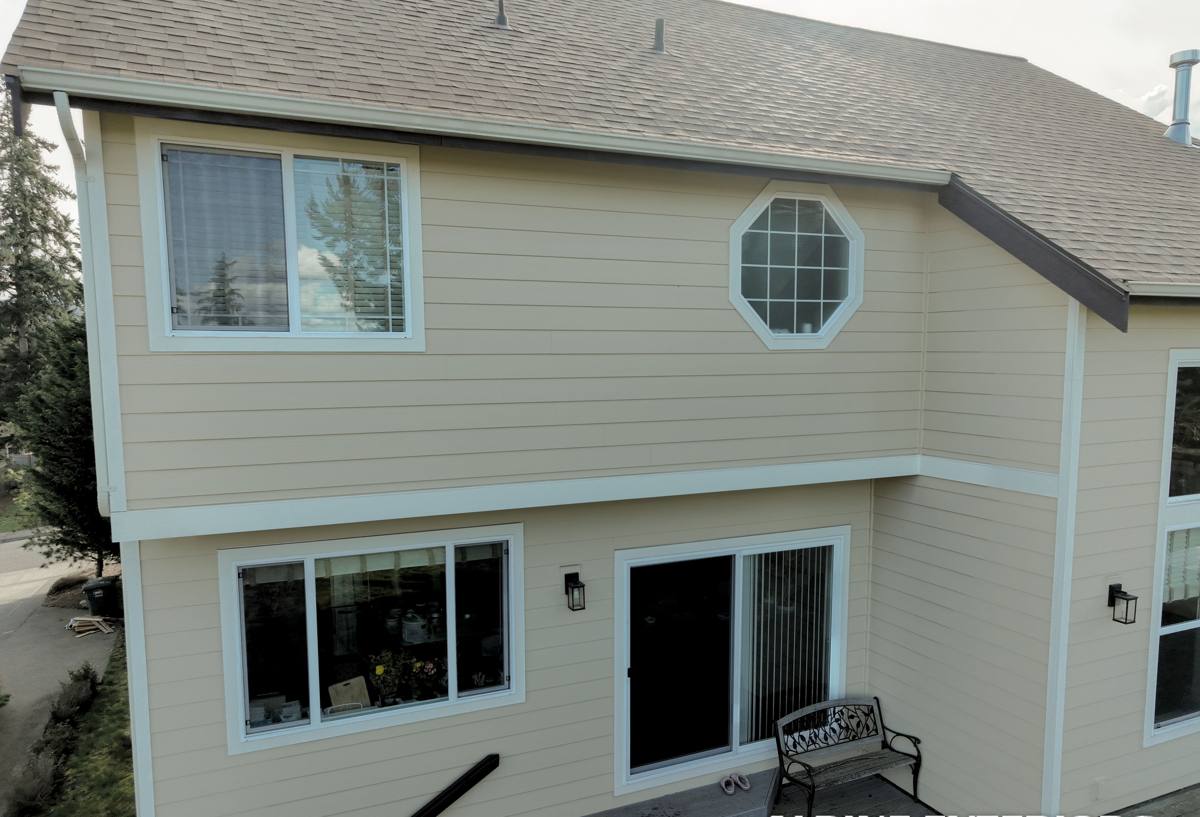
What "Correct" Metal Roofing Looks Like Here
Panel System and Fastening
Standing seam and exposed-fastener panel systems both have a place, but they behave differently in wet, salty, moss-prone conditions. Standing seam uses concealed clips and no field-penetrating fasteners through the panel face, which means fewer long-term points where water and salt air can work into a fastener hole. Exposed-fastener panels cost less up front but rely on neoprene washers under every screw — washers that harden and shrink over time, especially with UV exposure and freeze-thaw cycling. On a Lynden home, that's a maintenance item you should plan for, not a surprise.
Underlayment and Ice/Water Protection
Every metal roof we install goes over a synthetic underlayment rated for the exposure, with self-adhered ice-and-water membrane at eaves, valleys, and any low-slope transitions — the places wind-driven rain and wet snow are most likely to back up under panels. This isn't optional in our book; it's the layer that saves the roof deck if a seam or flashing detail is ever compromised.
Flashing and Penetrations
Chimneys, plumbing vents, skylights, and valleys are where the majority of roof leaks start, metal or otherwise. Custom-formed flashing that's properly lapped with the panel system — not generic pre-formed pieces caulked into place — is what keeps water out at these transitions for the life of the roof. Caulk is a backup, never a primary seal.
Ventilation
Metal roofs need to breathe. Without proper intake and exhaust ventilation, moisture gets trapped in the attic space, which on a home in this climate means condensation risk in the colder months and a shortened lifespan for the roof deck underneath the metal. We check existing ventilation on every reroof and correct it when it's inadequate, rather than just covering over the problem.
Salt Air: What It Actually Does to a Roof
Whatcom County isn't oceanfront the way the outer coast is, but Lynden still sees salt-bearing air move through the region, and it's a slow, cumulative issue rather than a dramatic one. Salt accelerates corrosion at cut edges, fastener heads, and any point where a protective coating has been scratched or is thinner than spec. This is why coating and metal gauge matter more here than in a dry inland climate — a roof spec that's fine in eastern Washington isn't automatically fine in Whatcom County.
- Factory-applied paint systems (like PVDF/Kynar-type coatings) hold up better against salt exposure and UV than thinner, lower-grade finishes.
- Cut edges should be treated or positioned so raw metal isn't left exposed to the weather wherever it can be avoided.
- Fastener and clip material should be matched to the panel metal to avoid galvanic corrosion between dissimilar metals.
- Coastal-grade or heavier-gauge steel or aluminum is worth the modest upcharge for homes closer to open water or exposed hilltop sites.
Moss: The Slow-Motion Problem
Moss season in this part of Washington is long, and a roof under mature trees or on a north-facing slope can stay damp for weeks at a stretch. Metal roofing resists moss far better than composition shingle or wood roofing because there's no granulated or fibrous surface for spores to root into — but moss can still accumulate on the smooth surface itself, especially in valleys and at panel seams where debris collects. Left alone, that buildup holds moisture against the finish and can shorten the life of the coating over many years, even if it won't rot the panel the way it would a wood shake roof.
The fix is mostly mechanical, not chemical: keep gutters and valleys clear, keep overhanging branches trimmed back so the roof gets sun and airflow, and rinse debris off periodically rather than letting it compost in place. We can talk through a simple maintenance routine for your specific roof and tree cover during the estimate.
Choosing a Metal System for a Lynden Home
| Factor | Standing Seam | Exposed-Fastener Panel |
|---|---|---|
| Fastener exposure | Concealed clips, no face penetrations | Screws through panel face with washers |
| Long-term maintenance | Minimal; no washer replacement | Washers typically need replacement over the roof's life |
| Upfront cost | Higher | Lower |
| Best fit | Long-term ownership, lower-slope areas, higher wind/rain exposure | Budget-conscious projects, outbuildings, steeper simple gable roofs |
| Salt air performance | Strong, fewer penetration points | Good with quality coatings, but washer points are the weak spot |
Neither system is wrong — the right choice depends on your roof's slope, exposure, budget, and how long you plan to own the home. We'll walk through the trade-offs specific to your roof rather than defaulting to one system for every job.
Our Process on a Lynden Roof
- On-site assessment — we look at slope, exposure, existing ventilation, decking condition, and tree cover before recommending a system.
- Tear-off and deck inspection — we don't cover over soft or water-damaged decking; it gets replaced before anything goes back on.
- Underlayment and ice/water membrane — installed at eaves, valleys, and all low-slope transitions.
- Panel installation — laid out to minimize seams in high-exposure areas, fastened per manufacturer spec for wind and snow load.
- Custom flashing — formed and installed at every penetration, valley, and wall transition.
- Ventilation check — intake and exhaust confirmed or corrected as part of the job, not treated as a separate add-on.
- Final walkthrough — we go over the finished roof and maintenance expectations with you directly.
What Local Experience Actually Buys You
A roofing crew that works around Bellingham and Whatcom County regularly knows what a poorly flashed valley looks like after five winters of driving rain, and what a moss-clogged panel seam looks like after three. That's not something you get from a spec sheet — it comes from repairing the mistakes other installs made in this exact climate. We spec coatings, gauges, and fastening details for what Lynden weather does to a roof over 20 or 30 years, not just for what looks fine on installation day.
Cost Factors to Understand Before You Get Quotes
| Factor | Why It Moves the Price |
|---|---|
| Panel system | Standing seam runs higher than exposed-fastener due to material and labor |
| Roof complexity | Valleys, dormers, and multiple penetrations add flashing labor |
| Deck condition | Rotted or soft decking found at tear-off adds repair cost |
| Coating grade | Higher-grade finishes cost more but hold up longer against salt air and UV |
| Tear-off vs. overlay | Full tear-off costs more but is the only way to properly assess and repair the deck and ventilation |
We don't quote a number without seeing the roof — anyone who does is guessing. What we can tell you honestly is that metal roofing costs more up front than composition shingle but typically outlasts it by a wide margin, which changes the real cost picture over the life of the roof.
Signs Your Current Roof Needs Attention
- Heavy moss buildup in valleys or on north-facing slopes
- Rusting or staining at fastener heads or panel seams
- Visible sagging or soft spots when viewed from the attic side
- Water stains on interior ceilings, especially near chimneys or vent penetrations
- Loose or missing fasteners after a windstorm
- Granule buildup or bare spots if you currently have a shingle roof nearing replacement age
If you're seeing any of these, it's worth having someone look at the roof before the next wet season rather than after a leak shows up inside the house.
If you're weighing a metal roof for your Lynden home, we're happy to walk the roof with you, talk through the system options above, and give you a straightforward estimate — no pressure, no upsell. Use the form below to get started.