 Whatcom County
 What Lynden's Climate Actually Does to a House
Lynden sits inland from Bellingham Bay, tucked against farmland and the Nooksack River valley near the Canadian border, but "inland" in Whatcom County doesn't mean sheltered. The same weather systems that push salt-tinged marine air across Blaine, Birch Bay, and Bellingham keep rolling east and north, and they bring their moisture with them. Add the valley's own microclimate — cool, damp, and shaded much of the year by cloud cover and surrounding tree lines — and you get siding conditions that are tougher than most homeowners assume just because the water isn't visible from the yard.
Three things stack up against exterior cladding here. First, driving rain: Whatcom County's storms rarely fall straight down, they come in sideways on wind, which means siding has to shed water at laps, corners, and penetrations, not just on flat wall faces. Second, the region's long stretch of overcast, humid months gives moss, algae, and mildew a running start on any surface that holds moisture or stays shaded. Third, the marine-influenced air that reaches this far into the county carries enough moisture and salt content to accelerate corrosion on fasteners, trim, and any siding product that isn't built to handle it. None of this is dramatic on its own, but over ten or fifteen years it separates siding that was installed and finished correctly from siding that wasn't.
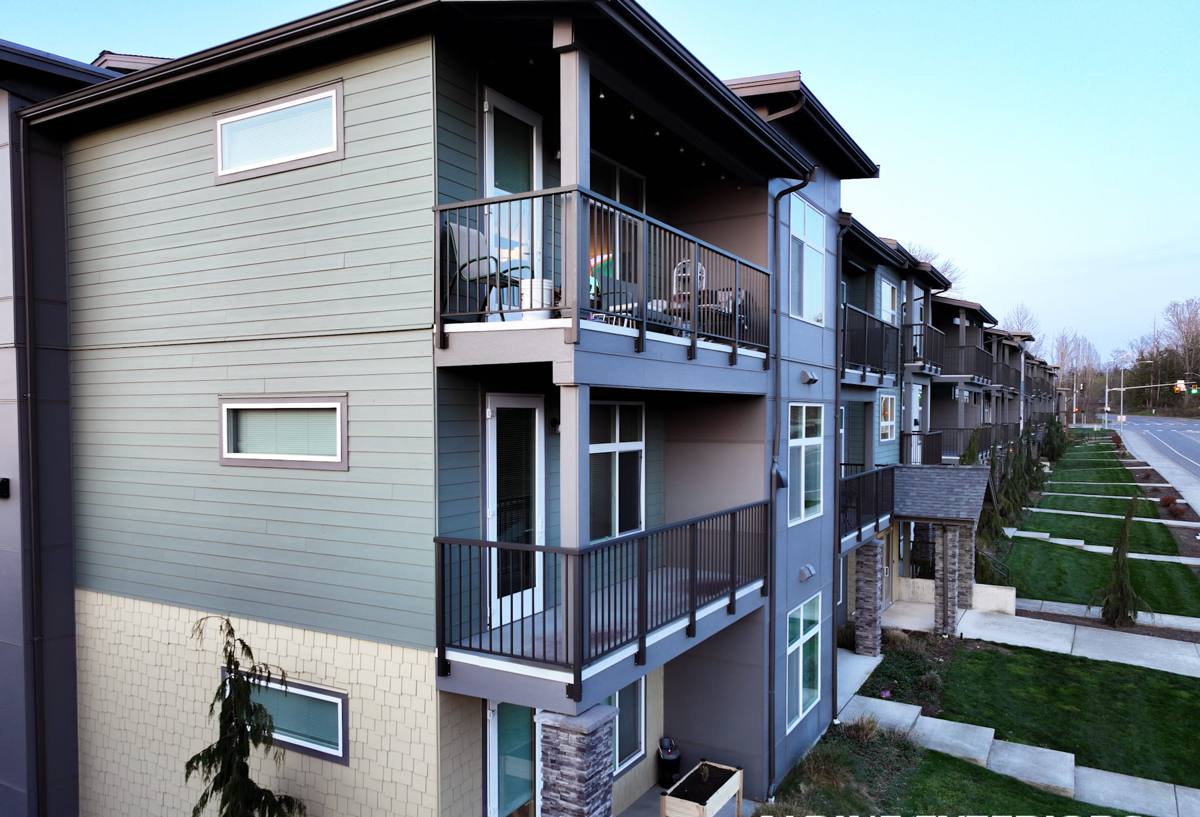
Why We Only Install James Hardie Here
James Hardie fiber cement is engineered specifically for climates like this one. The HZ5 product line, in particular, is formulated for the wetter, cooler regions of the Pacific Northwest — it resists moisture absorption, doesn't swell or rot the way wood-based products can, and holds its factory-applied ColorPlus finish through repeated wet-dry cycles instead of chalking or fading the way field-applied paint does. It's also non-combustible, which matters less for moss and rain but is still part of why we standardized the whole company on this one product rather than juggling multiple lines.
We don't install vinyl, LP SmartSide, cedar, primed spruce, or other fiber cement brands, and that's a deliberate call, not a sales pitch. Each of those products has legitimate strengths, but in a climate that punishes moisture-sensitive materials and rewards low-maintenance, factory-finished surfaces, Hardie is the one product line we're willing to put our name behind for the long haul. Installing one product exclusively also means our crews aren't relearning fastening patterns, flashing details, or finish requirements from job to job — they know this material's behavior cold.
What a Correct Installation Involves
Water management comes before the siding goes up
Most siding failures in this climate aren't failures of the siding itself — they're failures of what's behind it. A correct Hardie install starts with checking and, where needed, correcting the water-resistive barrier, window and door flashing, and kick-out flashing at rooflines before a single plank goes on. On a house that's absorbed years of Whatcom County rain through a marginal flashing detail, skipping this step just seals moisture in behind a new, good-looking wall.
Gaps, fasteners, and clearances
James Hardie publishes specific installation requirements — minimum clearances from grade, roofing, and decks; correct nail placement and depth; proper gaps at butt joints and trim to allow for expansion. These aren't optional details. A plank fastened too tight or hung too close to grade will trap moisture, buckle, or invite the rot and moss growth the product is otherwise resistant to. This is where a lot of installation problems on other people's jobs actually originate — not bad material, bad execution.
Finish integrity
ColorPlus factory finish is baked on under controlled conditions and carries its own finish warranty, but cut edges, field modifications, and touch-up work all need to be handled with Hardie-approved products and technique to keep that warranty intact. We treat this as a checklist item on every job, not an afterthought.
How Hardie Compares to the Alternatives in This Climate
| Material | Moisture behavior | Moss/algae resistance | Maintenance | Typical lifespan here |
|---|---|---|---|---|
| James Hardie fiber cement | Dimensionally stable, doesn't swell or rot | Factory finish sheds growth well when cleaned periodically | Occasional wash, no repainting for many years | Decades with correct install |
| Vinyl | Doesn't rot, but warps/distorts with heat and can crack in cold snaps | Growth clings to textured surfaces; fades over time | Low, but replacement panels can be hard to color-match later | Moderate, shorter in harsh sun/cold cycling |
| LP SmartSide (engineered wood) | Wood-based; vulnerable at cut edges and joints if moisture gets in | Susceptible if finish is compromised | Requires diligent caulk/paint upkeep | Shorter if maintenance lapses |
| Cedar / primed spruce | Natural wood movement; absorbs moisture readily | Prone to moss and mildew in shaded, damp conditions | Regular refinishing required | Shortest without consistent upkeep |
This isn't a knock on the other materials — vinyl and engineered wood both have a place, and plenty of homes wear them fine. It's why, given Whatcom County's specific mix of rain, shade, and marine air, we decided one product line was worth standardizing on rather than installing whatever a homeowner had seen advertised.
What Drives the Cost on a Lynden Job
| Factor | Pushes cost up | Keeps cost down |
|---|---|---|
| Existing wall condition | Rot, soft sheathing, or failed flashing found under old siding | Sound sheathing and water barrier underneath |
| House shape and trim | Multiple gables, dormers, lots of trim and corner detail | Simple rectangular walls, fewer transitions |
| Siding profile choice | Board-and-batten or specialty profiles with more cutting | Standard lap siding |
| Access | Steep lots, tall second stories, tight setbacks | Easy ground-level access all around |
We won't quote a number here that isn't tied to an actual house, because the honest answer is that it varies a lot based on the factors above. What we can say is that a proper quote should always separate any needed repair work from the siding installation itself, so you can see what you're paying for.
Our Process on a Lynden Home
- Walk-through and assessment: we look at the current siding, trim, flashing, and any visible moisture or moss staining before quoting anything.
- Tear-off and inspection: once old siding is off, we check sheathing and the water-resistive barrier for hidden damage before covering anything back up.
- Repair as needed: any soft sheathing, damaged flashing, or trim gets corrected — this step is non-negotiable regardless of how it affects the schedule.
- Install to Hardie spec: correct fastener placement, clearances, and joint gaps, following James Hardie's published installation requirements for this climate zone.
- Trim and detail work: corners, window and door surrounds, and transitions finished to shed water, not just to look clean.
- Final walk-through: we go over the finished job with the homeowner before calling it done.
A Homeowner's Maintenance Checklist
Correct installation does most of the work, but a little seasonal attention keeps a Hardie exterior looking right for the long term in this climate:
- Rinse siding once or twice a year with a garden hose or low-pressure wash, focusing on north-facing and shaded walls where moss and algae take hold first
- Check caulking at trim joints, window surrounds, and corners annually for cracking or separation
- Keep gutters clear so overflow doesn't run down the wall face during heavy rain
- Trim back shrubs, hedges, and tree limbs that keep siding shaded and damp longer than the rest of the house
- Watch for any soft spots, staining, or bubbling paint near ground level, roof lines, or deck ledger boards — these usually point to a flashing or drainage issue worth catching early
Why It Matters That We Already Work in Lynden
A siding crew that's worked on houses in Lynden and across Whatcom County has already seen how the local weather plays out over years, not just on install day. That means we're not guessing at flashing details for this rainfall pattern, we're not surprised by how moss establishes itself on shaded gables here, and we're not treating marine air corrosion as a hypothetical. It also means warranty and follow-up questions get handled by people who are still working in the area, not a crew that passed through once and moved on. For a product like James Hardie, where the difference between a twenty-year exterior and a problem-plagued one often comes down to installation detail, that local track record is worth something real.
If you're considering new siding for a home in Lynden or elsewhere in Whatcom County, we're happy to take a look and give you a straightforward, no-pressure estimate — just fill out the form below.