 Whatcom County
 An Outdoor Structure Built for Lynden's Inland Climate
Lynden sits further inland than the towns that hug Bellingham Bay, but that distance from the water doesn't buy a deck much of a break. Whatcom County's weather moves through the whole county on largely the same schedule — long stretches of overcast skies, storms that roll in off the Pacific and push rain sideways as much as straight down, and a stretch of the calendar where things just don't fully dry out. A deck built in Lynden has to hold up to that pattern year after year, not just look good for a summer or two.
What's different here is the setting. Lynden is agricultural country with larger lots, more open exposure to wind across fields, and properties that back up to the Nooksack River or sit on lower ground near it. Those conditions change how a deck should be sited, framed, and detailed compared to a tighter, more sheltered lot closer to town. We build decks around the actual property in front of us, not a generic template pulled from a coastal job across the county.
Open Exposure and Wind
Rural and semi-rural lots around Lynden often don't have the tree cover or neighboring structures that break up wind the way a denser residential block does. That means a deck here can take more direct wind-driven rain across its full surface, and railing and post connections need to be detailed with that in mind rather than assuming some natural windbreak will do part of the job.
Low Ground Near the Nooksack River
Lynden sits along the Nooksack River, and low-lying yards near it can hold water longer after storms than ground further from the river. That doesn't rule out a deck on that kind of lot — it just means footing depth, post base clearance, and drainage under the structure need to match the actual soil and water table on that specific property, not a generic assumption carried over from higher ground.
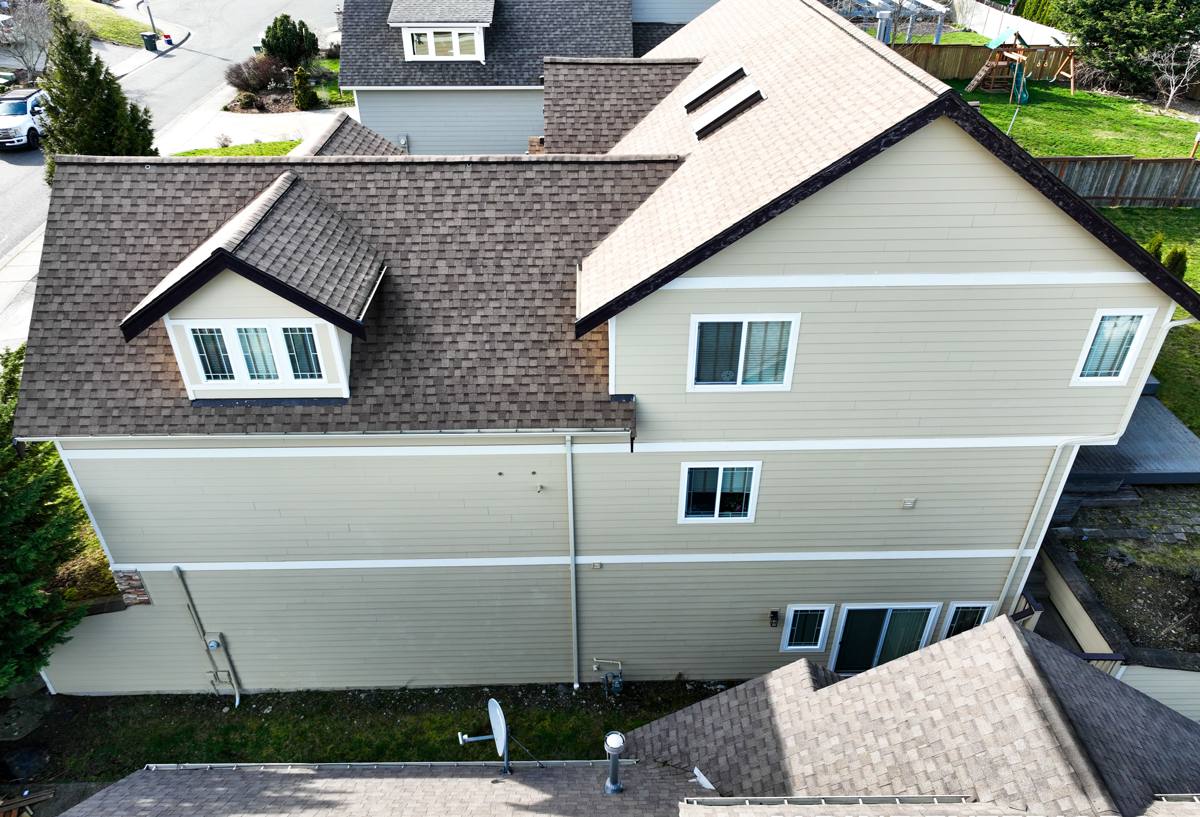
What Whatcom County's Weather Actually Does to a Deck Over Time
Driving Rain
Storms moving through the county rarely drop rain straight down by the time they reach Lynden. Wind pushes it at an angle, up under railing caps, into decking gaps, and into any joint detailed as if water only ever falls from above. A deck built for this area treats every horizontal surface and seam as a place water can get in sideways, because on an open lot, it regularly does.
Salt-Tinged Air That Still Reaches Inland
Lynden is far enough from the water that salt exposure isn't as constant as it is directly on Bellingham Bay, but the Salish Sea's influence still carries across the county on the prevailing weather patterns. It's a lighter dose than a waterfront lot gets, but it's still enough to shorten the working life of budget-grade fasteners and hardware over the years, especially in connections buried inside the framing that nobody checks after the build is done.
A Moss Season That Doesn't Take Much of a Break
Frequent rain and long overcast stretches mean a lot of Lynden decks don't get enough sustained dry weather to fully dry out, particularly in shaded corners or under tree cover along a property line. A mossy board isn't just an appearance issue — it traps moisture against the surface underneath, which speeds up rot and material breakdown well beyond what plain rain exposure would cause on its own.
Why the Combination Matters More Than Any One Factor
Any single one of these conditions is manageable on its own. What makes decks in Lynden and the rest of Whatcom County demanding is that they run together most of the year, without a long dry season to let a structure recover in between. A detail that would hold up fine somewhere drier can fall short here simply because the deck never gets that recovery window.
Where Water Actually Finds Its Way Into a Deck
- The ledger-to-house connection — the highest-consequence joint on the whole structure, because a failure here can send water behind the home's siding, not just into the deck framing.
- Decking gaps cut too tight — boards installed without enough spacing swell, trap debris, and hold moisture against the fasteners instead of shedding it.
- Post bases and footings set too close to grade — hardware sitting near soil that stays saturated after storms stays wet far longer than hardware set with proper clearance.
- Railing post connections — through-bolted posts that aren't flashed or capped correctly let water track down into the post and the framing below it.
- Stair stringers and lower framing — the least visible parts of a deck also see the most splash-back and ground moisture, especially on lower lots.
What Actually Drives the Cost of a Deck Built to Last
Most homeowners assume decking boards are the main cost driver. They matter, but a handful of structural and hardware decisions move the final number just as much — and they're exactly the items that get quietly downgraded when a bid needs to come in lower than it should.
| Cost Factor | Why It Matters Here | Relative Impact |
|---|---|---|
| Footing depth and placement | Sized to the actual soil and water table on the lot, which varies more on rural and river-adjacent properties around Lynden | Moderate to high |
| Fastener and connector grade | Corrosion-resistant hardware costs more up front but doesn't fail early in this area's damp, moisture-heavy air | Low to moderate |
| Ledger flashing detail | Proper step-flashing and sequencing takes more labor than caulk alone, but protects the wall behind the deck as well as the deck itself | Moderate |
| Decking material | Ranges from pressure-treated wood to premium composite or PVC, with price tied directly to how much upkeep you're willing to take on | High |
| Railing style and post connections | Code-compliant post-to-frame hardware and baluster spacing add labor no matter which railing material is chosen | Low to moderate |
| Deck size and layout | Larger footprints common on Lynden's bigger rural lots add material and framing time in direct proportion to square footage | Variable |
We walk through this table with every homeowner before a number goes on anything, so the estimate is something you understand rather than a total you're just asked to trust.
Choosing a Decking Material Without the Sales Pitch
Pressure-treated wood is the least expensive option and looks good on day one, but it demands the most ongoing attention — regular cleaning and resealing to keep moisture and moss from gaining ground in a climate that doesn't give a surface much time to dry between rains. Cedar has better natural rot resistance and a warmer look that suits a lot of the farmhouse and traditional styles common around Lynden, though its maintenance schedule is close to treated wood overall. Composite and PVC decking cost more to install but trade ongoing sealing for occasional washing, since neither material absorbs water or breaks down the way wood fiber does over time. A capped composite or cellular PVC surface also gives moss a harder, smoother surface to work with, which matters in a place where moss has most of the year to try.
There isn't a single correct answer here — it depends on how much time you want to spend maintaining the surface versus paying more once to reduce that upkeep. We'll walk through that trade-off honestly for your specific property and budget rather than pushing whichever material happens to be easiest to sell.
A Quick Material Comparison
| Material | Upfront Cost | Ongoing Maintenance | Moss Resistance |
|---|---|---|---|
| Pressure-treated wood | Lowest | Regular cleaning and resealing | Lower — porous surface holds moisture |
| Cedar | Moderate | Periodic sealing and cleaning | Moderate — naturally rot-resistant but still absorbs water |
| Composite (capped) | Higher | Occasional washing | Higher — smoother surface sheds moss more easily |
| PVC | Highest | Occasional washing | Highest — doesn't absorb water at all |
How We Build a Deck in Lynden
- Site walk and design conversation, where we look at your lot's drainage, sun and shade patterns, soil, and how the deck will attach to the house.
- Permit submission to the relevant local jurisdiction, sized and documented to match what's actually being built.
- Footings and framing, sized to the lot's actual soil and water table and assembled with corrosion-rated fasteners throughout, not just at the joints most likely to get inspected.
- Ledger flashing and decking installation, with gap spacing and board orientation set for drainage and airflow, not just a tight-looking finish on day one.
- Railing and stair completion, with post connections detailed to shed water rather than trap it against the frame.
- Final walkthrough, where we go over basic maintenance specific to the material you chose and what to watch for as the seasons turn.
Maintenance That Actually Matches This Climate
What a deck needs to stay sound in Lynden depends heavily on the material, but a few habits apply across the board. Keep gaps between boards clear of leaf litter and field debris so water and air can keep moving underneath. Rinse or gently scrub visible moss and algae before it spreads across a wider section of the surface. Check railing post bases and stair stringers once or twice a year for softness or discoloration, since those lower, less-visible areas take on more splash and ground moisture than the open deck surface does.
- Clear debris from board gaps and around post bases every few months, more often near trees or fields.
- Rinse or scrub moss and algae early, before it spreads or gets ground into the surface texture.
- Reseal wood decking on the schedule the manufacturer recommends — don't stretch it to save a season.
- Inspect the ledger flashing and any visible fasteners once a year for corrosion or gaps in the sealant.
- Confirm downspouts and yard grading near the deck are still directing water away from the footings, especially on lower ground closer to the river.
Why Local Experience in Lynden and Whatcom County Matters
A deck built to a generic national spec sheet can still fail here on schedule, because that spec was written for a climate that gets a real dry season to let a structure recover. A crew that already works Lynden and the rest of Whatcom County knows how open, rural lots take wind-driven rain differently than sheltered in-town lots, how far river-adjacent ground stays saturated after a storm, and which fastener and flashing choices hold up through a moss season that doesn't take much of a break. That's not a marketing point — it's the difference between a deck that needs real repair in five years and one that's still solid well past fifteen.
We also treat the ledger connection as part of the home's overall exterior water management, not an isolated deck detail, because siding and exterior moisture control is our core trade. That perspective carries over into every deck we build, whether the rest of the project involves new siding or not.
Ready to Talk Through Your Project?
If you're weighing a new deck or replacing one that's showing its age, we're glad to come take a look at your property, walk the site with you, and give you a straightforward read on what it'll take to build it right for a Lynden lot. Reach out for a free, no-pressure estimate using the form below.