 Whatcom County
 Sunnyland's Siding Problem Starts With the Weather
Sunnyland is a mature, tree-shaded neighborhood, and that's exactly what makes siding decisions here different from a new subdivision on open ground. Established tree canopy means more shade, more standing moisture on north- and west-facing walls, and more organic debris settling into siding laps and trim joints. Add in Whatcom County's broader climate pattern — proximity to Bellingham Bay puts salt-laden air into the mix, Pacific storm systems drive rain sideways instead of straight down, and the region's mild, wet winters stretch the moss season out for months rather than weeks — and you get siding conditions that are genuinely harder on a wall than most manufacturers assume when they write their national installation specs.
None of this means siding is doomed here. It means the material and the installation both have to be matched to what the wall actually experiences, not just what looks good in a showroom. That's the whole conversation on this page: what Sunnyland homes need from their siding, what a correct job looks like, and why a crew that already works this neighborhood catches problems a crew unfamiliar with the area might miss.
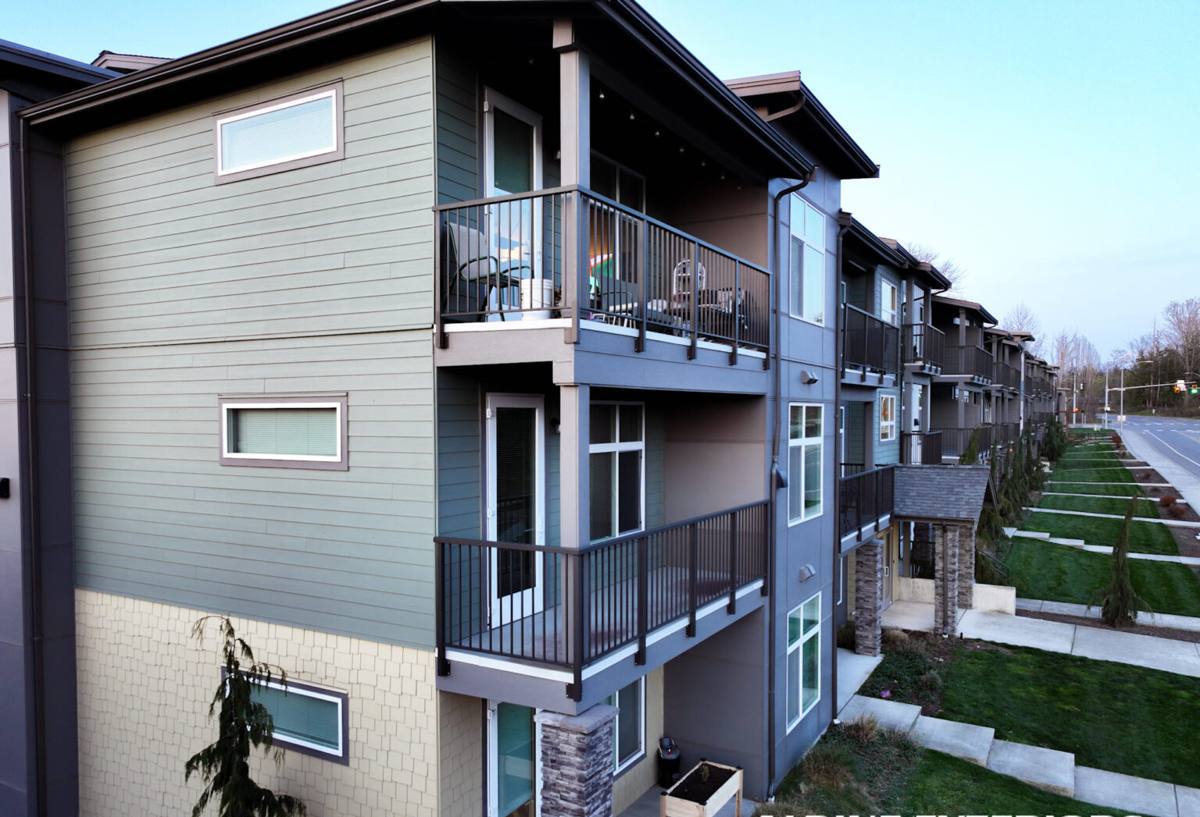
Why We Only Install James Hardie in This Climate
We install James Hardie fiber cement siding exclusively — not vinyl, not LP SmartSide, not cedar, not other fiber cement brands. That's a deliberate standard, and the reasoning is climate-specific, not brand loyalty.
Moisture behavior is the deciding factor
Fiber cement is cement, sand, and cellulose fiber — it doesn't rot, it doesn't delaminate the way engineered wood products can if water gets past a seam, and it doesn't warp or buckle the way vinyl can when it's exposed to repeated wet-dry cycling. Whatcom County sits in James Hardie's moisture-engineered product zone, meaning the formulation is built for a climate that stays damp for long stretches rather than one that cycles through hard freezes. That matters in a neighborhood like Sunnyland, where tree shade keeps siding wet longer after a storm than it would on an open, sun-exposed lot.
The factory finish matters more than people expect
ColorPlus, Hardie's factory-applied finish, is baked on under controlled conditions rather than field-sprayed. That gives it better adhesion and a harder, smoother surface than a job-site paint coat — which matters directly for moss and algae, since organic growth gets a much better foothold on a porous, weathered surface than on a hard, factory-cured one. It's not moss-proof; nothing exposed to Whatcom County's damp season indefinitely is. But it holds up longer between cleanings than raw wood or field-painted siding does.
Non-combustible construction
Fiber cement doesn't burn, which isn't a wildfire-zone talking point exclusive to dry climates — it's simply a better long-term risk profile for any home, and it's one more reason we standardized on a product built around it rather than combustible alternatives.
What a Correct Installation Actually Involves Here
The material is only half the equation. Most siding failures we get called out to inspect in this region trace back to installation shortcuts, not the product itself. On a Sunnyland home, a correct Hardie job includes:
- A drainage plane and rain screen gap behind the siding so wind-driven rain that gets past the surface has somewhere to go besides your sheathing
- Proper flashing at every window, door, and roof-wall intersection — kickout flashing where a roofline meets a wall is easy to skip and is one of the most common sources of hidden rot we find on older homes
- Fastener placement and spacing that follows Hardie's published spec exactly, not a generalized "close enough" pattern
- Correct clearance — siding held up off grade, decks, and roof surfaces per manufacturer minimums so splashback and standing moisture don't sit against the bottom edge
- Field-cut edges primed and touched up with matched paint, since a raw cut edge is the one place factory-finished siding loses its factory protection
- Sealant used only where Hardie actually calls for it — over-caulking seams that are designed to breathe traps moisture instead of shedding it
Every one of these is a small decision at install time that either keeps water moving off the wall or gives it a place to sit. In a climate that doesn't dry out quickly, that difference compounds over years.
Matching the Right Hardie Product to Sunnyland's Housing Mix
Sunnyland's homes run from older bungalows and cottages to mid-century ranches and craftsman-style houses, and the right Hardie product depends on the home's style and exposure as much as personal taste.
| Product | Best Fit | Why It Works Here |
|---|---|---|
| HardiePlank lap siding | Most home styles, especially craftsman and traditional exteriors | Widest color and texture selection; proven track record on Pacific Northwest wall assemblies |
| HardieShingle | Accent gables, dormers, or full facades on cottage-style homes | Matches the shingle-style look common in older Bellingham-area neighborhoods without the maintenance burden of real wood shingles |
| HardiePanel | Porch ceilings, accent walls, modern or mixed-material exteriors | Clean, flat look for homes mixing siding textures |
| HardieTrim | Corners, window and door surrounds, fascia | Fiber cement trim eliminates the wood trim rot that's often the first failure point on older homes here |
We'll talk through which combination fits your home's architecture during the estimate — there's rarely one "right" answer, but there is usually a best one for a given roofline, exposure, and budget.
The Moss and Moisture Reality — and What It Means for Upkeep
No siding material in Whatcom County is maintenance-free. The honest comparison is about how much upkeep a material needs and how forgiving it is when that upkeep gets delayed a season.
| Material | How Moss/Algae Behaves | What That Means Long-Term |
|---|---|---|
| Cedar / untreated wood | Moss and mildew take hold readily on the porous grain; growth can hold moisture against the wood itself | Needs regular sealing/staining and cleaning to avoid rot starting under the growth |
| Vinyl | Moss and algae collect in the overlapping seams and can trap moisture behind panels | Panels can warp or buckle with age, and trapped moisture isn't visible until damage is advanced |
| James Hardie (ColorPlus) | Hard, factory-cured surface is less hospitable to growth than porous or seamed materials, though shaded areas still need occasional washing | Cement core doesn't rot or feed fungal growth even if moss sits on the surface longer than ideal |
A simple homeowner maintenance routine goes a long way regardless of material:
- Rinse siding (garden hose, not a pressure washer aimed directly at seams) once or twice a year, more often on shaded walls
- Keep gutters clear so overflow doesn't run down the siding face and streak or feed moss growth
- Trim back vegetation and tree limbs that keep a wall section shaded and damp
- Check caulking annually at penetrations — hose bibs, vents, light fixtures — and re-seal if it's cracking
- Inspect any field-cut trim edges for exposed, unpainted fiber cement and touch up promptly
Our Process, Start to Finish
The steps don't change from house to house, but the details we're watching for at each one do, based on the home's exposure and age.
- On-site estimate — we walk the exterior, note existing moisture damage, tree shading, drainage issues, and trim condition, then scope the job in writing.
- Product and color selection — we go through Hardie's plank, shingle, and trim options and colors against your home's style and HOA or neighborhood character if relevant.
- Tear-off and inspection — removing the old siding is when hidden rot, missing flashing, or past water intrusion actually shows up; we address sheathing damage before anything new goes on, not after.
- Weather barrier and rain screen installation — this layer, not the visible siding, is what actually keeps bulk water out of the wall assembly.
- Hardie installation to manufacturer spec — fastening, flashing, clearances, and sealant placement done to the published installation guide, not shortcuts.
- Final inspection and cleanup — walk-through, touch-up paint on any field cuts, and warranty registration paperwork completed.
Why Hiring a Crew That Already Works Sunnyland Matters
A crew that's worked this specific neighborhood knows things a crew from outside the area has to learn on your dime. That includes which wall orientations tend to hold moisture longest under mature tree cover, what Bellingham's permitting and inspection process actually requires, and how to plan logistics — material staging, dumpster placement, access — on the tighter, older lots common in established Whatcom County neighborhoods. It also means the crew has already seen how James Hardie siding performs here specifically over years, not just in a manufacturer's general climate guidance.
What Drives Cost on a Sunnyland Siding Job
| Cost Factor | Why It Matters |
|---|---|
| Tear-off scope | Removing multiple old layers or asbestos-containing siding takes more labor and disposal cost than a single-layer tear-off |
| Hidden moisture damage | Rotted sheathing or framing found during tear-off has to be repaired before new siding goes on — this is the most common source of a mid-project cost change |
| Home size and wall complexity | Steep gables, multiple stories, and dormers all add labor time and staging cost |
| Trim scope | Full HardieTrim replacement at corners and openings costs more up front but removes the wood trim that usually fails first |
| Product line and finish | Shingle-style accents and premium ColorPlus finishes cost more than standard lap siding in a standard color |
We give real numbers during the on-site estimate rather than a phone quote, because the two biggest cost variables — hidden damage and trim scope — genuinely can't be assessed without walking the house.
If you're weighing a siding project on a Sunnyland home, we're glad to come take a look and walk you through what we see, with no pressure to sign anything on the spot. Use the form below to request a free estimate.