 Whatcom County
 Edgemoor's Exterior Sits Between Two Weather Systems
Edgemoor homes catch a mix that's harder on siding than most people realize: bay-adjacent salt air moving in off the water, long stretches of driving rain pushed sideways by wind, and a moss season that can run most of the year in the shade pockets under mature trees and along north-facing walls. None of these three things is unusual on its own for Whatcom County. Together, on the same wall, for years at a time, they add up to a specific set of failure patterns — paint that chalks and fades faster than it should, trim that swells at the joints, and moss and algae staining that keeps coming back no matter how many times it's pressure washed off.
This page is about one product, installed in one place: James Hardie fiber cement siding on homes in and around Edgemoor. It's not a general siding primer. It's what we've learned about what this specific climate does to a wall, what a correct Hardie installation looks like in response, and why the install crew matters as much as the product itself.
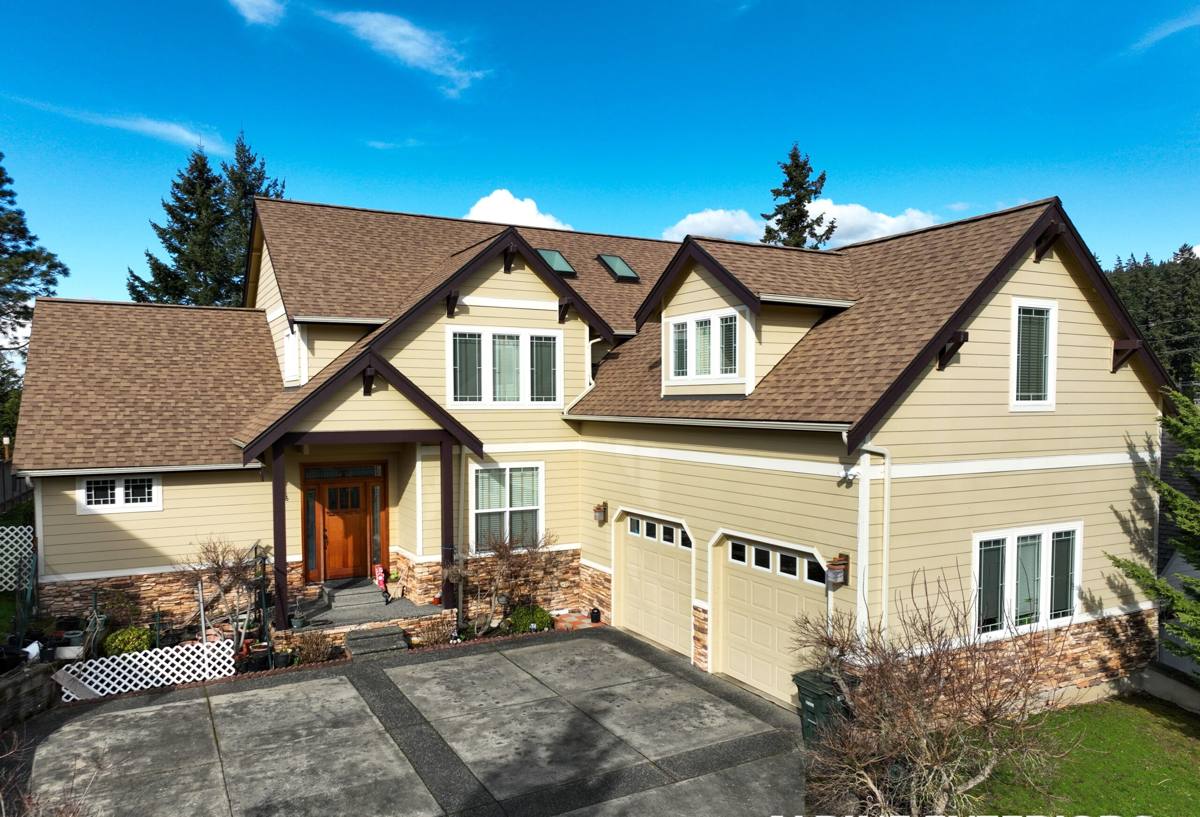
What Salt Air, Rain, and Moss Actually Do to Siding
Salt Air
Homes closer to the water deal with airborne salt that settles on every exterior surface, including siding, trim, and fasteners. Salt is corrosive to unprotected metal and it's abrasive to standard paint films over time — it pulls moisture to the surface and accelerates weathering. Fiber cement itself doesn't corrode, but the fasteners, flashing, and trim details around it can, which is why fastener choice and flashing material matter more here than in an inland neighborhood.
Driving Rain
Whatcom County's rain isn't just frequent, it's often wind-driven, which pushes water sideways into laps, seams, and butt joints rather than letting it run straight down. Siding that relies on caulk alone at horizontal joints, or that's installed with tight or reversed laps, will eventually let water behind the cladding. Once water gets behind siding and can't dry out, you get the rot, mold, and sheathing damage that turns a cosmetic problem into a structural one.
Moss and Algae Season
Shaded, moisture-retaining surfaces in this climate grow moss and algae for most of the year, not just in winter. On some materials that's mostly cosmetic; on wood-based products it can hold moisture against the substrate long enough to start real decay. It also means paint and finish quality matter — a chalky, porous surface holds onto organic growth and stains far more than a dense, factory-cured finish.
Why We Standardized on James Hardie for This Climate
We install James Hardie fiber cement exclusively. We don't install vinyl, LP SmartSide, Cemplank, Allura, or bare cedar or primed spruce, and that's a deliberate standard, not a lack of options. Fiber cement doesn't rot, doesn't feed insects, and is non-combustible — none of which vinyl or wood-based siding can claim. Hardie's ColorPlus factory finish is baked on and cured under controlled conditions, which holds color and resists the chalking and fading that field-applied paint struggles with in a wet, sun-and-shade climate like this one. And Hardie's HZ5 product line is engineered specifically for climates with more moisture exposure, which fits Edgemoor's profile better than a generic all-climate product.
That said, no siding product installs itself correctly. Hardie siding installed with the wrong nails, wrong gaps, or wrong flashing will fail in this climate just like anything else — the product only performs to spec when the installation matches the spec.
What a Correct Installation Looks Like Here
- HZ5 panels and trim for the added moisture and freeze-thaw margin, not a generic zone product
- Stainless or hot-dip galvanized fasteners rated for coastal exposure, driven per Hardie's fastening schedule — not whatever nails were already in the gun
- Weather-resistive barrier and flashing at every penetration and horizontal transition, integrated shingle-style so water sheds outward instead of pooling behind the plane
- Correct clearances — minimum gaps from grade, roofing, decks, and horizontal trim so splash-back and standing water don't sit against the bottom edge of the siding
- Proper lap and joint treatment — factory-primed cut edges sealed, joints backed or flashed rather than caulk-only
- Correct nailing pattern and blind-nailing where specified so panels can move slightly with temperature and moisture without cracking or popping fasteners
Every one of these is in Hardie's published installation manual. None of them is optional, and skipping any one of them is exactly how a premium product ends up with a below-average lifespan.
Where Corners Get Cut — and What It Costs Later
| Detail | Correct approach | Common shortcut | Result of the shortcut |
|---|---|---|---|
| Fasteners | Stainless/hot-dip galvanized, coastal-rated | Standard electro-galvanized nails | Streaking, fastener corrosion, popped heads within a few years |
| Flashing at joints | Shingle-lapped, integrated with WRB | Caulk-only seams | Water intrusion once caulk shrinks or cracks |
| Bottom clearance | Min. clearance from grade/decks per spec | Siding installed tight to grade or hardscape | Wicking moisture, moss growth at the base, early rot at sheathing |
| Cut edge treatment | Field-sealed with Hardie-approved sealer/primer | Left raw or unsealed | Accelerated moisture absorption at every cut, edge swelling |
| Product line | HZ5 for this moisture zone | Standard/generic zone product | Reduced margin against sustained wet exposure |
Our Process for Edgemoor Homes
1. Walk and Assess
We look at the whole envelope, not just the visible siding condition — orientation to prevailing wind and rain, shaded/moss-prone faces, existing flashing and trim condition, and any signs of past moisture intrusion at windows, decks, or grade lines.
2. Tear-Off and Sheathing Check
Existing siding comes off and the sheathing underneath gets inspected before anything new goes up. If there's hidden rot from old water intrusion, it gets addressed then, not covered over.
3. Weather Barrier and Flashing
A new weather-resistive barrier goes on with all flashing integrated at windows, doors, and horizontal transitions before a single piece of siding is hung.
4. Hardie Installation to Spec
HZ5 panels and trim, correct fasteners, correct clearances, correct lap and joint detailing — installed to Hardie's manual, not to whatever's fastest.
5. Final Walkthrough
We go over caulk lines, paint touch-up at cut edges, and clearances with the homeowner before calling the job done.
ColorPlus Finish and Long-Term Appearance
In a climate with this much sun-to-shade variation and organic growth pressure, the finish matters as much as the substrate. ColorPlus is a multi-coat, factory-baked finish applied and cured before the siding ever reaches the jobsite, which gives it more consistent color depth and better fade and chip resistance than siding painted on-site after installation. It also comes with its own finish warranty, separate from the substrate warranty on the fiber cement itself — worth understanding as two different guarantees covering two different failure modes.
Maintenance Through Moss Season
Correctly installed Hardie siding is genuinely low-maintenance, but "low" isn't "none," especially with Edgemoor's growing season for moss and algae:
- Rinse shaded and north-facing walls periodically with a garden hose — avoid high-pressure washing directed at seams or up under laps
- Keep gutters clear so overflow doesn't run down the face of the siding and hold moisture at the top courses
- Trim back vegetation and tree limbs that keep a wall section shaded and damp longer than the rest of the house
- Check caulk at trim and penetrations yearly and re-caulk before it cracks, not after
- Watch bottom courses near grade, decks, and hardscape for standing moisture or debris buildup
Warranty: What's Actually Covered
James Hardie backs its fiber cement products with a long, transferable limited warranty on the substrate, and a separate finish warranty on ColorPlus color and coating performance. Warranty coverage generally assumes installation followed the published manual — which is another reason installation quality isn't a side issue. A warranty is only as good as the installation it's sitting on top of.
Why Hiring a Crew That Already Works Edgemoor Matters
A crew that's worked this stretch of Whatcom County already knows which walls take the worst of the driving rain, where salt exposure calls for upgraded fasteners, and which shaded sections need extra attention to flashing and clearance because they never fully dry out. That's not something you can fully capture in a spec sheet — it comes from having done the work here before and having seen what holds up and what doesn't.
What to Ask Before Hiring Anyone for Hardie Siding
- Are they Hardie-certified or specifically trained on Hardie's install requirements, not just siding in general?
- Will they specify HZ5 (or the correct zone product) in writing, not just "Hardie siding"?
- What fastener type are they using, and is it rated for coastal/salt-air exposure?
- How do they detail flashing at horizontal joints and penetrations — shingle-lapped or caulk-only?
- Do they inspect and address sheathing condition before installing new siding, or just cover over the old wall?
If your Edgemoor home's siding is showing chalking, moss staining that won't stay gone, or soft spots near the bottom courses, it's worth a second look before another wet season sets in. We'd be glad to walk the exterior with you and give you a straightforward, no-pressure estimate on what correct James Hardie siding would look like for your specific walls — just fill out the form below.