 Whatcom County
 Why Happy Valley Homes Need Siding Built for This Climate
Happy Valley sits inside a stretch of Whatcom County where the weather doesn't really give a house a break. Rain falls in long, low-intensity stretches for much of the year, moisture-laden air off the Salish Sea works its way into wall assemblies, and shaded, tree-lined lots stay damp long after a storm has passed. Add in the salt air that drifts inland off the water and the moss season that seems to start earlier every year, and you have a set of conditions that will find every weakness in a siding system over time.
None of this means Happy Valley is an unusually harsh place to build. It's a normal Pacific Northwest marine climate. But "normal" here still means more annual moisture exposure than most siding products were designed to shed decade after decade. That's the lens we use when we talk to homeowners in this neighborhood about siding: not what looks good on day one, but what still performs after fifteen or twenty wet seasons.
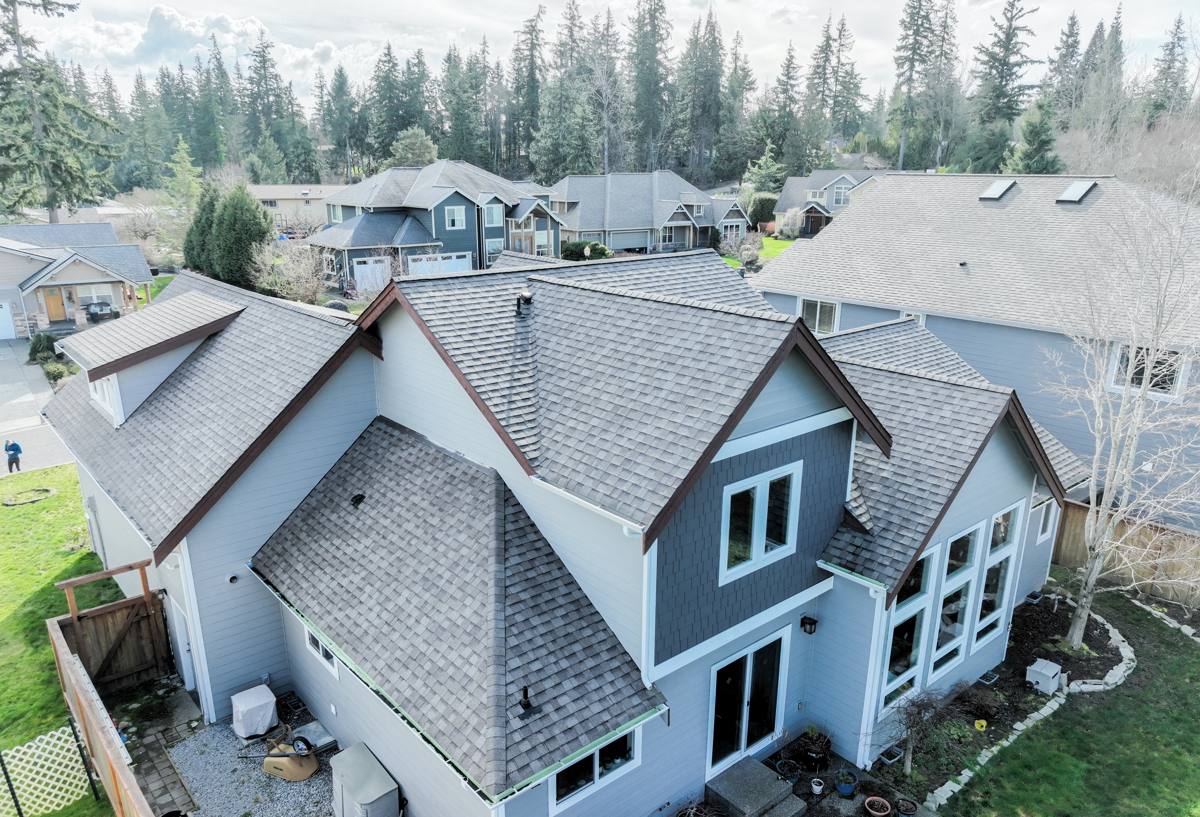
What Constant Rain and Moss Do to the Wrong Siding Material
Moisture problems on a house rarely show up as a single dramatic failure. They show up as small, cumulative issues that compound: a panel edge that stays damp two days longer than it should, a caulked seam that starts to crack, a north-facing wall that never fully dries between rain events. Over years, that pattern leads to swelling, soft spots, cupping, or paint and finish failure, depending on the material.
Moss and Algae Growth
Moss doesn't just grow on roofs. On siding, it takes hold wherever a surface stays shaded and damp — under eaves, behind shrubs, on the north and west walls that get the least sun exposure. Once established, moss holds moisture against the siding surface, which accelerates whatever degradation process that material is already prone to.
Salt-Laden Air
Salt air doesn't just affect homes right on the waterfront. It travels inland with prevailing winds and settles on exterior surfaces, where it can accelerate corrosion of metal fasteners and trim and contribute to finish breakdown on lower-quality coatings over time.
Why We Install James Hardie and Nothing Else
We made a decision as a company to install only James Hardie fiber cement siding, and a climate like this one is a big part of why. Hardie's HZ5 product line is engineered specifically for climates that see this kind of sustained moisture exposure — it's formulated and tested for regions like ours, not a one-size-fits-all product sold the same way in Arizona as in Washington.
Fiber cement itself is not a new idea, but the way Hardie manufactures it matters. It's non-combustible, it doesn't swell or delaminate the way wood-based products can when they take on water repeatedly, and it holds its shape and fastener grip over time in a way that matters a lot when a house is going to sit in wet conditions for eight or nine months of the year.
ColorPlus Factory Finish
Most of what we install carries Hardie's ColorPlus finish — a factory-applied, baked-on finish rather than field-applied paint. In a climate where field-applied coatings are fighting damp conditions during application and curing, a factory finish avoids that variable entirely and holds its color and adhesion more consistently over the life of the siding.
Warranty That Reflects Confidence in the Product
Hardie backs its siding with a strong, transferable warranty — a meaningful detail if a homeowner sells the house down the road. That warranty structure is part of why we don't install products with weaker or more conditional coverage; it's a signal of how the manufacturer expects the product to hold up in real conditions, not just in a lab.
What a Correct Installation Actually Involves
The siding material only performs as well as the installation behind it. In a wet climate, the details that are invisible once the job is done are the ones that determine whether a house stays dry for the next thirty years or develops problems in five.
Weather Barrier and Flashing First
Before a single piece of siding goes up, the house needs a continuous, properly lapped weather-resistant barrier, and every penetration — windows, doors, vents, hose bibs — needs correctly installed flashing that directs water back out, not into the wall cavity. This step is where most long-term moisture failures actually originate, regardless of what siding eventually goes over it.
Rainscreen and Drainage Gap
In a climate this wet, a drainage gap between the siding and the weather barrier isn't optional in our view — it gives incidental moisture a path to escape and dry, rather than sitting trapped against the back of the siding. This is one of the details that separates a correct installation from one that simply looks finished.
Fastening and Clearances
Hardie specifies exact fastener types, spacing, and penetration depth, along with minimum clearances from grade, roofing, and decks. Skipping or fudging these specs is one of the fastest ways to void a warranty and create a callback down the line — moss and standing debris at ground-contact points are a common source of avoidable damage.
Joints, Caulking, and Butt Seams
Every seam is a potential entry point for water. Correct butt-joint treatment, proper caulk selection, and attention to how panels meet trim and corners all matter more in a climate that doesn't give surfaces much time to dry between rain events.
Comparing Siding Options for a Climate Like This
We get asked why we don't offer other materials as a lower-cost option. Here's an honest look at the trade-offs as we see them, based on how these products behave in sustained wet, shaded conditions.
| Material | Moisture Behavior | Maintenance Burden | Typical Longevity Here |
|---|---|---|---|
| James Hardie fiber cement | Engineered for climates like ours; resists swelling and moisture-driven damage when installed to spec | Low — factory finish, occasional washing | Decades, with warranty backing |
| Vinyl siding | Doesn't absorb moisture itself, but can trap it behind panels and is prone to warping in temperature swings | Low, but limited repair options if damaged | Moderate; appearance and fit degrade over time |
| LP SmartSide (engineered wood) | Wood-based core is more sensitive to sustained moisture exposure at cut edges and seams | Higher — finish and seam maintenance matter more here | Shorter than fiber cement in wet climates if maintenance lapses |
| Cedar / primed spruce | Natural wood; absorbs and releases moisture constantly, especially in shaded, damp areas | High — regular refinishing and moss/mildew treatment | Shortest without diligent, ongoing upkeep |
Every one of these products has a legitimate place in the market. We simply concluded that for the moisture load a Whatcom County exterior sees year after year, fiber cement gives homeowners the best combination of low maintenance and long-term performance without asking them to babysit their siding.
How Our Process Works on a Happy Valley Home
We approach every job in this neighborhood the same methodical way, because the climate rewards it.
1. On-Site Assessment
We walk the property, note shaded and damp-prone wall areas, check existing moisture damage around windows and trim, and identify drainage or grading issues that could undermine new siding regardless of material.
2. Prep and Water Management
We address the weather barrier, flashing, and drainage gap before siding installation begins — the part of the job that determines long-term performance but is invisible once complete.
3. Installation to Manufacturer Spec
Fastening patterns, clearances, joint treatment, and finish handling all follow Hardie's published installation requirements, not shortcuts that speed up the schedule at the expense of the warranty.
4. Final Walkthrough
We review the completed exterior with the homeowner, covering what to expect in year one and what basic upkeep looks like going forward.
What Affects the Cost of a Job Like This
- Square footage and the complexity of the home's shape (corners, gables, dormers)
- Condition of the existing wall sheathing and weather barrier underneath the current siding
- Amount of trim, window, and door detailing that needs flashing and finish work
- Whether existing siding needs to be fully removed or there's underlying damage to repair first
- Site access and how shaded/damp conditions affect scheduling and drying time during the job
- Product line and ColorPlus color selection
Why Hiring a Crew That Already Works in This Area Matters
A crew that regularly works Whatcom County jobs already understands how the moisture patterns here behave differently from a drier region — where moss actually establishes on a given lot, how much drying time to plan around between rain systems, and which details tend to get overlooked by installers who don't normally work in a marine climate. That local familiarity shows up in fewer callbacks and a house that's genuinely built for what Happy Valley weather does to it, not just for a generic installation manual.
If you're planning a siding project in Happy Valley or elsewhere in Whatcom County, we're happy to take a look at your home and walk you through what correct James Hardie installation looks like for your specific situation — no pressure, no obligation. Reach out for a free estimate using the form below.