 Whatcom County
 Building a Deck That Can Actually Handle Ferndale
Ferndale sits close enough to the water and low enough in the Nooksack valley that decks here take a different kind of beating than decks inland. Salt-tinged air off the Strait works into fasteners and hardware over time. Driving rain doesn't just fall straight down — it blows sideways under railings and into seams that a calmer climate would never test. And the long stretch of gray, damp months every fall through spring means anything horizontal — boards, joists, ledgers — sits wet far longer than most manufacturers' installation guides assume. A deck that's merely "built to code" can still fail early here if it wasn't built with this specific climate in mind.
Composite decking has become the go-to choice for a lot of Ferndale homeowners precisely because it doesn't feed the moss and rot cycle the way untreated or under-maintained wood does. But composite isn't maintenance-free, and it isn't foolproof against poor installation. The material only performs as well as the substructure and detailing underneath it. That's the part of the job most homeowners never see — and the part that determines whether a deck looks good for two years or twenty.
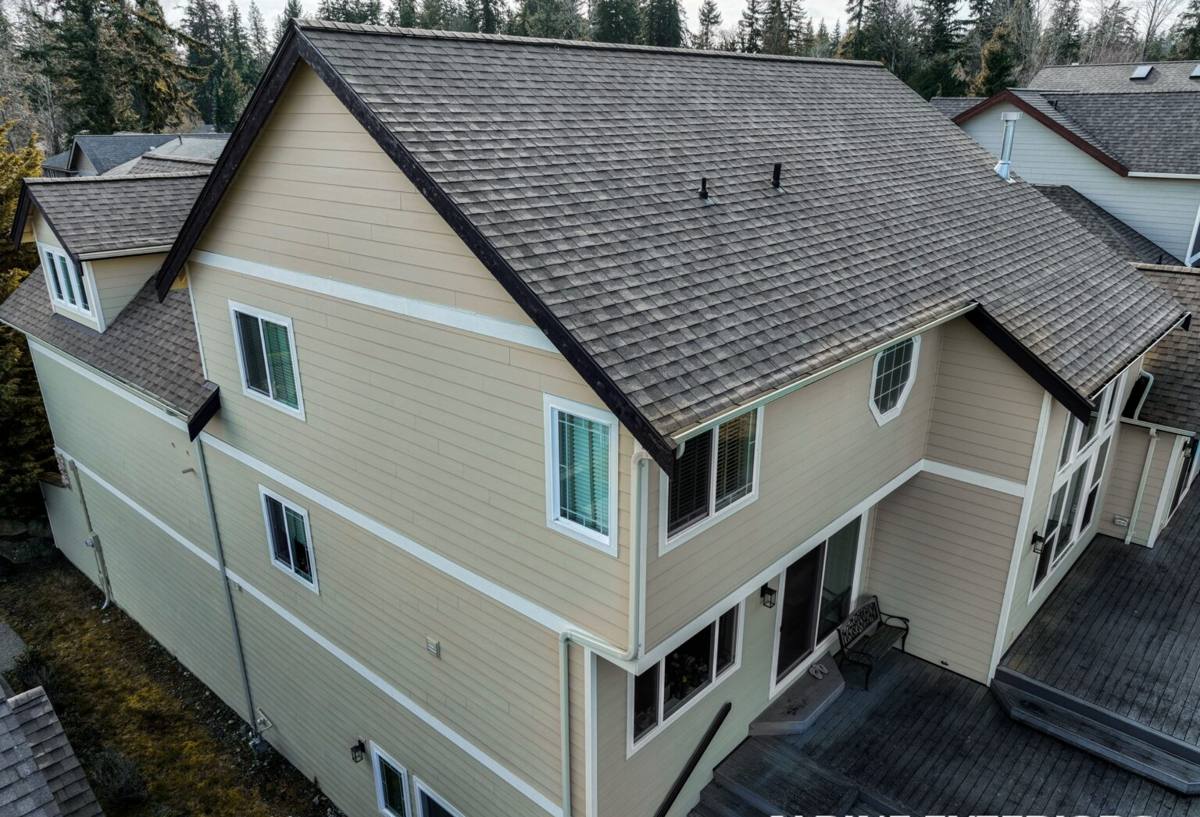
What Ferndale's Climate Actually Does to a Deck
Salt Air and Metal Fatigue
Even a few miles inland from the water, airborne salt accelerates corrosion on anything not rated for coastal exposure — screws, joist hangers, post bases, and railing hardware. Standard zinc-coated fasteners can start showing rust streaks within a couple of seasons in this environment. We spec stainless steel or heavy-duty coated fasteners rated for coastal or treated-lumber contact specifically because of this.
Driving Rain and Wind-Driven Moisture
Whatcom County storms often come in sideways off the water, not straight down. That means rain gets pushed under rail caps, into fascia board seams, and behind ledger boards where a calmer climate's flashing details would hold up fine. Every horizontal-to-vertical transition on a deck — ledger-to-house, post-to-beam, rail-to-post — needs flashing and gap detailing that accounts for wind-driven water, not just gravity.
Moss, Algae, and the Long Wet Season
Ferndale's moss season runs long — realistically most of the year outside of a dry summer stretch. Moss and algae need moisture, shade, and organic debris to take hold, and a deck surface that stays damp under leaf litter or in a shaded corner is exactly that environment. Composite surfaces resist rot, but the surface texture still needs airflow underneath and regular clearing to keep growth from becoming a slip hazard.
Why Composite Makes Sense for This Specific Location
We don't push composite on every deck project — it's not automatically the right call everywhere. But for Ferndale specifically, a few climate-driven factors tend to favor it:
- No annual re-staining or sealing cycle to keep up with during a wet season that rarely gives you enough consecutive dry days to do the job right.
- Cap-stock composite boards resist moisture absorption at the surface, which matters when boards are wet more often than they're dry for months at a time.
- Consistent density means no soft spots developing from years of standing water the way some wood decks eventually show, especially near ground-level framing.
- Color and texture stay more stable under the gray, low-UV winter light Ferndale gets most of the year, so the deck doesn't look weathered and patchy within a season or two.
That said, composite still requires a correctly built substructure, proper drainage, and periodic cleaning. It trades one kind of maintenance (sealing, staining, sanding) for another (surface cleaning, moss control, hardware checks). Homeowners who understand that trade-off going in tend to be happiest with the result.
What a Correct Composite Deck Install Actually Involves
The composite boards themselves are the easy part. The framing and detailing underneath are where most long-term problems start — or get prevented. A job we're proud to put our name on includes:
Substructure and Framing
Pressure-treated or naturally rot-resistant framing lumber, sized and spaced to the composite manufacturer's span rating — not standard wood-decking spacing, which is usually wider than composite allows. Composite boards are heavier and behave differently under load than wood, so undersized joist spacing is one of the most common causes of bounce and premature sagging.
Ledger Attachment and Flashing
Where the deck attaches to the house, proper flashing (not just caulk) needs to shed water away from the ledger board and the wall assembly behind it. This is the single most common point of hidden rot on older decks in this region, because wind-driven rain finds any gap in a ledger connection that wasn't flashed correctly the first time.
Ventilation and Drainage Underneath
Low-clearance decks need airflow beneath the boards so moisture doesn't get trapped against the framing. In a climate this wet, that airflow is what keeps the substructure — which is usually still wood even under composite decking — from becoming a slow-motion rot problem hidden under a nice-looking surface.
Fastening Method
Hidden fastener clip systems are standard on most composite lines now, giving a clean surface with no exposed screw heads to trap water or corrode. Getting clip spacing and board gapping right matters more in a high-moisture climate, since boards will expand and contract seasonally and need room to do that without buckling.
Railings and Hardware
Post bases, rail brackets, and any exposed hardware get coastal-rated fasteners and, where possible, hardware that sheds water rather than pooling it against a joint.
How Our Process Works
- On-site assessment. We look at existing structure (if replacing a deck), grade and drainage around the site, sun/shade exposure, and how wind and rain typically hit that side of the house.
- Design and material selection. We walk through board options, color, and layout, and talk through the maintenance trade-offs honestly rather than just upselling the premium line.
- Permitting. Deck projects in Whatcom County and the City of Ferndale generally require a permit depending on size and height — we handle that paperwork as part of the job.
- Demolition or site prep. If we're replacing an old deck, we haul away the old material and inspect the ledger and any framing that's being reused.
- Framing. Correctly spaced, properly fastened, and flashed at every wood-to-house connection.
- Composite installation. Boards, hidden fasteners, fascia, and any picture-framing or border detail.
- Railings and finish work. Stairs, railings, post caps, and lighting if included.
- Final walkthrough. We go over care and cleaning specifics for the board line installed, not generic advice.
Composite vs. Other Decking Materials in This Climate
| Material | Moisture Behavior | Upkeep in Ferndale's Climate | Typical Lifespan |
|---|---|---|---|
| Composite (cap-stock) | Resists surface absorption; core still needs airflow underneath | Periodic cleaning, moss/algae clearing | Long-term, backed by manufacturer warranty |
| Pressure-treated wood | Absorbs moisture readily; prone to cupping and splitting if not sealed | Annual sealing/staining recommended in this climate | Shorter without consistent upkeep |
| Cedar | Naturally rot-resistant but still absorbs water over time | Regular sealing to hold color and resist graying | Moderate, varies with maintenance |
| PVC (all-synthetic) | Fully resists moisture absorption | Low; mainly surface cleaning | Long-term, but higher upfront cost |
There's no single "best" material for every homeowner — it depends on budget, how much upkeep you actually want to do, and how the deck will be used. We'll give you a straight answer based on your specific site, not just the product we'd rather sell.
Keeping Moss and Algae Under Control Long-Term
Composite doesn't rot the way wood does, but a shaded, damp deck surface in Whatcom County will still grow moss and algae if it's ignored. A simple seasonal routine keeps it looking right and, more importantly, keeps it safe underfoot:
- Sweep debris (leaves, needles, seed pods) off the surface regularly — decomposing organic matter is what feeds moss growth.
- Rinse the deck with a hose and a soft-bristle broom a few times a year, more often in shaded areas.
- Use a cleaner rated for composite decking if moss or algae has already taken hold — avoid pressure washers on high settings, which can damage the cap-stock surface.
- Check that gaps between boards stay clear so water and debris can drain through rather than pooling.
- Inspect railings and hardware once a year for early rust streaks, especially closer to the water where salt air is stronger.
- Trim back overhanging branches or shrubs that keep sections of the deck shaded and slow to dry.
What Affects the Cost of a Composite Deck in Ferndale
| Factor | Why It Matters Here |
|---|---|
| Deck size and height | Larger or elevated decks need more framing, railing, and often engineering review |
| Board tier | Composite lines range from entry-level to premium cap-stock; pricing and warranty scale with the line |
| Substructure condition | Replacing rotted or undersized framing adds cost but is not optional for a safe, lasting deck |
| Flashing and ledger work | Correcting a poorly flashed ledger connection on an older house adds labor but prevents hidden rot |
| Railing style | Composite, metal cable, or glass rail systems vary significantly in material cost |
| Site access | Sloped lots or limited equipment access around the home can add labor time |
We give a firm, itemized quote after the on-site visit — not a ballpark over the phone — because so much of the real cost depends on what's happening underneath the surface, especially on older homes where the existing ledger or framing needs attention.
Permits and Local Requirements
Most composite deck projects in Ferndale and unincorporated Whatcom County require a building permit, particularly for decks attached to the house, elevated decks, or anything with railings. Requirements can vary by exact location, lot, and structure size, so we handle the permit application and inspection scheduling as part of the project rather than leaving that on the homeowner. Skipping permitting on an attached deck isn't just a compliance issue — it also means no third-party check on ledger attachment and structural framing, which are exactly the details that cause problems down the road in this climate.
Why a Crew That Already Works Ferndale Makes a Difference
A lot of decking problems we get called to fix started with a crew that builds mostly in drier, inland climates and treated Ferndale like any other job site. Flashing gets skipped or minimized. Fastener grade gets downgraded to save cost. Joist spacing follows a generic spec sheet instead of accounting for how long these boards sit wet. None of that shows up on day one — it shows up two or three winters later, in the form of soft framing, rusted hardware, or a ledger connection that's been quietly letting water into the house.
Working regularly in Whatcom County means we already know which details matter here: how to flash a ledger against wind-driven rain, which fastener grade actually holds up against salt air, and how much airflow a low-clearance deck needs to stay dry underneath through a wet fall and winter. That's not something you can fully substitute with a manufacturer's install manual written for a national market.
Get a Straight Answer on Your Deck Project
If you're weighing a new composite deck or replacing an aging wood one, we're happy to come take a look, talk through what your specific site needs, and give you a clear, no-pressure estimate. There's a form below to get that conversation started.