 Whatcom County
 Board & Batten Siding, Built for Everson's Weather
Board and batten has been a Pacific Northwest farmhouse and rural staple for a reason — the vertical lines shed water naturally, and the deep shadow lines from the battens give a home real texture instead of a flat wall. In Everson, that profile has to do more than look good. Homes here sit in a corridor that gets a long wet season, persistent damp air moving up from the Sound, and enough shade and moisture overlap most winters to grow moss on anything that stays damp too long. Board and batten siding that isn't detailed correctly for those conditions will hold water at the battens, trap moisture behind the panel, and start showing streaking and soft spots years before it should.
This page is specifically about board and batten siding for homes in and around Everson — not a general primer. If you're comparing bids for this exact profile on a home dealing with Whatcom County's salt air, driving rain, and moss season, here's what actually matters.
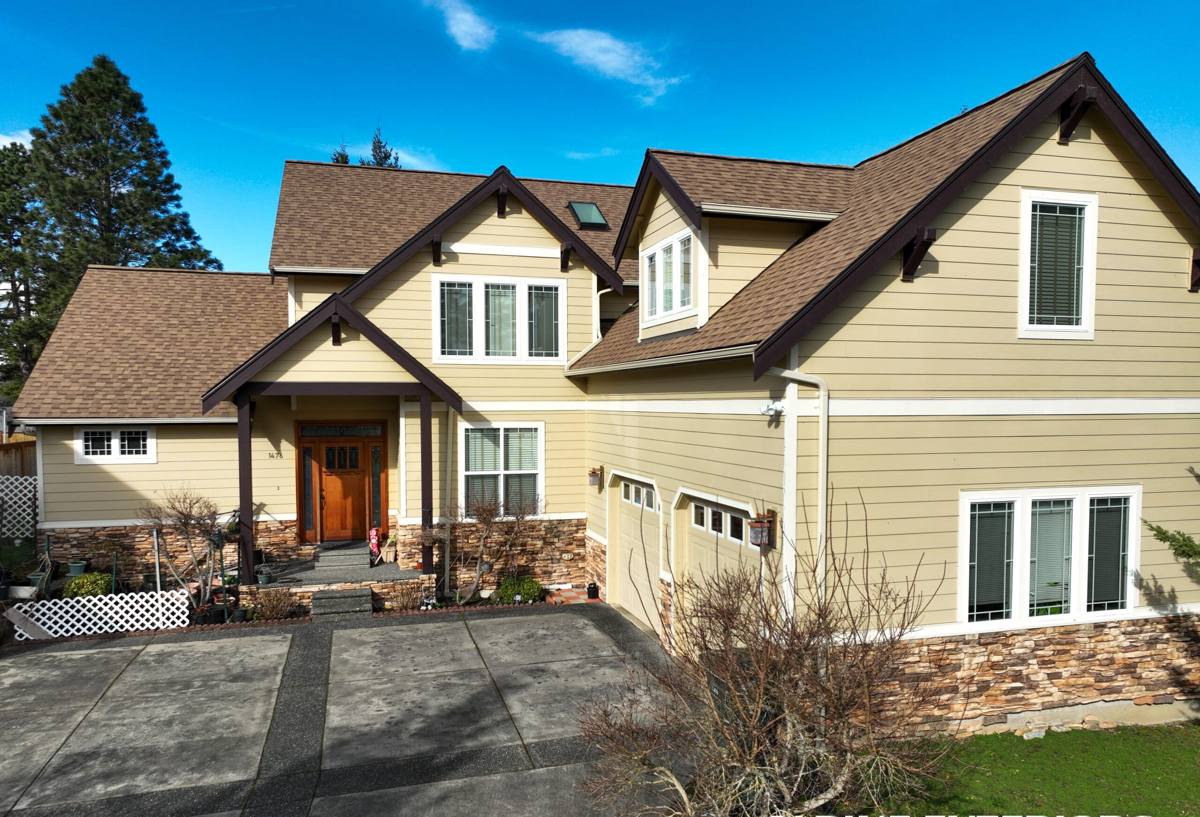
What Board & Batten Siding Is (and Isn't)
Board and batten is a vertical siding pattern: wide flat panels or boards installed vertically, with narrow strips (the battens) covering the seams between them. Historically it was solid wood, which is why it still reads as a farmhouse or craftsman look. Today, most correctly-built board and batten systems use engineered panels — we install James Hardie's fiber cement board and batten and vertical panel products exclusively.
Why the Profile Matters More Than People Think
Because board and batten relies on vertical seams and overlapping battens instead of horizontal lapped boards, the water management is different from lap siding. Get the panel spacing, batten width, and fastening pattern wrong, and you've built a system that funnels water into the wall instead of off of it. This is a profile where installation detail matters at least as much as the material.
What We Install
- James Hardie fiber cement vertical panels with battens, factory-primed or ColorPlus finished
- Hardie's HZ10 product formulation, engineered for the Pacific Northwest's wet, moderate climate zone
- Corrosion-resistant fastening hardware rated for coastal and near-coastal exposure
- Proper rain screen and flashing detailing behind the panel system, not just the panel itself
What Everson's Climate Does to Board & Batten Siding Over Time
Whatcom County's mix of salt-tinged air, long stretches of driving rain, and a moss season that can run half the year is hard on any exterior. Board and batten has specific failure points that show up faster here than in drier climates.
Salt Air and Fasteners
Board and batten depends on a lot of exposed fastener points — through the battens, through the panel edges, at trim. Standard fasteners corrode faster in salt-influenced air, and a rusting fastener head under paint is one of the first visible failures homeowners notice: a small rust bleed streak running down a batten. We spec fastening hardware rated for coastal exposure specifically because of this.
Driving Rain and Wind-Driven Moisture
Vertical siding sheds bulk water well when it's detailed right, but driving rain with any wind behind it pushes moisture sideways and can force it behind panels at the seams if the laps, caulk joints, or flashing are undersized or missing. Board and batten built without a drainage gap behind the panel has nowhere for that intruded moisture to go — it sits against the wall sheathing.
Moss and Prolonged Damp
Everson's moss season means anything horizontal or shaded stays wet longer — window sills, batten tops, trim returns. Moss holding moisture against a board and batten seam for months at a time is a slow but real threat to whatever's underneath, especially on north- and west-facing walls that don't get much sun to dry out between storms.
What a Correct Board & Batten Installation Actually Involves
A lot of the difference between board and batten that lasts 30+ years and board and batten that needs attention in year eight comes down to what's behind the panel, not the panel itself.
Rain Screen Gap
We install with a drainage gap between the panel and the weather-resistant barrier, so any moisture that does get past the outer surface can drain and the wall assembly can dry. This is especially important on a vertical profile where seams run the full height of the wall.
Flashing at Every Transition
Window and door heads, roof-to-wall intersections, and horizontal trim bands all need proper flashing — not just caulk. Caulk is a maintenance item; flashing is the actual water management. On board and batten, this matters most where a horizontal element interrupts the vertical run.
Batten Spacing and Fastening
Battens have to be spaced to Hardie's engineering specs and fastened into solid backing, not just through the panel into air. Improper batten fastening is one of the more common corner-cutting mistakes we see when we're called out to look at another contractor's earlier work.
Panel Gaps and Sealant Joints
Panel-to-panel and panel-to-trim gaps need to be sized correctly and sealed with a sealant rated for the movement fiber cement and lumber trim go through seasonally. Too tight, and the assembly can't move without cracking the joint; too loose, and it's a water path.
Why We Only Install James Hardie for This Profile
We get asked why we don't offer board and batten in LP SmartSide, vinyl, cedar, or primed spruce alternatives. Each of those has legitimate strengths — LP SmartSide is engineered wood with real impact resistance, cedar has a warmth that's hard to replicate, vinyl is inexpensive. Our standard isn't that those products are bad; it's that after years of installing and repairing siding in this climate, James Hardie's fiber cement performs more predictably here, and we'd rather stand fully behind one system we know inside and out than split our expertise across several.
The Trade-Offs We Weighed
| Factor | Board & Batten Consideration |
|---|---|
| Moisture behavior | Fiber cement doesn't swell, rot, or delaminate at cut edges the way wood-based panels can if a seam is compromised |
| Combustibility | Non-combustible, a meaningful factor for homeowners weighing wildfire-adjacent insurance considerations |
| Finish durability | ColorPlus factory finish resists fade and chipping better than field-applied paint on wood or engineered wood panels |
| Maintenance | Fiber cement holds up to Everson's moss and damp exposure with less repainting than wood-based options |
| Warranty structure | Hardie's transferable warranty on both the substrate and factory finish gives homeowners real coverage, not just a manufacturer defect clause |
None of this means the products we don't install are wrong choices for every homeowner. It means we've decided, as a standard, what we're willing to warranty and stand behind on this profile in this climate — and that's James Hardie fiber cement.
Our Process for Everson Board & Batten Projects
- On-site assessment — we look at wall orientation, existing moisture damage, current siding condition, and how the home has weathered so far, before quoting anything.
- Detailing plan — we map out flashing points, rain screen approach, and batten layout specific to that home's elevations, not a one-size template.
- Removal and inspection — once old siding is off, we check sheathing and framing for hidden moisture damage before anything new goes up.
- Weather barrier and rain screen install — the unglamorous part that determines whether the finished siding lasts.
- Panel and batten installation — fastened, spaced, and sealed to Hardie's specifications for our climate zone.
- Final walk-through — we go over the finished work and what maintenance, if any, it'll need going forward.
What Drives Cost on a Board & Batten Project
| Cost Factor | Why It Matters |
|---|---|
| Wall condition underneath | Hidden rot or moisture damage found during tear-off adds repair scope before new siding goes up |
| Number of transitions | Windows, doors, roof lines, and trim bands each need flashing detail — more transitions, more labor |
| Panel vs. individual board layout | Engineered panel systems install faster than true individual board-and-batten layouts |
| Finish selection | Factory ColorPlus finish costs more upfront than primed panels but eliminates a repaint cycle |
| Home height and access | Multi-story walls and steep sites add scaffolding and time |
We give real numbers after seeing the home — not a phone-quote range that changes once we're on the roof.
Maintenance That Actually Matters in This Climate
- Rinse off accumulated moss, pollen, and grime once or twice a year, especially on shaded north- and west-facing walls
- Check caulk joints at window and door transitions annually for cracking or separation
- Watch for any rust streaking near fastener points, which can signal hardware that needs attention
- Keep gutters and downspouts clear so runoff isn't sheeting directly down a wall section
- Trim back vegetation that shades siding and keeps it damp longer than the rest of the house
Why Hiring a Crew That Already Works Everson Matters
Board and batten built to a spec sheet in a dry climate isn't automatically built right for Whatcom County. A crew that's installed and repaired this profile through actual Everson winters knows where the driving rain hits hardest on a given lot orientation, how much moss pressure a shaded wall is really going to see, and which detailing shortcuts show up as problems in year three instead of year twenty. That's not something a general contractor picks up from a manual — it comes from doing the work here, repeatedly, and going back to look at how earlier projects actually held up.
If you're considering board and batten siding for a home in Everson, we're happy to take a look and give you a straightforward, no-pressure estimate — including an honest read on your walls' current condition before we talk about the new siding at all.