 Whatcom County
 Why Blaine's Marine Climate Is Hard on Windows
Blaine sits right on the water, with Semiahmoo Bay, Drayton Harbor, and the Strait of Georgia all within a few miles of most homes in town. That location is part of what makes Blaine a good place to live, but it's also a tough environment for exterior building materials — windows included. Salt-laden air moves inland on a regular basis, wind-driven rain comes in sideways during winter storms, and the long, damp stretch from fall through spring keeps wood, trim, and seals wet for months at a time. Add in the shoulder seasons where moss and algae get a foothold on anything that stays shaded and damp, and you've got a climate that will find every weak point in a window installation — the frame material, the seals, the flashing, all of it.
None of this means Blaine homes need exotic products. It means the window and the installation both have to be matched to marine conditions, not just picked off a showroom floor because they looked good in a drier part of Whatcom County.
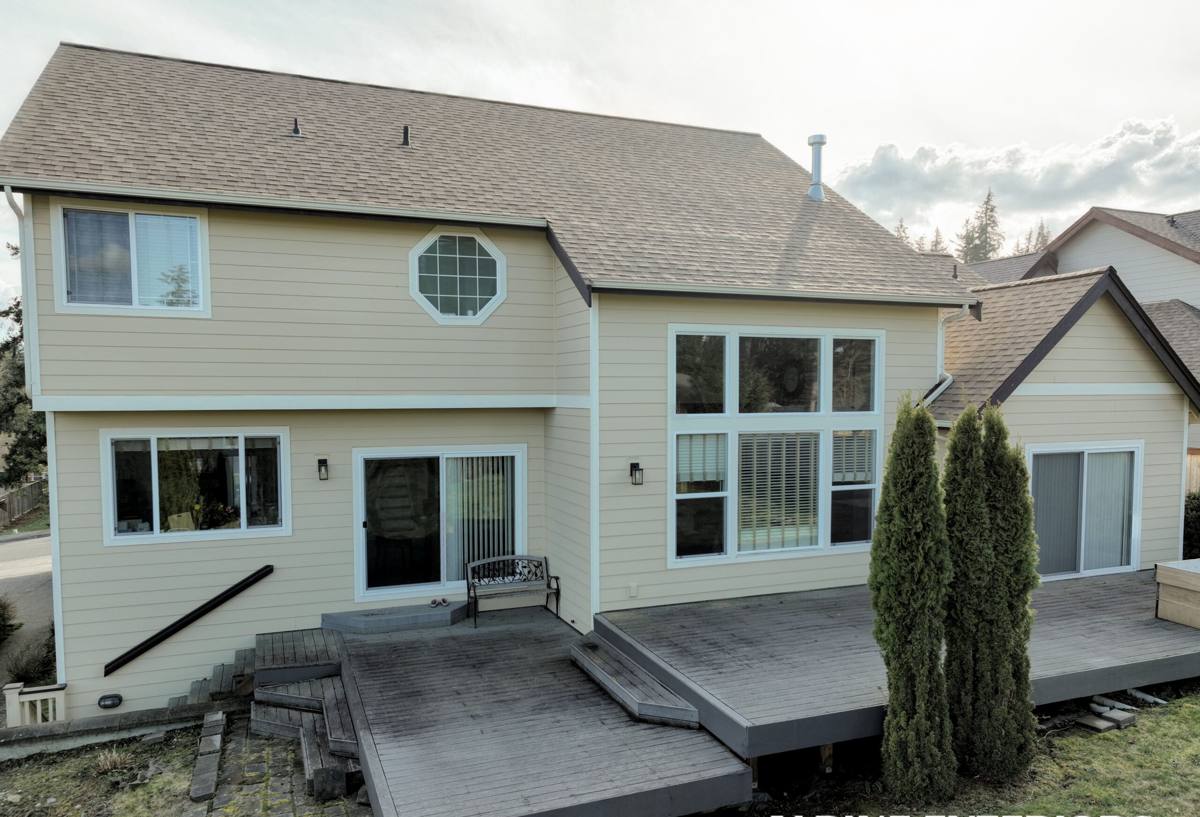
Signs Your Blaine Home's Windows Are Underperforming
Most homeowners don't think about their windows until something forces the issue — a cold draft, a spike in the heating bill, or visible damage. Here's what we typically see first in this area:
- Fogging or a permanent haze between the panes (a failed seal on a double- or triple-pane unit)
- Visible corrosion or pitting on aluminum frames or hardware — common near the water
- Soft, discolored, or swelling wood at the sill or bottom corners of the frame
- Noticeable draft or cold spots near the window when wind is coming off the bay
- Moss or dark streaking on the exterior trim around the window, even when the roof and gutters are in good shape
- Difficulty opening, closing, or locking the sash — frames can swell and bind in persistently damp conditions
- A heating bill that creeps up each winter without an obvious cause
Any one of these on its own might just need a repair. Several at once, especially on the side of the house that takes the most weather, usually points to windows that are past the point where sealing or reglazing makes sense.
What "Energy-Efficient" Actually Means in This Climate
Energy efficiency for a window comes down to a few measurable properties, and they matter differently depending on where you live. In Blaine, the priorities are keeping heat in during a long, mild-but-damp winter and keeping moisture out year-round — this isn't a climate with brutal cold snaps or intense summer sun, so the numbers that matter most are slightly different than what you'd prioritize in, say, eastern Washington.
U-Factor Matters More Than SHGC Here
U-factor measures how much heat a window lets escape — lower is better. Because our winters are wet and mild rather than extremely cold, a solid U-factor is still important for comfort and heating costs, but it doesn't need to be pushed to the extreme values you'd want in a colder climate. Solar Heat Gain Coefficient (SHGC) — how much solar heat a window lets in — matters less here simply because we don't get the intense, sustained sun that makes SHGC a priority in other regions. A window with a moderate SHGC that still lets in useful daylight is usually the right call for Whatcom County.
Gas Fills and Multi-Pane Glass
Double-pane windows with an argon gas fill are the standard baseline for a Blaine home today, and they perform well for most rooms. Triple-pane windows add a real, measurable improvement in insulation and sound dampening — worth considering on the side of the house facing the water or a busy road, where wind noise and heat loss are both more noticeable. It's not usually worth the added cost on every window in the house, but it's a smart upgrade on the ones that take the brunt of the weather.
Frame Material: The Decision That Matters Most Near Salt Water
More than any other single choice, frame material determines how a window holds up in a coastal environment. Here's how the common options compare for a Blaine installation:
| Frame Material | Salt Air / Moisture Performance | Maintenance | Notes for Blaine |
|---|---|---|---|
| Vinyl | Very good — won't corrode or rot | Low — occasional cleaning | Our default recommendation for most homes; consistent performance in marine air |
| Fiberglass | Excellent — dimensionally stable in wet/dry cycles | Low | Strong option for larger openings or homes taking direct weather exposure |
| Wood | Poor without diligent upkeep | High — regular painting/sealing required | Can work for interior-side aesthetics when clad on the exterior; unclad wood is a hard sell this close to the water |
| Wood-clad (vinyl or aluminum-clad exterior) | Good — exterior face is protected | Moderate | Popular where homeowners want a wood interior look without the exterior maintenance burden |
| Aluminum | Fair — prone to corrosion and pitting near salt air unless marine-grade and well-finished | Moderate | We're selective about where we'll recommend it in Blaine specifically |
We don't install bare aluminum-frame windows on homes with direct salt air exposure as a matter of professional standard — not because the material can't be made to work in the right application, but because the corrosion risk and finish maintenance it demands aren't a good trade-off for most homeowners here when vinyl and fiberglass perform as well or better for less upkeep.
Installation Details That Matter More in Blaine Than Elsewhere
A window is only as good as its installation, and that's especially true in a climate that delivers driving rain on a regular basis. The window itself can meet every efficiency spec on paper and still fail early if the flashing, sealing, and drainage aren't done right.
Flashing and Water Management
Every opening needs a proper flashing sequence — a sill pan to catch and direct any water that gets past the primary seal, house wrap integration that sheds water down and over the window rather than behind it, and head flashing that keeps wind-driven rain from working its way up under the siding. This is the step that gets rushed on a fast, low-cost install, and it's the step that causes rot and hidden water damage years later — often well after the installer is gone.
Sealing That Accounts for Wind-Driven Rain
Standard caulking isn't enough on the sides of a house that catch wind off the water. We pay particular attention to sealing details on window orientations that face prevailing weather, using materials rated for the movement and exposure they'll actually see, not just the minimum code requirement.
Fastening and Structural Fit
A window that isn't shimmed and fastened correctly will operate poorly and stress its own seals over time — leading to exactly the kind of premature seal failure we see reported above. Getting the unit square, level, and properly anchored in the rough opening is basic craftsmanship, but it's also where corners get cut when a crew is moving too fast.
Our Process for a Blaine Window Replacement
- On-site assessment. We look at each window's current condition, orientation, and exposure — a window on the water-facing side of the house often needs different specs than one on a sheltered wall.
- Product recommendation. Based on that assessment, we recommend frame material, glass package, and gas fill by opening, not a single blanket spec for the whole house.
- Written estimate. Clear pricing, materials, and scope before anything is ordered.
- Removal and flashing prep. Old units come out carefully, and we inspect the rough opening and sheathing underneath for any hidden moisture damage before anything new goes in.
- Installation. Sill pan, flashing, air sealing, and fastening done to hold up against Whatcom County weather, not just to pass a quick visual check.
- Final inspection and cleanup. We check operation, sealing, and exterior finish work before we call the job done.
Maintenance in a Salt-Air, High-Moss Environment
Even a well-installed, high-quality window benefits from some basic upkeep in this climate:
- Rinse salt residue off exterior frames periodically, especially on homes closest to the water
- Keep nearby vegetation trimmed back so windows and trim get some sun and airflow, which discourages moss and algae growth
- Check and clear weep holes on vinyl and fiberglass frames so water drains rather than pools
- Inspect exterior caulking annually and touch up before small gaps become water intrusion points
- Operate sashes periodically through the winter to keep hardware from binding in damp conditions
None of this is heavy maintenance — it's the kind of seasonal attention that keeps a good installation performing well for its full service life instead of running into avoidable problems early.
What Affects Cost
Every home and every opening is different, so we don't quote sight-unseen, but these are the main variables that move price up or down on a Blaine window project:
| Factor | Effect on Cost |
|---|---|
| Frame material (vinyl vs. fiberglass vs. clad wood) | Fiberglass and clad wood typically cost more than vinyl |
| Double-pane vs. triple-pane glass | Triple-pane adds cost per unit; often reserved for exposed elevations |
| Window size and configuration | Large or custom-shaped openings cost more than standard sizes |
| Extent of rough-opening or sheathing repair needed | Hidden moisture damage found during removal adds cost but should never be skipped |
| Full-frame replacement vs. insert replacement | Full-frame costs more but is often the right call when flashing or framing is compromised |
| Number of windows done at once | Doing multiple windows in one project typically lowers the per-window cost |
Why Local Experience in Blaine Matters
A crew that works across Whatcom County regularly, and in Blaine specifically, already knows which elevations on a given street layout tend to take the worst of the weather, what kind of moisture issues show up behind older siding near the water, and which products hold up and which ones don't over a few winters in this specific environment. That's the kind of judgment that doesn't come from a spec sheet — it comes from doing the work here, repeatedly, and seeing how installations actually perform a few years down the road. It's also why we're straightforward about trade-offs instead of upselling every home to the most expensive option: the right window for a sheltered inland lot in Whatcom County isn't always the right window for a home facing open water in Blaine, and a contractor who knows the difference will spec your project accordingly.
If your windows are showing their age, or you're just looking for an honest read on what a Blaine home actually needs from a window upgrade, we're happy to take a look. Reach out for a free, no-pressure estimate using the form below.