 Whatcom County
 Edgemoor's Roofing Problem Isn't Like the Rest of the Country's
Edgemoor sits close enough to the water that salt air is a daily fact of life on the roof, not an occasional nuisance. Add Whatcom County's long wet season, a moss cycle that basically never fully shuts off, and stretches of driving, wind-pushed rain, and you've got a roofing environment that punishes shortcuts. A shingle roof that would coast for twenty-five years in a dry inland climate can start showing granule loss, algae streaking, and soft decking well ahead of schedule here if it wasn't built and maintained for these conditions from day one.
We're not describing a hypothetical. This is the normal wear pattern we see on Edgemoor homes: north-facing slopes that stay damp longer, valleys and low-slope sections that collect moss first, and fastener lines that corrode faster near the water than they would a few miles inland. None of that means asphalt shingles are the wrong choice for this neighborhood — they're still the most cost-effective, widely serviceable roofing material available, and a correctly installed asphalt shingle roof holds up fine here. It just means "correctly installed" has a specific, local meaning.
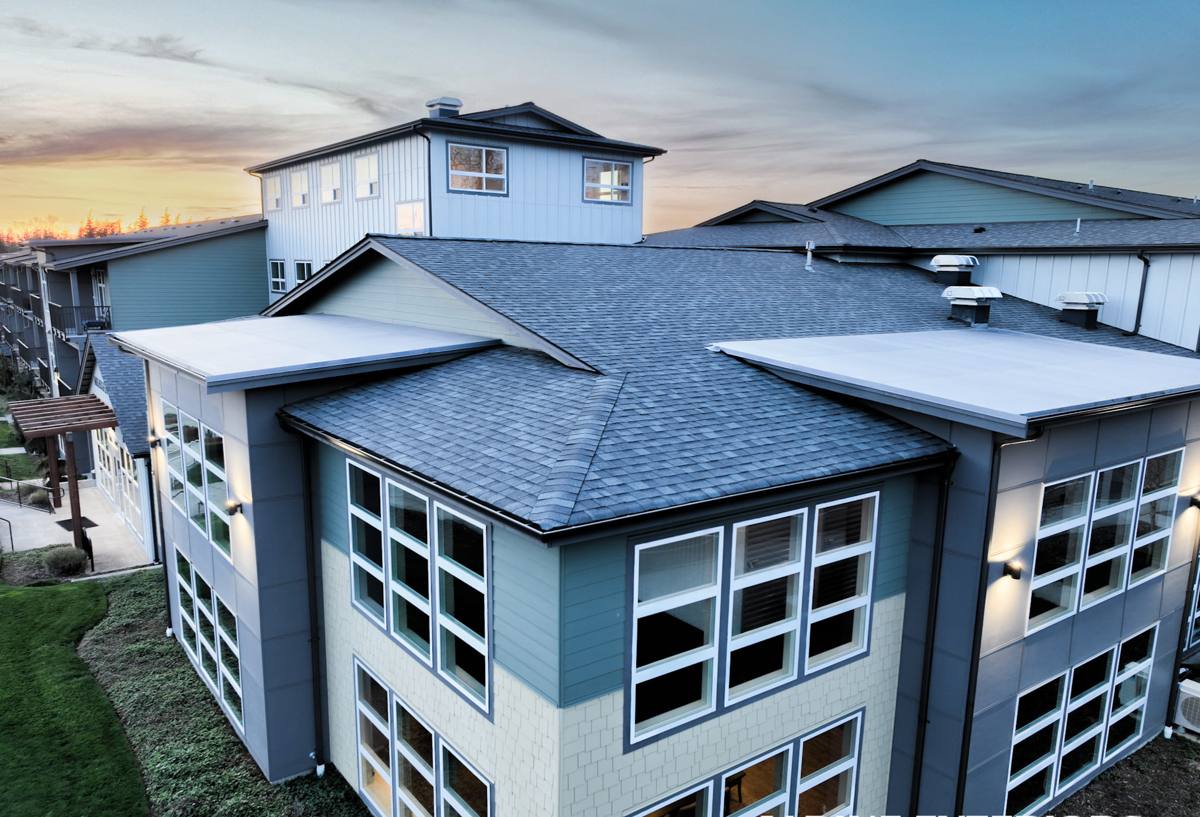
What Salt Air, Rain, and Moss Actually Do to a Roof
Salt air
Airborne salt accelerates corrosion on exposed metal — nail heads, flashing, vent caps, gutter fasteners. On a roof that was fastened or flashed with the wrong grade of metal, or where nails weren't sealed properly, salt exposure shows up as rust streaking and premature fastener failure years before the shingles themselves are due for replacement.
Driving rain
Wind-driven rain doesn't just fall straight down — it gets pushed sideways and upward under shingle edges, around chimneys, and into any gap in flashing or underlayment. A roof built for a calmer climate, with minimal underlayment coverage or loosely lapped flashing, can leak in exactly the spots a fair-weather roof never would.
Moss
Whatcom County's moss season runs long — shade, moisture, and mild temperatures are exactly what moss wants, and Edgemoor's tree cover and marine humidity give it plenty of both. Moss isn't just cosmetic. Once it takes hold, it lifts shingle edges, holds moisture against the roof deck, and works its way under tabs, which is how a moss problem quietly becomes a leak problem.
What a Correctly Built Roof Looks Like Here
A roof that's actually built for Edgemoor's conditions, not just installed to code minimums, includes a few things that matter more here than they would in a drier climate:
- Full synthetic underlayment coverage (not just at eaves and valleys) so wind-driven rain that gets past the shingle layer still has a second line of defense
- Corrosion-resistant fasteners and flashing rated for coastal or marine exposure, not standard-grade galvanized
- Ice-and-water shield or equivalent membrane at valleys, eaves, and roof penetrations, where driving rain and moss both concentrate
- Balanced intake and exhaust ventilation, so moisture from inside the attic doesn't add to what the shingles are already dealing with from outside
- Shingle products with algae-resistant (AR) granules, since standard granules discolor faster under constant marine humidity
- Properly lapped step and counter-flashing at chimneys and walls, sealed and mechanically fastened rather than relying on caulk alone
None of this is exotic. It's standard practice done thoroughly, with materials chosen for the actual climate instead of a generic spec sheet.
Signs an Edgemoor Roof Needs Attention
Because moss and salt-driven wear tend to start quietly, most homeowners don't catch a developing problem until it's already inside the attic. Here's what we'd actually check for, and what you can look for yourself from the ground or a ladder:
- Moss growth along ridges, valleys, or the shaded (usually north-facing) slope
- Granules collecting in gutters or downspouts — a sign shingles are wearing thin
- Curling, cupping, or lifted shingle edges, especially where moss has taken hold
- Rust streaking below vent caps, flashing, or exposed fasteners
- Dark streaking or discoloration across the roof field (algae, not just dirt)
- Soft or spongy spots underfoot on the roof deck, or sagging between rafters
- Daylight visible through the attic roof deck, or damp insulation after a storm
- Water stains on interior ceilings, particularly after wind-driven rain events
Any one of these on its own might just mean routine maintenance. Two or three together usually means it's time for a real inspection before the next wet season does more damage.
Our Asphalt Shingle Roofing Process
The process itself isn't unusual — what matters is the attention paid to the details that this climate punishes if they're skipped.
1. Inspection and honest assessment
We look at the roof from the deck up: ventilation, existing flashing condition, signs of moss or moisture intrusion, and the actual state of the decking underneath. If a roof can be reasonably repaired instead of replaced, we'll say so.
2. Tear-off and deck check
Full tear-off to bare decking on replacements, with any soft or water-damaged sheathing replaced before anything new goes down. Roofing over an existing layer, or over a compromised deck, just locks moisture problems in — not something we do.
3. Underlayment and flashing first
This is where a marine-climate roof earns its keep. Full underlayment coverage, membrane at vulnerable points, and flashing that's actually lapped and fastened correctly — not caulked as an afterthought.
4. Shingle installation
Manufacturer nailing patterns, proper exposure, and algae-resistant shingles as standard for this area, not an upsell. Ventilation components go in as part of the same job, not tacked on later.
5. Final walk-through
We walk the finished roof and the site with you, confirm cleanup, and explain what maintenance (if any) the roof will need going forward.
Shingle Options and What They Actually Cost You Over Time
Homeowners usually ask about upfront price first, but in a climate like Edgemoor's, the bigger question is how a shingle tier holds up against moss, algae, and wind over the years you'll own the roof. Broad, honest ranges below — exact pricing depends on roof size, pitch, tear-off scope, and access.
| Shingle Tier | Typical Lifespan Here | Wind Rating | Moss/Algae Resistance | Relative Cost |
|---|---|---|---|---|
| Standard 3-tab | 15–20 years | Lower (60–70 mph range) | Standard granules only; discolors faster | Lowest |
| Architectural (dimensional) | 20–30 years | Higher (100–130 mph range) | Usually available with AR granules | Mid-range |
| Premium/designer | 30+ years | Highest tier, varies by product | AR granules standard; heavier profile sheds moisture better | Highest |
For most Edgemoor homes, architectural shingles with algae-resistant granules hit the practical sweet spot — meaningfully better wind and moss performance than 3-tab without the full premium price jump. We'll walk through the actual product lines and warranties available for your specific roof rather than pushing one tier by default.
Ongoing Moss and Algae Maintenance
Even a well-built roof in this area benefits from periodic upkeep — this is a maintenance climate, not a set-it-and-forget-it one.
| Maintenance Task | Why It Matters Here | Rough Frequency |
|---|---|---|
| Soft wash / moss removal | Prevents moss from lifting shingle edges and holding moisture against the deck | Every 1–2 years, more often on heavily shaded slopes |
| Gutter and downspout cleaning | Clogged gutters back rainwater up under eaves during driving rain | 2–3 times per year |
| Zinc or copper strip installation | Slows future moss regrowth on ridges with rain runoff | One-time, reapplied as it wears |
| Flashing and fastener check | Catches salt-driven corrosion before it becomes a leak | Annually, or after major storms |
None of this needs to be aggressive or expensive — it's mostly about not letting moisture and organic growth sit on the roof longer than necessary.
Ventilation: The Overlooked Half of the Job
A roof that's soaked from the outside by rain and one that's damp from the inside due to poor attic ventilation end up with the same result — a shortened shingle lifespan and a deck vulnerable to rot. In a humid marine climate like Whatcom County's, balanced intake (soffit) and exhaust (ridge or box vents) ventilation isn't optional extra credit; it's what keeps moisture from condensing on the underside of the deck during the cold, wet months. We check attic ventilation as a standard part of every roofing job in this area, not just on request.
Why a Crew That Already Works Edgemoor Matters
A roofing crew that mostly works drier, inland climates isn't necessarily going to under-build your roof on purpose — but they may not default to full underlayment coverage, coastal-grade fasteners, or algae-resistant shingles unless you specifically ask, because those aren't universal defaults everywhere. A crew that works Edgemoor and the surrounding Whatcom County neighborhoods regularly treats those choices as standard, because we see what happens to roofs that skip them. We also know which slopes in this kind of terrain tend to hold moss longest, where driving rain tends to find weak flashing first, and what a roof needs to actually perform through a full Pacific Northwest wet season — not just pass inspection on a dry day.
If your Edgemoor roof is showing moss, granule loss, rust streaking, or you're just not sure how much life is left in it, we're happy to take a straightforward look and give you an honest read — no pressure, no inflated urgency. Reach out for a free estimate using the form below, and we'll walk the roof with you and explain exactly what we find.