 Whatcom County
 Building Decks for Blaine's Marine Climate
Blaine sits about as close to the water and the Canadian border as you can get in Whatcom County, and that location shapes everything about how a deck should be built here. Salt-laden air off the Strait of Georgia and Semiahmoo Bay, near-constant winter rain, and a moss season that can stretch six months or more all put extra stress on outdoor structures. A deck built with generic, one-size-fits-all methods might look fine for a year or two, then start showing rust streaks, soft spots, or slick green growth well before it should.
We build and repair decks throughout Whatcom County, and Blaine properties get a specific set of considerations: corrosion-resistant fasteners, drainage that actually moves water off the structure instead of pooling it, and material choices that don't turn into a moss farm by the second winter. This page walks through what that looks like in practice.
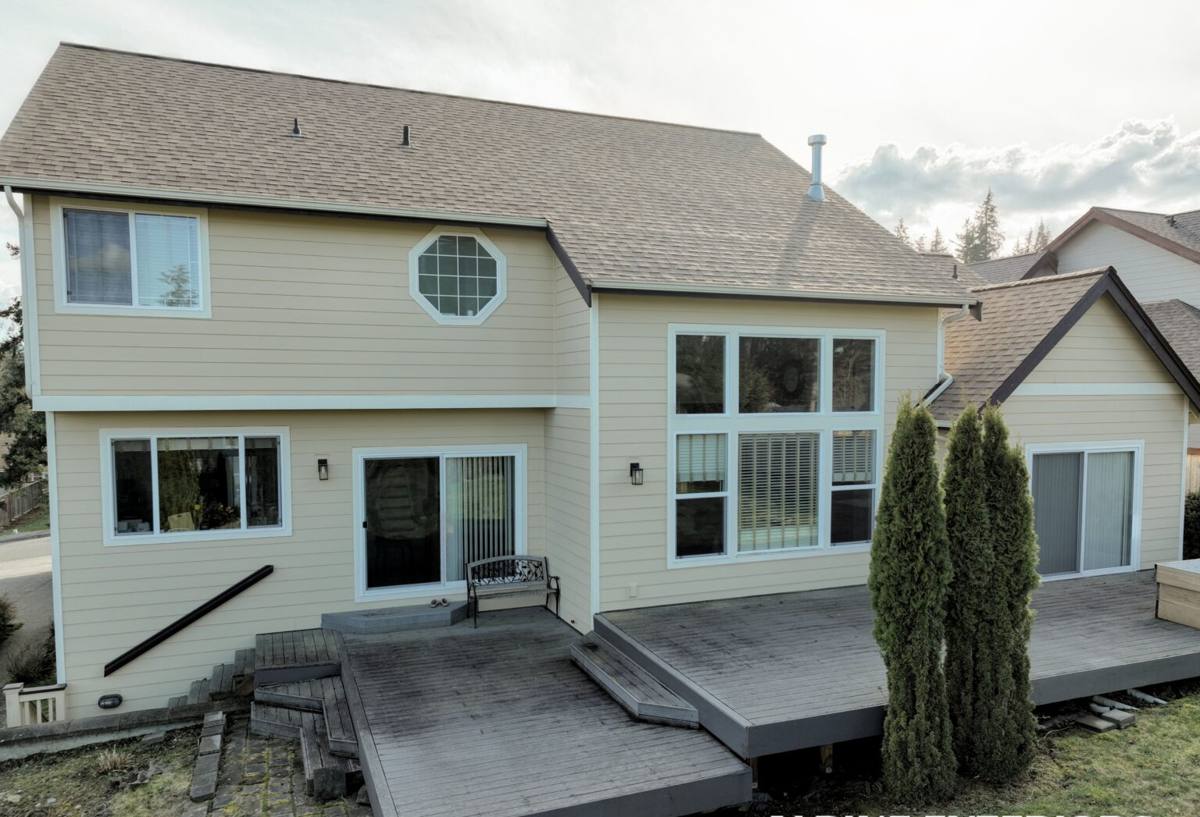
Why Blaine's Climate Changes the Job
Salt Air and Metal Fatigue
Proximity to saltwater accelerates corrosion on anything metal — nails, screws, joist hangers, post bases, and railing hardware. Standard galvanized fasteners can start showing rust streaks down the decking boards within a couple of seasons in a coastal-exposure yard. That staining isn't just cosmetic; it's a sign the fastener itself is degrading, which eventually means loose boards and weakened connections.
Driving Rain and Wind-Driven Moisture
Whatcom County gets plenty of straight-down rain, but Blaine's open exposure to the water also brings wind-driven rain that hits decks and ledger connections at an angle. That means water can find its way into joints and end grain that a calmer inland site would never expose. Flashing details and end-grain sealing matter more here than they would a few miles inland.
Moss Season
Long, wet, mild winters are ideal moss conditions, and a deck surface that stays damp and shaded — under trees, on the north side of a house, or in a low-airflow corner — will grow moss faster than most homeowners expect. Moss holds moisture against the decking surface, which accelerates rot in wood products and can make composite or PVC surfaces genuinely dangerous to walk on when wet.
What a Correctly Built Deck Needs Here
- Stainless steel or heavy-duty coated fasteners rated for coastal/marine exposure, not standard galvanized hardware
- Joist hangers and structural connectors matched in corrosion resistance to the fasteners used with them (mixing metals invites galvanic corrosion)
- Proper ledger board flashing where the deck attaches to the house, to stop wind-driven rain from getting behind the siding
- Gapping and slope in the decking layout so water sheds off the surface instead of sitting in seams
- Footings and post bases set to keep wood posts off grade contact and out of standing water
- A decking material choice that matches how much sun, shade, and foot traffic the specific spot on the property will see
Decking Material Options for a Coastal Property
There's no single "best" decking material for every Blaine yard — the right call depends on budget, how much shade the deck sits in, and how much maintenance the homeowner actually wants to do. Here's how the common options compare under this area's conditions.
| Material | Moisture/Salt Behavior | Moss Resistance | Maintenance |
|---|---|---|---|
| Pressure-treated wood | Good if sealed and refinished regularly; end grain and cut edges need re-treatment | Moderate — moss grows on any wood surface that stays wet and shaded | Higher — annual cleaning and periodic sealing |
| Cedar | Naturally decay-resistant but still needs periodic sealing near saltwater exposure | Moderate — same shaded/wet spots are still vulnerable | Higher — sealing every 1-2 years to hold color and resistance |
| Composite decking | Very good — doesn't absorb moisture or salt the way wood does | Better, but capped composite can still get slick with moss film in shaded, low-airflow areas | Lower — periodic washing, no sealing |
| PVC decking | Excellent — fully synthetic, doesn't take on moisture | Best of the group, though surface film can still form if never cleaned | Lowest — occasional washing |
We'll talk through these trade-offs honestly during an estimate rather than pushing one product line. A shaded, tree-covered lot near the water and a sunny, open lot on the same street can call for different answers even though they're both "in Blaine."
A Note on Warranty Structure
Composite and PVC products typically carry longer manufacturer warranties than wood, but those warranties are usually tied to specific fastening systems, ventilation requirements, and installation methods. If a deck isn't built to the manufacturer's spec — wrong fastener spacing, insufficient airflow underneath, improper joist spacing for the span — the warranty can be void even if the material itself never failed. Part of doing this job right is building to the spec the product actually requires, not just what looks similar.
Structural Basics That Get Skipped
A deck is a structure that has to carry live load — people, furniture, hot tubs, snow load in a hard winter — while sitting outside in wet ground for decades. A few basics that matter more than they get credit for:
- Ledger attachment: the connection to the house needs proper flashing and lag or through-bolt fastening, not just nails, especially with wind-driven rain in play
- Footing depth: footings need to be set below frost depth and sized for the load and soil conditions on the specific lot
- Joist spacing and spans: spacing changes depending on decking material — composite and PVC often require tighter joist spacing than solid wood
- Railing and guard posts: these take real lateral load from people leaning on them and need to be attached to structural framing, not just the outer decking board
- Permitting: most deck projects above a certain height or attached to the home require a building permit and inspection in Whatcom County jurisdictions — we handle that as part of the project rather than leaving it to the homeowner
Our Process for a Blaine Deck Project
1. On-Site Assessment
We walk the property and look at sun exposure, drainage patterns, existing structure (if it's a rebuild or repair), and how close the site is to the water and prevailing wind. This tells us which fastener grade, flashing detail, and decking material actually make sense for that specific spot rather than a generic recommendation.
2. Design and Material Selection
We go over decking material, railing style, and layout with the homeowner, including the honest maintenance trade-offs of each option, and settle on a plan and a written estimate before any work starts.
3. Permitting
For projects that require it, we pull the necessary permits and coordinate inspections so the finished deck is code-compliant and documented — this matters for resale and insurance down the line.
4. Framing and Structural Work
Footings, posts, ledger attachment, and joist framing go in first, using corrosion-resistant hardware sized correctly for the span and load. This is the part of the job that's invisible once the decking goes down, and it's the part that determines whether the deck is still solid in fifteen years.
5. Decking, Railing, and Finish Work
Decking boards go down with proper gapping for drainage and expansion, followed by railing, stairs, and any trim or skirting. We check slope and drainage again once the surface is complete.
6. Walkthrough
We walk the finished deck with the homeowner, cover basic maintenance for the material chosen, and answer questions about care in this climate — including how to manage moss buildup before it becomes a slip hazard.
Maintenance That Actually Matters Here
Whatever material a deck is built from, a few habits go a long way in Blaine's climate:
- Rinse or sweep debris out of decking gaps regularly so water can keep draining through
- Clean shaded, low-airflow areas more often — that's where moss establishes first
- Check fastener heads and railing connections annually for rust or looseness, even on stainless hardware
- Reseal wood decking on the manufacturer's recommended schedule, not just when it visibly needs it
- Keep gutters and downspouts near the deck clear so roof runoff isn't dumping extra water onto the structure
Why Local Experience Matters for This Job
A deck built inland, without daily exposure to salt air and wind-driven rain, can be built to a lower fastener and flashing standard and still hold up fine for its owner. That same build near Semiahmoo Bay or along the Blaine waterfront will corrode and leak years sooner. A crew that already works Blaine and the surrounding Whatcom County coastline knows which fastener grade to spec by default, which flashing details actually stop wind-driven rain, and which spots on a given lot are moss traps before the first winter proves it. That's the difference between a deck that needs real repair work in five years and one that's still solid in twenty-five.
Get an Honest Estimate
If you're planning a new deck, replacing an aging one, or dealing with rot, rust staining, or moss buildup on an existing deck in Blaine, we're happy to take a look and give you a straightforward, no-pressure estimate. Use the form below to get started.