 Whatcom County
 Cordata's Roofs Work Harder Than Most People Realize
Cordata sits close enough to the water and the lowland weather patterns that come with it that roofs here take a specific kind of beating. Salt-laden air moves through the area and slowly works on exposed metal fasteners, flashing, and vent components. Add Whatcom County's long stretch of driving rain each fall and winter, and you've got roofs that are under near-constant moisture pressure for months at a time. Then there's moss — the shaded, damp conditions common around Cordata's mature tree cover create a moss season that can run longer than in drier parts of the county, and moss holds water against shingles far longer than open sky ever would.
None of this means a roof over Cordata is doomed to fail early. It means the installation has to account for these conditions from day one, not get patched around them later. A roof built with generic assumptions — the kind that might be fine in a dry inland climate — tends to show its weaknesses here within a few years: soft decking, granule loss, moss creeping under shingle tabs, and slow leaks that show up as ceiling stains long after the water intrusion started.
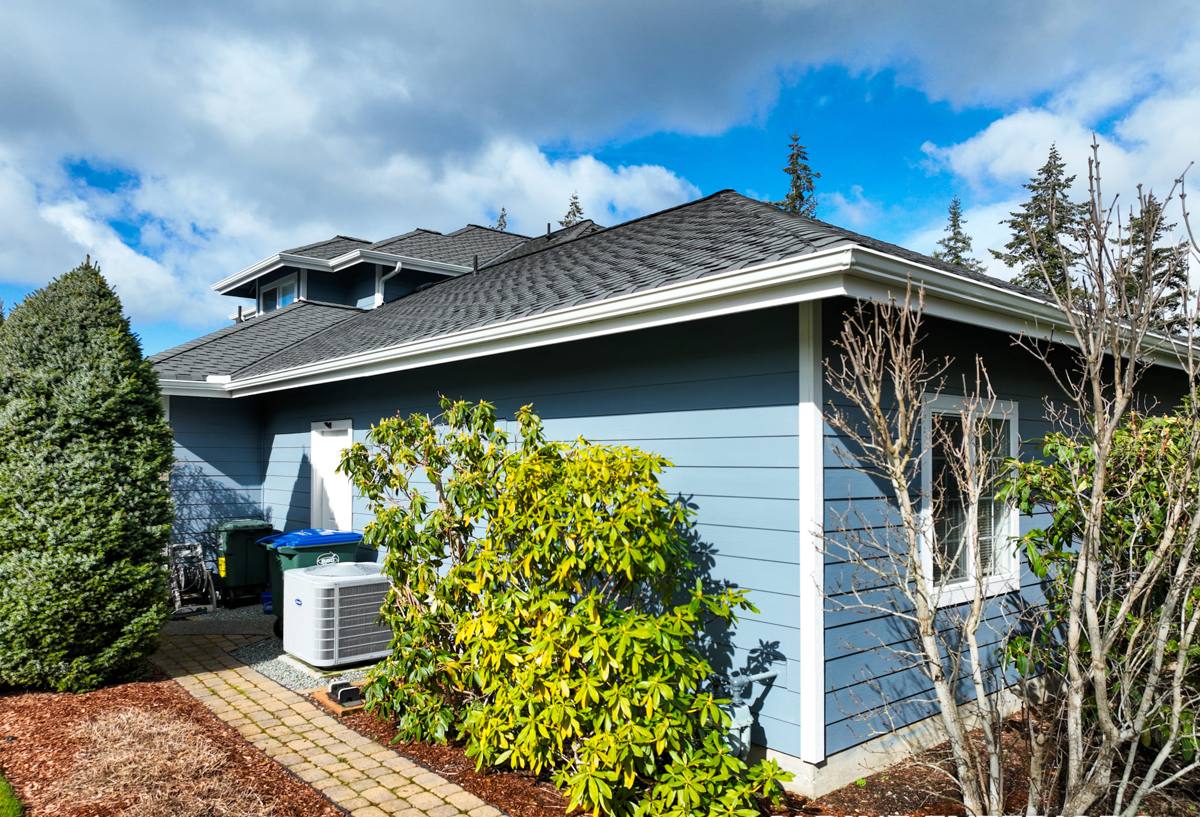
What Cordata Homes Actually Need From a New Roof
Moisture Management First
With this much sustained rain, the roofing system's ability to shed water fast and keep it out of the structure matters more than the shingle color or brand name. That means proper underlayment coverage, correctly lapped flashing at every valley, wall intersection, and penetration, and a drip edge detail that actually directs water into the gutter instead of behind the fascia.
Moss Resistance Built In, Not Bolted On
A long moss season calls for material choices and installation details that slow moss establishment — proper ventilation to reduce the damp, shaded microclimate under the roof deck, and in some cases zinc or copper strip details near the ridge that discourage moss growth over time. None of this eliminates moss entirely, but it buys years of extra service life and cuts down on how often the roof needs cleaning.
Corrosion-Aware Hardware
Given the salt air exposure, fastener and flashing material matters. Standard galvanized components can start showing rust streaks and early degradation faster near the coast than they would further inland. Stainless or heavier-gauge corrosion-resistant hardware at critical points costs a little more up front and pays for itself by not becoming the weak link in an otherwise solid roof.
What a Correct Roof Installation Actually Involves
A roof is only as good as what happens underneath the shingles. A rushed or corner-cutting install can look fine from the street and still fail within a few years. Here's what a proper job includes, regardless of which material ends up on top:
- Complete tear-off of old roofing material — layering a new roof over an old one traps moisture and hides deck problems
- Full inspection of the roof decking, with any soft, rotted, or delaminated plywood or sheathing replaced
- Ice-and-water shield membrane at eaves, valleys, and other vulnerable areas
- Synthetic or felt underlayment installed with correct overlap for our rainfall volume
- New flashing at every chimney, skylight, wall intersection, and roof penetration — reused old flashing is a common shortcut that leads to early leaks
- Balanced intake and exhaust ventilation sized correctly for the attic volume
- Proper nailing pattern and fastener placement per manufacturer specification, not just "close enough"
- Ridge cap and hip installation that sheds water correctly rather than just looking finished
Skipping any one of these doesn't necessarily show up on day one. It shows up in year four or five, as a leak, a rotted fascia board, or a shingle field that's failing years ahead of its rated life.
Choosing the Right Roofing Material for This Climate
There's no single "best" roofing material for every home — it depends on budget, roof pitch, the home's architecture, and how much long-term maintenance an owner wants to take on. Here's how the common options compare for a Cordata property dealing with salt air, sustained rain, and moss pressure:
| Material | Moisture Performance | Moss Resistance | Maintenance | Typical Lifespan |
|---|---|---|---|---|
| Architectural asphalt shingles | Strong when installed with proper underlayment | Moderate — benefits from zinc strips and periodic cleaning | Low to moderate | 25–30 years |
| Standing seam metal | Excellent — very fast water shedding | High — moss struggles to gain a foothold on smooth metal | Low | 40–50+ years |
| Cedar shake | Requires diligent ventilation and upkeep | Low without regular treatment and cleaning | High | 20–30 years with upkeep |
| Synthetic composite shingle | Strong, consistent performance | Moderate to high depending on product | Low | 40–50 years |
We don't install cedar shake as a standard offering. It can look great, but in a climate with this much sustained moisture and moss pressure, it demands a maintenance schedule most homeowners don't keep up with, and neglect shows up fast as rot and moss buildup. We'd rather steer clients toward a material that holds up with realistic, not ideal, upkeep.
Ventilation: The Detail That Determines Long-Term Success
Attic ventilation doesn't get much attention from homeowners, but it's one of the biggest factors in how long a roof actually lasts here. Poor ventilation traps warm, moist air against the underside of the deck. In a moss-prone, high-rainfall area like Cordata, that trapped moisture accelerates deck rot from the inside and creates exactly the damp conditions moss and mold prefer.
Correct ventilation balances intake — usually through soffit vents — with exhaust at or near the ridge. The two have to be sized to work together; adding exhaust vents without adequate intake can actually pull conditioned air out of the living space and pull moisture in through other gaps. We calculate ventilation needs based on actual attic square footage rather than installing a generic number of vents and calling it done.
Our Installation Process
Every roof project follows the same disciplined sequence, whether it's a modest single-story home or a larger property:
- On-site assessment — we inspect the existing roof, attic ventilation, and any visible signs of moisture damage before quoting anything
- Material selection — we walk through the trade-offs above so the choice fits the budget and the house, not just a sales sheet
- Tear-off and deck inspection — old material comes off completely, and any compromised decking gets flagged and replaced
- Underlayment and flashing — moisture barriers and new flashing go in at every critical point before a single shingle or panel is placed
- Installation — material goes on per manufacturer specification, with attention to nailing pattern, exposure, and alignment
- Ventilation check and final details — ridge, hip, and vent components are finished and the whole roof is inspected before cleanup
- Site cleanup — magnetic sweep for nails and full debris removal before we consider the job done
Signs Your Cordata Home May Need a New Roof
Roofs rarely fail all at once — they show warning signs first. If you're seeing any of the following, it's worth having someone take a look before it becomes a bigger repair:
- Shingles that are curling, cracking, or losing granules faster than expected for their age
- Heavy moss growth that keeps returning shortly after cleaning
- Dark streaking or staining on interior ceilings, especially after heavy rain
- Sagging areas anywhere on the roof plane
- Daylight visible through the attic roof boards
- Flashing that's visibly rusted, lifted, or separated from the roof surface
- A roof that's approaching or past the manufacturer's rated lifespan
What Drives the Cost of a New Roof
Every roof is priced based on its own specifics, but a few factors consistently move the number up or down:
| Factor | Effect on Cost |
|---|---|
| Roof size and number of planes | More square footage and complexity means more material and labor |
| Pitch and accessibility | Steep or hard-to-access roofs require more safety equipment and time |
| Decking condition | Rotted sheathing found during tear-off adds material and labor |
| Material choice | Asphalt shingle, metal, and composite options carry different price points and lifespans |
| Number of penetrations | Chimneys, skylights, and vents each require additional flashing work |
| Ventilation upgrades | Bringing older ventilation up to current standards adds modest cost but protects the investment |
We give a written, itemized estimate before any work starts so there's no guessing about where the money is going.
Why It Matters That We Already Work in Cordata
A crew that's worked roofs throughout Cordata and the rest of Whatcom County already understands how this specific stretch of coastline and tree cover behaves — where moss tends to build up fastest, which details need extra attention against salt air, and how local permitting and inspection processes work. That local familiarity shows up in fewer surprises during the job and a roof that's built for the conditions it will actually face, not a generic install dropped in from a one-size-fits-all playbook.
If your Cordata home needs a new roof, or you're just not sure whether it's time yet, we're happy to come take an honest look. Reach out for a free, no-pressure estimate using the form below.