 Whatcom County
 Why Cordata Homes Need a Metal Roof Built for This Climate
Cordata sits close enough to the water and far enough into the Whatcom County rain belt that roofs here take a different kind of beating than roofs inland. It isn't one dramatic storm that does the damage — it's the accumulation. Salt-laden air moving in off the bay works on exposed metal and fasteners year after year. Driving rain, pushed sideways by wind more often than it falls straight down, finds every weak seam and undersized flashing detail. And a moss season that can stretch from October well into spring keeps roof surfaces damp far longer than most manufacturers' installation guidelines assume.
A metal roof installed correctly can outlast two or three asphalt shingle roofs in this environment. A metal roof installed by a crew unfamiliar with Whatcom County conditions can develop problems — fastener corrosion, moss-driven panel lift, leaks at poorly detailed penetrations — inside of five to ten years. The material is only as good as the details underneath it.
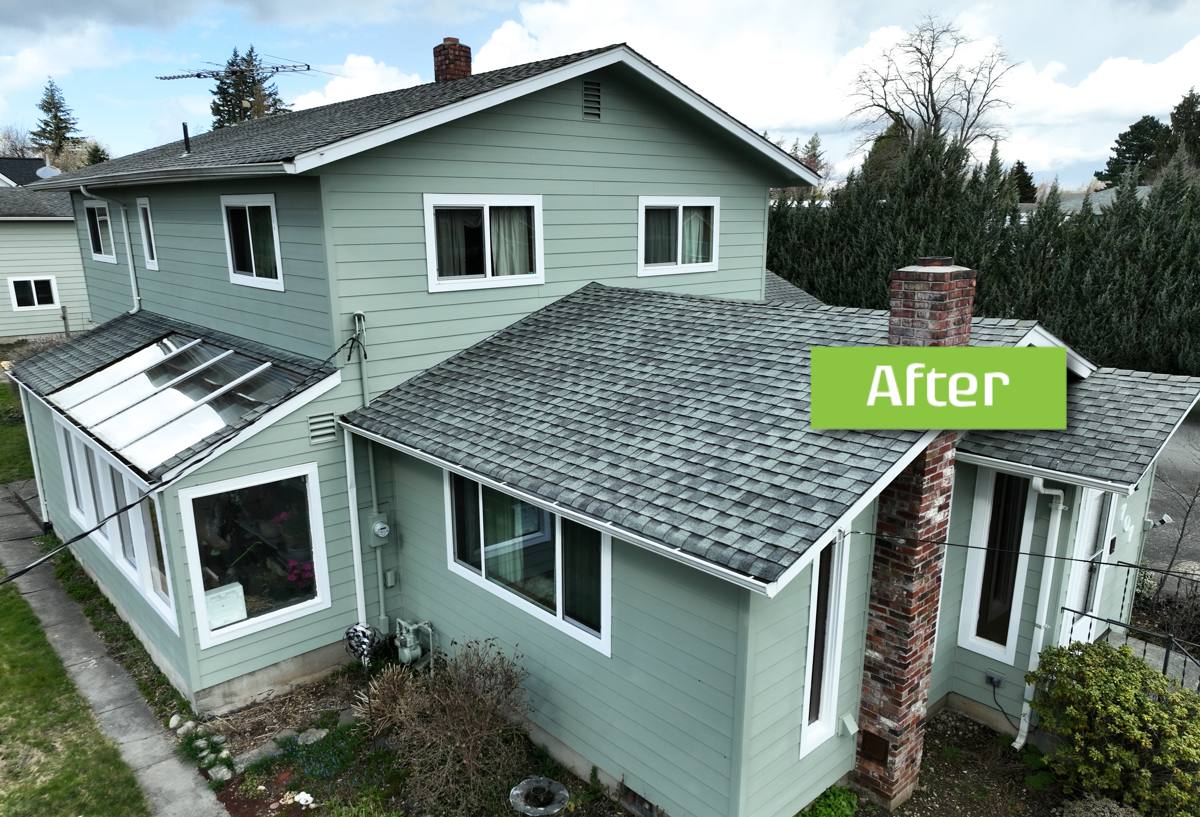
What Whatcom County Weather Actually Does to a Roof Over Time
Salt Air and Corrosion
Coastal and near-coastal air in this part of Washington carries fine salt particulate that settles on exposed metal. Over time this accelerates corrosion at cut edges, fastener heads, and any spot where a protective coating has been scratched or worn thin during installation. It's a slow process, which is exactly why it gets overlooked — the roof looks fine for years before the first rust streak shows up at a screw head or panel seam.
Driving Rain and Wind-Driven Moisture
Rain that comes in at an angle behaves differently than rain that falls straight down. It gets pushed up under lap joints, around vent boots, and into any flashing detail that was built for a calmer climate. Whatcom County's exposure to wind off the water means driving rain is a regular occurrence, not an occasional storm event, and roofing details here need to account for that as a baseline condition.
Moss Season
Shaded, north-facing, and low-slope sections of roof in Cordata can stay damp for months at a stretch. Moss and algae take hold in that moisture, and once established they hold water against the roof surface, work into seams, and — on the wrong roofing material — can lift edges and create pathways for leaks. Metal handles moss better than most materials, but it isn't immune, and panel selection and detailing still matter.
Choosing the Right Metal Roofing System for a Cordata Home
Not all metal roofing is the same product wearing a different name. The panel type, fastening method, and coating all affect how a roof performs against salt air and sustained moisture.
| System | How It's Fastened | Best Fit | Trade-Off |
|---|---|---|---|
| Standing seam | Concealed clips, no exposed fasteners on the field | Long-term, low-maintenance roofs; homes closer to salt air exposure | Higher material and labor cost |
| Exposed-fastener panel | Screws driven through the panel face | Budget-conscious projects, outbuildings, simpler rooflines | Fasteners are a recurring maintenance point and the first thing to corrode or back out over time |
| Stone-coated steel | Concealed fastening with an interlocking profile | Homeowners who want a traditional shingle or shake look with metal's durability | More complex install; fewer crews do it correctly |
For most Cordata homes, we steer clients toward standing seam or a well-installed stone-coated system specifically because concealed fasteners remove the weakest point in a coastal-influenced climate. Exposed-fastener panels aren't a bad product — they're a legitimate lower-cost option for the right project — but every screw penetration is a spot that needs to be re-checked over the life of the roof, and that maintenance burden matters more here than it would in a drier inland area.
Coating and Finish
The paint system on a metal panel is doing real work, not just providing color. A baked-on Kynar-type (PVDF) finish holds up to UV and salt exposure noticeably better over decades than a basic polyester coating, and it resists chalking and fading. On a coastal-influenced roof, we consider the coating spec as important as the metal gauge underneath it.
What a Correct Metal Roof Installation Actually Involves
The panels are the visible part of a metal roof, but most of the work that determines whether it leaks happens underneath and around them.
- A synthetic underlayment rated for the exposure, run correctly at laps and penetrations — not the cheapest roll available
- Ice-and-water shield or equivalent membrane at eaves, valleys, and any low-slope transition where wind-driven rain is most likely to intrude
- Fasteners matched to the panel metal to avoid galvanic corrosion between dissimilar metals
- Flashing custom-bent for the actual roof geometry, not a generic stock piece forced to fit
- Proper panel expansion allowance so temperature swings don't stress seams or fasteners over years of movement
- Ventilation detailing that keeps moisture from condensing on the underside of the panels
Skipping or rushing any one of these doesn't usually show up on day one. It shows up two, five, or ten years later as a leak that's hard to trace back to its actual cause, because the panel itself still looks fine.
Our Process, Start to Finish
1. On-Site Assessment
We walk the roof and the attic space where accessible, checking current decking condition, ventilation, and any existing moss or moisture damage before we talk about panel systems.
2. Honest Recommendation
We'll tell you which system fits your home, your roofline, and your budget — including when a lower-cost exposed-fastener system is genuinely the right call and when it isn't worth the long-term maintenance trade-off for your specific exposure.
3. Tear-Off and Deck Prep
Old roofing comes off, decking gets inspected for rot or soft spots (common under long-standing moss growth), and any damaged sheathing is replaced before anything new goes down.
4. Underlayment and Flashing
This is the stage that determines whether the roof performs in driving rain. We don't shortcut it, and we don't substitute stock flashing where a custom bend is needed.
5. Panel Installation
Panels go down with correct fastening, spacing, and expansion allowance for the specific system chosen.
6. Final Walkthrough
We review the finished roof with you, explain any maintenance points specific to your home's exposure, and make sure you know what normal wear looks like versus something worth a call.
Moss, Algae, and Salt Air: What Ongoing Maintenance Actually Looks Like
Metal roofing needs far less maintenance than shingle or wood roofing, but "far less" doesn't mean "none," especially in a Cordata microclimate that stays damp for a good part of the year.
- Keep overhanging branches trimmed back — shade is the biggest driver of prolonged moss growth
- Clear debris from valleys and gutters each fall, before the wet season builds up organic material against the panels
- Do a visual check of fastener heads and flashing annually on exposed-fastener systems specifically
- Rinse visible moss or algae growth gently rather than pressure-washing, which can drive water under laps
- Watch for any panel discoloration or rust streaking near cut edges, which is often the earliest sign of coating failure
Mistakes We See on Roofs Installed by Crews Unfamiliar With This Area
We get called out to look at roofs installed by crews who do good work in drier climates but didn't adjust their details for Whatcom County conditions. The pattern is usually the same: underlayment or ice-and-water membrane sized for a lighter rain climate, stock flashing pieces used instead of custom bends at tricky transitions, and no real plan for moss-prone shaded sections. None of these show up on the day the roof is finished. They show up as a leak report a few winters later, after the driving rain and sustained moisture have had time to find the gap.
Cost Factors Homeowners Should Understand
| Factor | Why It Affects Price |
|---|---|
| Panel system | Standing seam runs higher than exposed-fastener panel due to material and labor complexity |
| Roof complexity | Valleys, dormers, and multiple planes require more custom flashing and labor time |
| Deck condition | Rot or moisture damage found during tear-off adds repair cost but shouldn't be skipped |
| Coating quality | PVDF/Kynar-type finishes cost more upfront but last longer against salt air and UV |
| Access and pitch | Steep or hard-to-access rooflines increase labor time and safety requirements |
We give straightforward, written estimates that break these factors out so you can see what you're actually paying for, rather than a single lump number.
Why a Crew That Already Works in Cordata Matters
A roof detailed correctly for a drier region isn't automatically wrong here — it's just built for a different set of conditions than what Cordata actually experiences. A crew that regularly works Whatcom County roofs already knows where wind-driven rain tends to intrude, which north-facing sections hold moss the longest, and which flashing details have proven themselves over repeated wet seasons in this specific area. That local pattern recognition is hard to replace with a generic installation manual, and it's the difference between a roof that's built to spec and a roof that's built for where it actually sits.
If you're weighing metal roofing for a home in Cordata, we're glad to come take a look and give you a straightforward, no-pressure estimate — no invented urgency, just an honest read on what your roof actually needs. Use the form below to get started.