 Whatcom County
 Composite Decking Built for How Nooksack Actually Weathers
Nooksack sits in the part of Whatcom County where marine-influenced air, frequent rain, and shaded tree cover combine to keep outdoor structures damp for long stretches of the year. A deck here doesn't fail because of one bad storm — it fails slowly, from months of moisture sitting where it shouldn't, fasteners corroding out of sight, and moss finding a foothold in every low spot. Composite decking, installed correctly, is one of the more reliable answers to that pattern. It doesn't need yearly staining, it resists the rot that wood decking eventually succumbs to, and it holds up to the driving rain and long wet seasons that define this part of the county.
That said, "composite decking" covers a wide range of products and installation quality. The material itself is only half the equation. The other half is how the deck is framed, ventilated, fastened, and flashed — details that matter more in a climate like ours than they would somewhere dry.
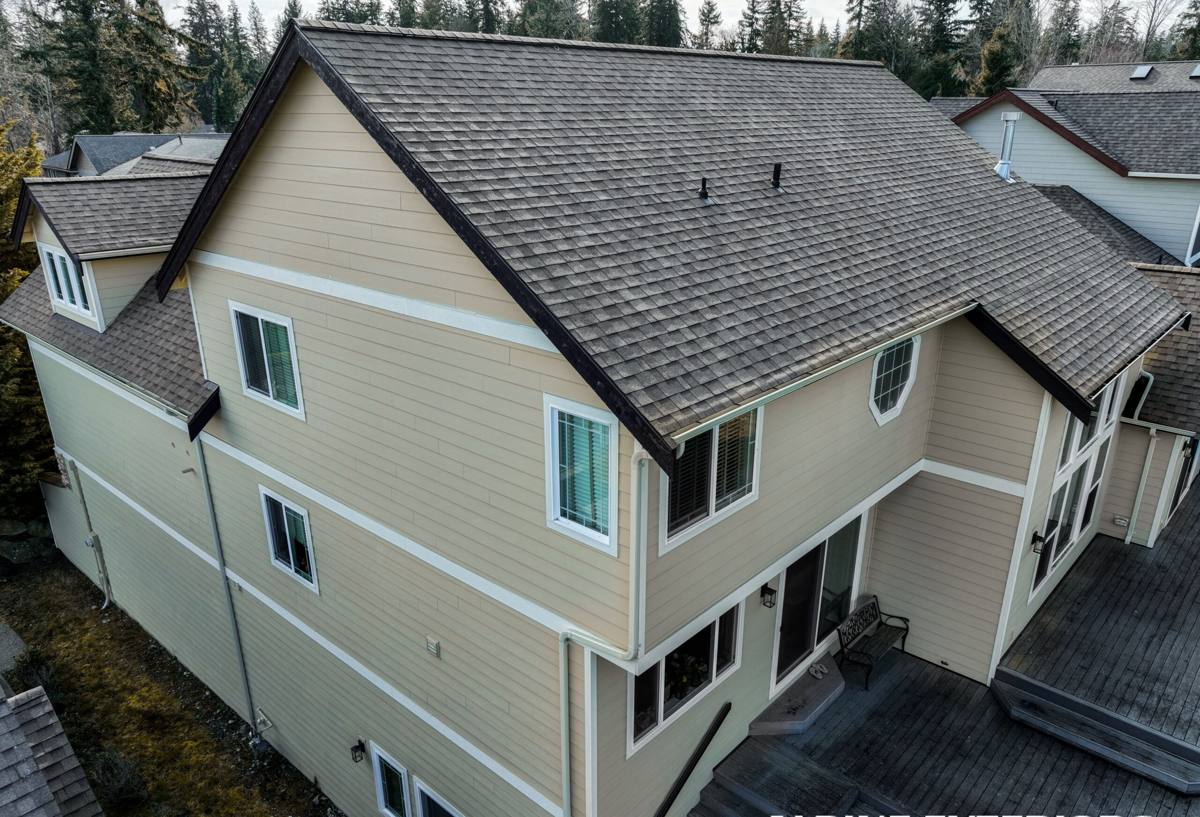
What Whatcom County's Climate Does to a Deck Over Time
Understanding the failure points helps explain why we build the way we do. In Nooksack and the surrounding county, three conditions do most of the damage:
Driving rain
Wind-driven rain doesn't just fall straight down — it gets pushed sideways into ledger connections, under poorly sealed board ends, and into any gap where water can collect instead of shed. Over years, that repeated wetting is what rots substructures and corrodes fasteners, even under decking that looks fine on the surface.
Salt-tinged marine air
Whatcom County's proximity to Puget Sound and the Strait of Georgia means the air carries a degree of salt moisture inland, even away from the immediate waterfront. That salt content accelerates corrosion on lower-grade fasteners, fastener heads, and any exposed metal hardware in a deck's frame — which is why fastener selection matters as much as the decking material itself.
A long moss season
Shade, moisture, and mild temperatures give moss and algae a long window to establish on any surface that doesn't drain or dry quickly. On a deck, that means board grooves, fastener channels, and the gaps between boards and framing are the areas most likely to hold organic growth if the deck wasn't built with drainage and airflow in mind from the start.
Composite vs. Wood vs. PVC: An Honest Comparison
We install more than one decking material, and each has real trade-offs. Here's how they compare for a Whatcom County property specifically:
| Material | Moisture Resistance | Maintenance | Typical Lifespan Here | Trade-offs |
|---|---|---|---|---|
| Pressure-treated wood | Moderate — absorbs moisture | High: annual cleaning, periodic staining/sealing | 10–15 years before major repair or replacement | Lowest upfront cost, but the most exposed to our moss and rot conditions |
| Composite (capped) | High — engineered to resist moisture uptake | Low: periodic washing, no staining | 25–30+ years with correct installation | Higher upfront cost; installation precision matters more |
| PVC/cellular decking | Very high — no wood content | Low | 25–30+ years | Higher cost still; different feel underfoot; fewer wood-look options in some lines |
For most Nooksack homeowners we talk to, capped composite is the sweet spot: it resists the moisture and moss issues that plague wood, without the premium cost of full PVC systems. But we'll walk through all three honestly if you're not sure which fits your project and budget.
What a Correct Composite Decking Installation Actually Involves
Composite boards themselves are fairly forgiving materials, but the framework underneath them is not something you can afford to get wrong in this climate. A correct installation includes:
Substructure and spacing
Joist spacing has to match the manufacturer's specification for the board profile you're using — composite boards flex differently than wood, and under-spanned joists lead to bounce and, eventually, board fatigue. We also run joist tape or a moisture barrier over framing lumber, which is cheap insurance against the slow rot that comes from water wicking up into untreated wood framing.
Ledger attachment and flashing
Where the deck attaches to the house, proper flashing is what keeps driving rain from working its way behind siding and into the wall assembly. This is one of the most common shortcuts we see on decks that were built quickly — and one of the most expensive to fix later, since it usually means opening up siding to correct.
Fastener selection
Given the salt content in our regional air, we use fasteners and hidden clip systems rated for coastal or marine exposure, not general-purpose hardware. It costs a little more upfront and prevents the streaking and structural weakening that comes from corroded fasteners years down the line.
Ventilation and drainage
Composite decks need airflow underneath to dry out between rain events. That means correct ground clearance, sometimes a drainage system if the deck sits low or over living space, and gapping between boards that follows manufacturer spec rather than being tightened up for looks. Skimping here is exactly what creates the standing moisture that feeds moss growth.
Our Process, Start to Finish
- On-site assessment — we look at grade, drainage, sun/shade exposure, and the condition of any existing structure before quoting anything.
- Design and material selection — board profile, color, railing system, and layout, matched to your home and budget.
- Permitting — most deck work in Whatcom County requires a permit; we handle that process rather than leaving it to you.
- Demolition (if replacing an existing deck) — including an honest look at the substructure once old decking is off, since that's often where the real condition of a deck is revealed.
- Framing and flashing — built to span and moisture-barrier specifications suited to our climate, not just code minimums.
- Composite board installation — hidden fastening where the product allows, correct board gapping, and picture-frame or border detailing if specified.
- Final walkthrough — we go over care and maintenance specific to the product installed before we consider the job done.
Board Selection and Cost Factors
Composite decking pricing varies by brand, board profile (capped vs. uncapped, solid vs. hollow core), railing choice, and the complexity of your substructure. Rather than quote a number that won't hold up project to project, here's what actually moves the price:
| Factor | Lower Cost | Higher Cost |
|---|---|---|
| Board type | Uncapped or entry-line composite | Fully capped, premium wood-grain finishes |
| Substructure condition | Existing framing reusable | Full tear-out and reframe required |
| Ground clearance | Standard clearance, gravity drainage | Low clearance requiring a drainage system |
| Railing system | Basic composite or metal baluster rail | Glass panel or cable rail systems |
| Access | Ground-level, easy material staging | Elevated decks, tight side-yard access |
We'll give you a real, itemized number after seeing the site — not a phone estimate — because in Nooksack, the condition of what's underneath an existing deck can change the scope of work more than the decking material choice does.
Living With Composite Decking in a Wet Climate
One of the main reasons homeowners switch to composite is lower maintenance, but "lower" doesn't mean "none," especially with our moss season. A short seasonal routine keeps a composite deck looking and performing the way it should:
- Sweep debris and fallen leaves off regularly — trapped organic matter is what gives moss and mildew something to grow on
- Rinse the deck surface periodically with a garden hose, especially in shaded areas that don't get direct sun to dry them out
- Use a soft-bristle brush and a cleaner labeled safe for composite decking if moss or algae does appear — avoid pressure washers set too high, which can damage the board's cap layer
- Keep planters and furniture feet from sitting in one spot for months at a time, which traps moisture against the board surface
- Check railing posts and fastener points once a year for any movement or corrosion staining
- Clear gutters and downspouts near the deck so runoff isn't draining directly onto or under it
Mistakes We Commonly Correct on Existing Decks
A fair amount of our work in Nooksack isn't new construction — it's repairing or rebuilding decks that were installed without our climate in mind. The recurring issues:
- Composite boards installed directly over unprotected wood framing with no moisture barrier
- Ledger boards attached without proper flashing, leading to hidden rot at the house connection
- Board gaps closed up tighter than spec for a cleaner look, which traps water and speeds up moss growth between boards
- General-purpose fasteners used instead of corrosion-resistant hardware, leaving rust streaks within a few seasons
- Low clearance decks built without any drainage plan, leaving the ground underneath permanently damp
None of these show up on day one. They show up two, three, or five years later — which is exactly why installation quality matters more than most homeowners expect when they're comparing bids.
Why Hiring a Crew That Already Works in Nooksack Matters
Whatcom County isn't one uniform climate zone — drainage, wind exposure, and shade patterns shift block by block depending on tree cover and elevation. A crew that regularly works in and around Nooksack has already seen how local conditions play out on real decks: which yards hold water longer, where moss takes hold fastest, and what framing details actually need extra attention versus what's fine as-is. That local pattern recognition is hard to replace with a general contractor who's building their first deck in the area. It also means we're not disappearing after the install — if a warranty issue or a maintenance question comes up two years in, we're still working in the same neighborhoods.
If you're considering composite decking for your Nooksack property, we're glad to walk the site, talk through material options honestly, and give you a straightforward, no-pressure estimate using the form below.