 Whatcom County
 Why Roofs in the Columbia Neighborhood Wear Differently
Homes in the Columbia neighborhood sit close enough to Bellingham Bay that salt-laden air is part of daily life on the roof, even if you never notice it at ground level. Add Whatcom County's pattern of driving, wind-pushed rain and a moss season that can stretch from fall through spring, and you've got a roof environment that's tougher on materials than a lot of homeowners realize until something starts leaking. We've worked enough roofs in this part of Bellingham to know the failure patterns are consistent: metal fasteners and flashing corrode faster near the water, moss gets a foothold on north-facing slopes and stays there most of the year, and wind-driven rain finds its way under shingles and flashing that would hold up fine in a drier climate.
None of this means Columbia homes need exotic solutions. It means the repair work has to account for what's actually happening to the roof, not just patch the visible symptom. A roof repair done without factoring in salt exposure or moss regrowth tends to fail again within a year or two, which costs homeowners more in the long run than doing it right the first time.
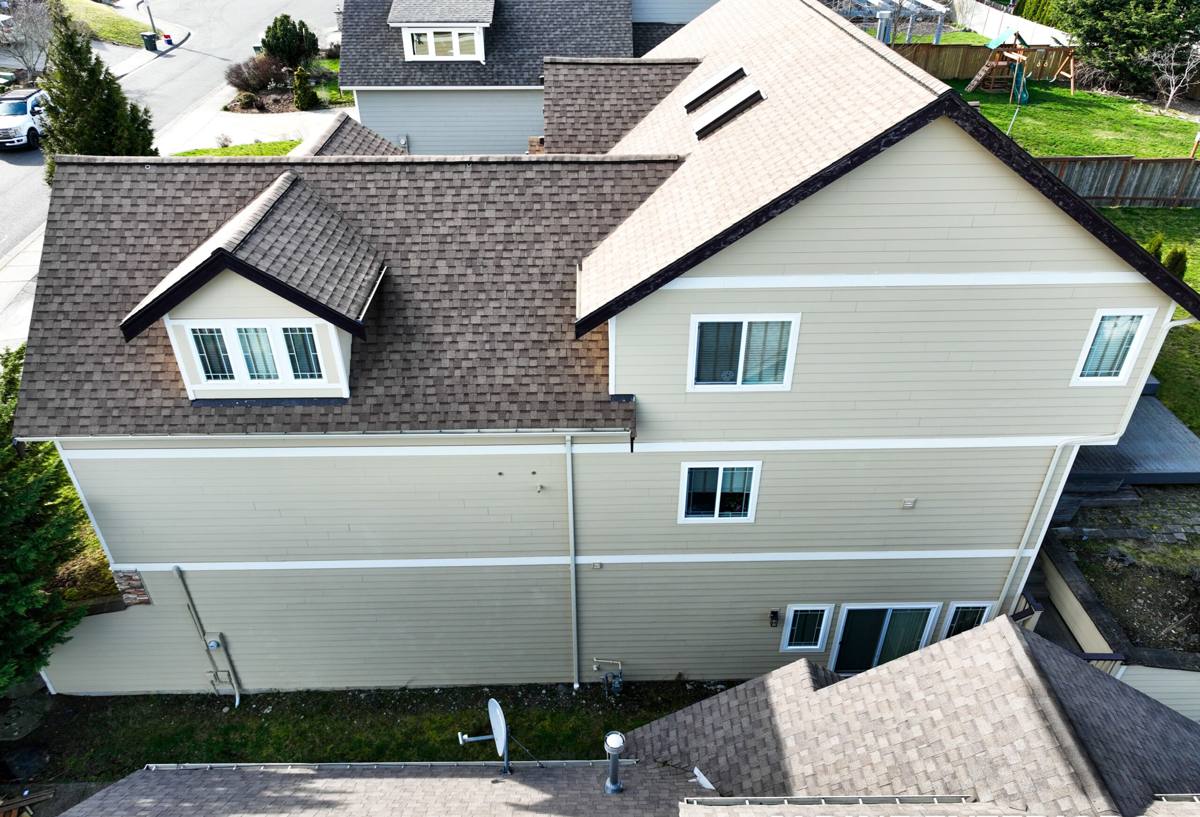
Signs Your Roof Needs Repair, Not a Full Tear-Off
Most roofs don't fail all at once. They show warning signs first, and catching those signs early is usually the difference between a repair bill and a replacement bill.
What to look for
- Granules collecting in gutters or at downspout outlets, a sign asphalt shingles are wearing thin
- Dark streaking or thick moss mats, especially on shaded or north-facing slopes
- Curling, cracked, or missing shingles after a windstorm
- Soft spots or sagging when walked on, which can mean sheathing is wet underneath
- Water stains on interior ceilings, particularly near chimneys, skylights, or valleys
- Rust streaks below metal flashing or fasteners
- Daylight visible through the attic roof deck
If you're seeing one or two of these and the roof is otherwise in reasonable shape for its age, a targeted repair is usually the right call. If you're seeing several at once, or the roof covering is past its expected service life, it's worth having someone look at the whole system before spending money on a patch.
What a Correct Roof Repair Actually Involves
A repair that actually holds up in this climate goes beyond swapping a few shingles. Here's what we consider standard, not optional, for roof repair work in Whatcom County.
Diagnosing the real source
Water rarely leaks in a straight line. A stain on a bedroom ceiling might trace back to a flashing gap several feet away, following a rafter or the underlayment before it shows itself. We start every repair by tracing the actual path of water intrusion, not just patching where the stain appears, because patching the wrong spot means the leak comes back.
Flashing and transitions first
The majority of roof leaks we find in this area start at flashing: chimneys, skylights, valleys, sidewalls, and vent penetrations. Flashing that's been sealed with caulk instead of properly lapped and integrated with the underlayment is one of the most common failure points we see on Columbia roofs, especially on homes with additions or skylights installed after the original roof.
Underlayment and decking condition
If shingles have failed in an area, we check the underlayment and roof deck underneath before covering it back up. Wet, delaminating sheathing needs to be replaced, not roofed over. Skipping this step is how a repair becomes a much bigger problem two winters later.
Moss and biological growth
Moss doesn't just look bad. Its root structure lifts shingle edges and holds moisture against the roofing material, accelerating wear underneath. Any repair on a moss-affected roof should include careful removal and, where appropriate, zinc or copper strip installation to slow regrowth, rather than just clearing the moss and leaving the roof exposed to the same regrowth cycle.
Roofing Materials Common in the Area and How They Repair
The right repair approach depends heavily on what's actually on the roof. Here's how the materials we most often see on Columbia-area homes compare when it comes to repair work.
| Material | Common Repair Needs Here | Repair Difficulty |
|---|---|---|
| Asphalt/composition shingle | Wind lift, granule loss, flashing leaks | Moderate — widely available materials, straightforward matching |
| Cedar shake/shingle | Moss and moisture damage, splitting, fastener corrosion | Higher — requires matching weathered wood and careful moisture management |
| Metal (standing seam/panel) | Fastener backout, seam sealant failure, salt-air corrosion at coastal-facing homes | Moderate to higher — needs metal-specific technique and compatible materials |
| Low-slope/torch-down or membrane | Seam separation, ponding water, membrane cracking at flashings | Higher — improper patching often traps moisture instead of releasing it |
Whatever material is on the roof, we match repairs to the existing system rather than mixing incompatible products. Combining materials that expand, contract, or corrode at different rates is a common source of repeat failures.
How Our Roof Repair Process Works
- On-site inspection. We get on the roof (and in the attic, when accessible) to see actual conditions, not just what's visible from the ground.
- Honest assessment. We tell you plainly whether the roof needs a repair, multiple repairs, or is close enough to the end of its life that replacement makes more financial sense.
- Written scope. Before any work starts, you get a clear description of what we found and what we plan to do about it.
- The repair itself. We work from the source of the problem outward, addressing flashing, decking, and covering material as needed, not just the visible surface.
- Debris and moss cleanup. We clear moss, old material, and debris from gutters and valleys as part of the job, since leftover debris is one of the fastest ways a fresh repair fails.
- Follow-up. We stand behind the work and want to hear from you if anything doesn't perform the way it should.
Repair vs. Replacement: What Actually Drives the Decision
Homeowners often ask us to just answer "repair or replace" over the phone, but that call really depends on a few specific factors we can only evaluate in person.
| Factor | Favors Repair | Favors Replacement |
|---|---|---|
| Age of roofing material | Within expected service life | At or beyond expected service life for the material |
| Extent of damage | Isolated to one area or a few penetrations | Widespread across multiple slopes |
| Decking condition | Dry, sound sheathing | Rot or delamination in multiple areas |
| Number of prior repairs | First or second repair on this roof | Long history of patch-on-patch work |
| Moss/moisture history | Recently addressed, manageable | Chronic, recurring despite treatment |
Costs vary a lot depending on the roof's pitch, access, material, and how much decking (if any) needs to be replaced. Small flashing or shingle repairs are typically a modest expense; extensive tear-off and decking replacement is a much larger investment. We'd rather give you a number after actually seeing the roof than guess over the phone and be wrong in either direction.
Long-Term Roof Care for Columbia Homes: A Maintenance Checklist
A repair holds up longer when it's paired with basic seasonal upkeep. This is what we recommend to homeowners in this part of Whatcom County specifically because of the salt air and moss pressure.
- Clear gutters and valleys at least twice a year, more often under overhanging trees
- Have moss treated before it forms thick mats, not after
- Check flashing around chimneys and skylights annually, since sealant degrades faster in coastal air
- Trim back branches that keep roof sections shaded and damp
- Inspect metal fasteners and flashing for early rust rather than waiting for staining to show
- After major windstorms, do a visual check for lifted or missing shingles
- Keep attic ventilation clear so moisture doesn't build up under the roof deck
Why a Crew That Already Works Columbia Matters
A roof repair company that hasn't worked much in this specific area is guessing at things a local crew already knows: which slopes hold moss longest based on tree cover and sun exposure, how far salt air travels inland before it starts affecting fasteners and flashing, and which older homes in the neighborhood are more likely to have layered roofing or non-standard past repairs. That local pattern recognition shortens the diagnosis and reduces the chance of a repair that misses the real cause.
It also means accountability. A crew that plans to keep working in Columbia and the surrounding Bellingham neighborhoods has every reason to do the job right the first time and to be reachable if a question comes up after the work is done.
Get a Straight Answer About Your Roof
If you're dealing with a leak, moss buildup, or storm damage on a Columbia-area home, we're glad to take a look and give you an honest read on what it actually needs. Fill out the form below for a free, no-pressure estimate.