 Whatcom County
 Board & Batten Siding in Sunnyland
Sunnyland's mix of older bungalows, mid-century houses, and newer infill sits close enough to Bellingham Bay that salt-laden air is part of daily life, and far enough into the Pacific Northwest rain belt that a wet exterior is the default for half the year. Board and batten siding is a popular choice in this neighborhood because the vertical lines suit the craftsman and cottage-style homes common here, and it reads as clean and modern on newer builds without looking out of place next to older neighbors. But board and batten is also one of the less forgiving siding profiles when it's installed wrong, and Sunnyland's climate is exactly the kind of environment that exposes those mistakes early.
This page covers what board and batten siding actually needs to hold up in Sunnyland, what a correct installation looks like, and why we only install it in James Hardie fiber cement rather than the vinyl, engineered wood, or cedar versions you'll also see quoted around Whatcom County.
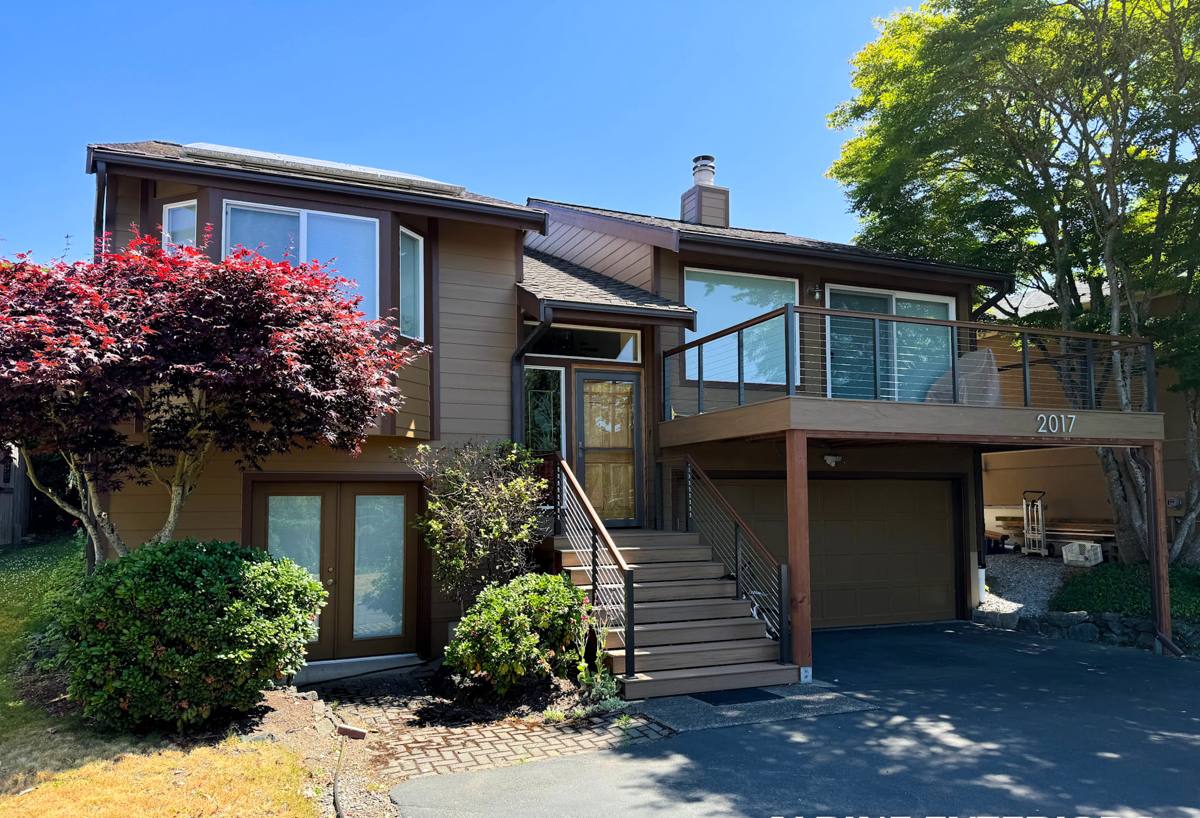
What Sunnyland's Climate Does to Vertical Siding
Three things matter most for board and batten performance here:
- Salt air: Homes within a few miles of Bellingham Bay deal with airborne salt that accelerates corrosion on fasteners, flashing, and any exposed metal trim. Over years, this shows up first at the battens themselves, where nails or screws are more numerous per square foot than on standard lap siding.
- Driving rain: Whatcom County's wind-driven rain doesn't just fall straight down — it gets pushed sideways against west- and southwest-facing walls, which is precisely where board and batten's many vertical seams and batten strips create more opportunities for water to find a way behind the cladding if the installation isn't detailed correctly.
- Moss season: The long stretch of cool, damp, low-sun months from fall through spring is prime moss and algae growth territory, especially on north-facing walls and anywhere battens sit close to landscaping or tree cover. Moss holds moisture against the siding surface for extended periods, which matters more for water-sensitive materials than for ones engineered to resist it.
None of this makes board and batten a bad choice for Sunnyland. It means the material and the installation details have to be right, because this profile has less margin for error than flat lap siding.
Why Board and Batten Needs More Attention Than People Expect
Board and batten looks simple — wide panels or boards with narrow battens covering the seams — but that simplicity is deceptive. Every batten strip is a fastening point, and every vertical seam under a batten is a place where water can travel if the water-resistive barrier and flashing details underneath aren't done correctly. On a standard horizontal lap siding job, gravity does a lot of the work shedding water downward and outward. On board and batten, the vertical joints rely much more heavily on what's happening behind the visible surface — the drainage plane, the fastening pattern, and the gap (or lack of one) between the siding and the wall sheathing.
This is also why board and batten shows installation shortcuts faster than other profiles. A lap siding job with a slightly wrong nailing pattern might go unnoticed for years. A board and batten job with the same shortcut, in a climate like Sunnyland's, tends to show staining, cupping, or moisture damage at the battens within a few wet seasons.
What a Correct Installation Includes
- A properly lapped, continuous water-resistive barrier behind the entire assembly, with all penetrations and transitions flashed — not just caulked
- A rainscreen gap (furring strips or a drainage mat) between the siding and the barrier, so any moisture that does get past the surface has somewhere to drain and dry rather than sitting against the wall
- Corrosion-resistant fasteners sized and spaced to manufacturer spec — this matters more in a salt-air environment than most homeowners realize
- Correct flashing and kickout details at every roof-to-wall intersection, window and door head, and horizontal trim transition
- Battens fastened in a way that allows the panel underneath to expand and contract without binding or splitting
- Proper clearance at the bottom of the wall — siding that terminates too close to grade, a deck, or a roofline invites the exact standing moisture and moss growth this climate produces
Why We Install Board and Batten Only in James Hardie Fiber Cement
Board and batten siding is sold in several materials, and each one behaves differently once it's carrying Whatcom County's rain and salt air year after year. We standardized on James Hardie fiber cement for this profile specifically because of how it holds up at the battens and seams — the parts of a board and batten wall that take the most abuse.
| Material | How it holds up under Sunnyland conditions |
|---|---|
| James Hardie fiber cement | Non-combustible, dimensionally stable in wet-dry cycling, factory-baked ColorPlus finish resists fading and doesn't rely on field-applied paint at the seams |
| Vinyl board and batten | Can warp or distort with temperature swings, seams are more visible over time, color is molded-in rather than painted so damage or fading can't be touched up |
| Engineered wood (LP SmartSide) | Wood-based core is more moisture-sensitive at cut edges and fastener points; needs consistent field sealing and repainting to keep that protection intact |
| Cedar / primed spruce | Attractive but high-maintenance in a wet climate — repainting or restaining on a regular cycle, and more vulnerable to moss, rot, and insect activity if maintenance slips |
We're not saying every one of these products is unusable — plenty of homes around Whatcom County have them and get reasonable service life with diligent upkeep. What we're saying is that after years of doing exterior work in this specific climate, fiber cement is the material we're willing to put our name on for a profile with this many seams and fastening points. James Hardie's HZ5 product line is engineered for the freeze-thaw and moisture cycling typical of the Pacific Northwest, and the ColorPlus factory finish means the color layer isn't depending on a field painter getting perfect coverage at every batten edge.
Our Process for a Sunnyland Board and Batten Project
1. On-Site Assessment
We look at your home's specific exposure — which walls take the worst of the driving rain, where moss has already established itself, whether there's an existing moisture or rot issue hiding under the current siding, and how close the house sits to grade, decks, or landscaping that holds moisture against the wall.
2. Tear-Off and Substrate Check
Old siding comes off and we inspect the sheathing underneath before anything new goes up. This is the point where hidden water damage from a previous installation gets caught — covering it up with new siding instead of addressing it is exactly how small problems become expensive ones.
3. Water Management Layer
We install a continuous water-resistive barrier, flash every penetration and transition, and build in a rainscreen drainage gap. This layer is the part of the job you'll never see again once the siding is up, and it's the part that determines whether the siding lasts.
4. James Hardie Board and Batten Installation
Panels and battens go up to manufacturer fastening specs, with corrosion-resistant fasteners appropriate for a coastal-influenced environment, correct clearances at the bottom of the wall, and attention to every window, door, and trim transition.
5. Final Walkthrough
We check flashing, caulking at appropriate joints (not as a substitute for proper flashing, but where the manufacturer specifies it), and clearances before calling the job finished.
Why a Crew That Already Works Sunnyland Matters
Whatcom County covers a lot of different exposure conditions — inland valley homes, foothill properties, and neighborhoods like Sunnyland that sit close to the water. A crew that's done siding work across these different pockets knows which walls in a bay-adjacent neighborhood tend to take the worst wind-driven rain, how aggressive moss growth gets on north-facing walls in this specific area, and what the local permitting and inspection expectations look like. That familiarity shows up in the details — flashing choices, fastener selection, where the rainscreen gap matters most — rather than applying a one-size-fits-all approach pulled from a different climate.
Questions Worth Asking Before You Hire Anyone for Board and Batten Work
- Will you install a rainscreen gap, or is the siding going directly over the water-resistive barrier?
- What fastener material and spacing do you use, and is it rated for coastal or salt-air exposure?
- How do you flash roof-to-wall intersections and window heads on a board and batten wall specifically?
- What clearance will the siding have from grade, decks, and roof lines?
- Is the manufacturer's warranty tied to using their certified installation process, and are you certified for it?
If you're weighing board and batten siding for a home in Sunnyland, we're happy to walk the property, point out the specific exposure issues your walls face, and give you a straightforward, no-pressure estimate. Use the form below to get started.