 Whatcom County
 Board & Batten Siding for Birchwood Homes
Birchwood homeowners looking at board and batten siding are usually after one of two things: a clean, modern vertical look on a new addition or garage, or a durable replacement for siding that's already showing its age. Either way, the material you choose and the way it's installed matter more here than in a lot of places. Whatcom County's marine climate — salt-laden air, sideways rain off the water, and a moss season that can stretch from fall through spring — is hard on exterior materials that aren't built or installed to handle it.
This page covers what board and batten siding actually needs to hold up in Birchwood's conditions, what a correct installation looks like, and why we install it in James Hardie fiber cement only.
Why Birchwood's Climate Is Tougher on Siding Than It Looks
Whatcom County doesn't get extreme weather in the way of hurricanes or hail storms, but it gets something arguably harder on siding: sustained, low-grade exposure. Homes here deal with a combination of factors that compound over years rather than showing up as one dramatic failure.
The three things working against your siding
- Salt air: Proximity to Puget Sound and Bellingham Bay means airborne salt that accelerates corrosion of fasteners and finishes not rated for coastal exposure.
- Driving rain: Wind-driven rain off the water doesn't just fall on siding — it gets pushed sideways and upward, finding gaps that vertical siding is especially prone to if the battens and seams aren't detailed correctly.
- Moss and prolonged dampness: Long stretches of overcast, wet weather keep siding surfaces damp for days at a time, which is exactly the environment moss, algae, and mildew need to take hold.
Board and batten siding is more vulnerable to some of these issues than lap siding, simply because of its geometry — more vertical seams, more edges, and (with the wrong material) more opportunities for water to get behind the cladding if the battens aren't fastened and flashed correctly.
What Board & Batten Actually Is, and Why the Look Matters in This Area
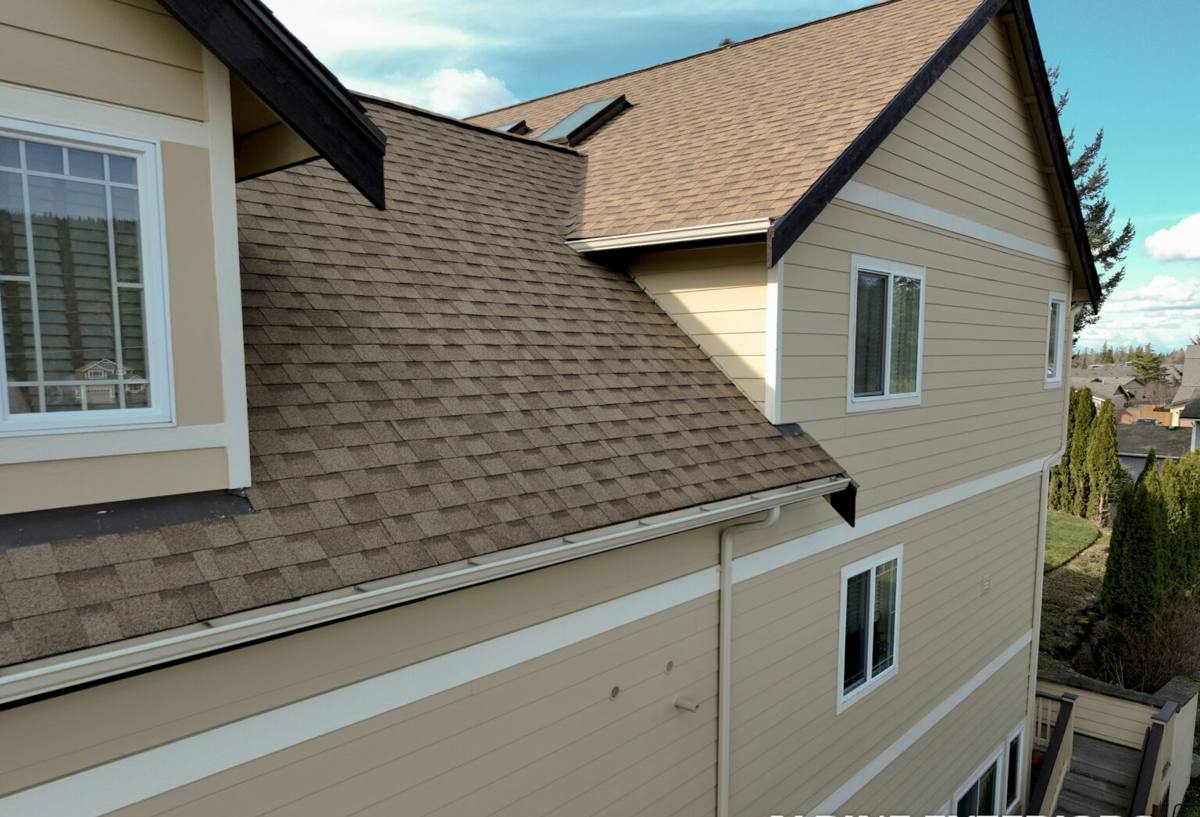
Board and batten is a vertical siding style: wide flat panels or boards installed side by side, with narrower strips (battens) covering the seams between them. It's a look that's shown up more and more on homes and additions around Whatcom County — it reads as clean and contemporary on a full elevation, and it pairs well with lap siding as an accent on gables, dormers, or entry features.
For Birchwood specifically, we see board and batten used two ways: as a full-house treatment on newer or updated homes going for a modern farmhouse or Pacific Northwest contemporary look, and as an accent alongside traditional lap siding to break up a facade. Both are legitimate uses — the accent approach is often the more budget-conscious option since it covers less square footage.
Where Board & Batten Goes Wrong
Vertical siding fails for predictable reasons, and almost all of them trace back to installation, not the concept itself.
Common failure points
- Fastening into battens instead of studs: Battens need to land over solid backing (studs or proper blocking) — face-nailing into sheathing alone leaves the fastener with nothing structural to grip, and over time that creates movement and gaps.
- No rainscreen or drainage gap: Vertical seams are natural water paths. Without a drainage plane behind the siding, moisture that gets past the batten joint has nowhere to go but into the wall assembly.
- Wrong or inconsistent fastener spacing: Battens that are under-fastened move in wind and temperature swings, which widens seams and accelerates caulk failure at the joints.
- Poor board material: Boards that swell, cup, or absorb water at the edges will telegraph every seasonal moisture cycle straight through the paint or finish.
None of this is unique to Birchwood, but the region's rain volume and duration mean mistakes that might take a decade to show up somewhere drier can show up in a few wet seasons here.
Why We Install Board & Batten in James Hardie Fiber Cement Only
We don't install LP SmartSide, vinyl, Cemplank, Allura, primed spruce, or cedar board and batten. That's a deliberate standard, not a lack of options, and it's worth explaining why — especially since board and batten is a style where material choice shows up fast.
How the alternatives actually perform in this climate
| Material | What it gets right | Where it struggles in Whatcom County |
|---|---|---|
| Cedar | Natural, warm appearance; long tradition in the Pacific Northwest | Needs regular refinishing to resist moisture and moss; end grain and seams absorb water and are prone to rot without diligent upkeep |
| Primed spruce/wood composite | Lower upfront cost, familiar installation | Primer is not a finish coat — swelling and edge deterioration show up faster in sustained wet conditions |
| Vinyl | Low maintenance, inexpensive | Can warp or become brittle with temperature swings; seams and battens are harder to detail cleanly for a true board and batten look; combustible |
| LP SmartSide / other engineered wood | Good workability, reasonable cost | Wood-strand core is still moisture-sensitive at cut edges and requires diligent sealing and maintenance to avoid swelling |
| James Hardie fiber cement | Non-combustible, dimensionally stable, factory-cured ColorPlus finish, engineered HZ product lines | Higher upfront material and installation cost than vinyl |
Every one of those alternative products has legitimate uses and loyal customers elsewhere. Our position is narrower and more practical: in a climate that delivers sustained rain, salt air, and moss pressure nearly year-round, we want a board and batten system that doesn't depend on a homeowner's maintenance schedule to stay water-tight. Fiber cement doesn't swell at cut edges, doesn't feed moss the way organic wood fiber can, and holds paint and factory finish far longer under constant damp exposure. James Hardie's HZ5 product line in particular is engineered for regions with exactly this kind of moisture and freeze-thaw profile.
The ColorPlus factory finish is also relevant to vertical siding specifically — because board and batten has so many exposed seams and edges, a finish that's baked on at the factory (rather than field-painted) holds color and resists fading and chipping at those high-exposure edges better than most site-applied paint jobs.
What a Correct Installation Looks Like
A board and batten job that's going to hold up in Birchwood's weather isn't just "good boards, good crew" — it's a specific sequence of details.
The installation checklist we hold every job to
- Weather-resistive barrier installed and lapped correctly before any siding goes up
- Drainage gap (rainscreen) behind the siding so any moisture that gets past a seam can drain and dry rather than sit against the wall
- Battens fastened into structural backing at manufacturer-specified spacing, not just into sheathing
- Corrosion-resistant fasteners rated for coastal/marine exposure
- Proper clearance at grade, decks, and roof lines so siding never sits in standing water or snow load
- Flashing detailed at every window, door, and horizontal transition — the points where vertical siding is most likely to leak if rushed
- Factory-finished panels handled and cut to preserve the ColorPlus coating's warranty coverage
Skipping any one of these doesn't necessarily cause a visible problem in year one. It shows up in year five or eight, usually as a stain, a soft spot, or a seam that's opened up — right when it's expensive to trace back to the cause.
Our Process for a Birchwood Board & Batten Project
1. On-site assessment
We walk the home, look at current siding condition (if replacing), check for any moisture or rot already present behind the surface, and talk through where board and batten makes sense — full elevation, accent areas, or a mix with lap siding.
2. Product and layout plan
We spec the Hardie panel and batten configuration, color, and finish, and map out how seams, corners, and transitions will be handled before any material is ordered.
3. Prep and moisture management
Old siding removal (if applicable), sheathing repair if needed, and installation of the weather-resistive barrier and drainage gap — the layer nobody sees but that determines how the job performs for the next 30 years.
4. Installation
Battens and boards installed to manufacturer fastening specs, with flashing detailed at every penetration and transition.
5. Final walkthrough
We review the finished work with you, confirm caulking and touch-up is complete, and go over basic care so the finish stays looking right through Whatcom County's wet seasons.
Cost Factors for a Birchwood Board & Batten Project
Every home is different, but the main variables that move a project's price are consistent:
| Factor | Why it matters |
|---|---|
| Full elevation vs. accent areas | Square footage covered is the biggest single driver of material and labor cost |
| Existing siding removal | Tear-off, disposal, and any sheathing repair add time and cost that's hard to estimate without seeing the wall |
| Home height and access | Multi-story sections, steep rooflines, or tight lot access affect labor time and equipment needs |
| Trim and transition complexity | More windows, corners, and roof intersections mean more flashing and detail work |
| Color and finish selection | Factory ColorPlus finishes vary by line but generally cost less over time than field painting and repainting |
Why Local Experience with Birchwood Homes Matters
A crew that already works in Birchwood and the surrounding Whatcom County area knows how this region's homes are built, what the typical wall assemblies look like, and how much moisture exposure to plan for on a given elevation. That's not something you can fully substitute with a general contractor from outside the area — the difference shows up in how the flashing is detailed at a north-facing wall that never fully dries out, or how a batten layout is planned around a home's actual exposure to prevailing wind and rain direction. Local experience also means we're not guessing at permitting norms or typical construction in the neighborhood — we've seen it.
If you're considering board and batten siding for a home in Birchwood, we're happy to walk the property, look at what you're working with, and give you a straight assessment — no pressure, no inflated claims about what a product can do. Reach out for a free estimate and we'll go over your options in person.